Why Are Iguanas Falling from Trees in Florida?
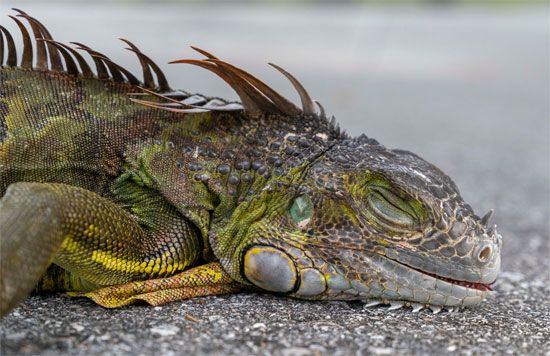
Iguanas in Florida fall from trees during cold snaps due to a phenomenon known as "cold-stunning."
Why Are Iguanas Falling from Trees in Florida?
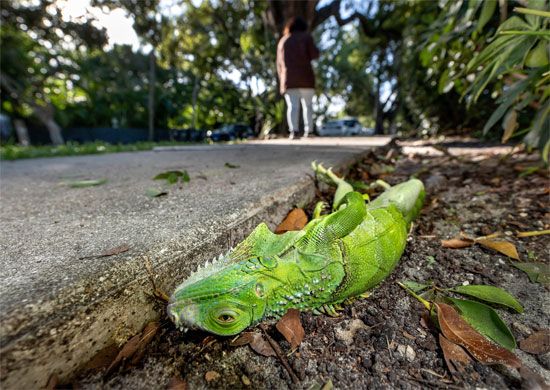
Iguanas in Florida fall from trees during cold snaps due to a phenomenon known as “cold-stunning.”1
Iguanas are cold-blooded ectotherms, meaning their body temperature and metabolism are entirely dependent on their environment. When temperatures drop below 7.2 °C (45 °F), these reptiles experience a rapid decline in metabolic activity, causing them to enter a state of dormancy or torpor. As they become stiff and lifeless, they lose their grip on tree branches and fall to the ground.1
It is important to note that these iguanas are invasive species that cause significant damage to local landscaping and ecosystems. While they may appear dead, they are often still alive and can recover once temperatures rise. Wildlife officials sometimes issue temporary rules allowing residents to collect these animals, though they must be handled with caution as they may become aggressive if they warm up quickly.1
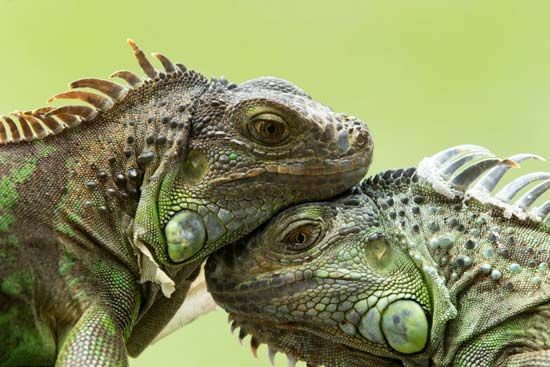
What is the difference between ectotherms and endotherms?
The primary difference between ectotherms and endotherms lies in how they regulate their body temperature and generate heat.
Ectotherms (Cold-blooded)
Ectotherms, which include reptiles, amphibians, fishes, and invertebrates, rely on external sources to regulate their body temperature. They absorb heat from their environment, such as by basking in the sun or lying on warm surfaces. Because they do not generate their own heat internally, they have a lower metabolic rate and require significantly less food than endotherms of a similar size. However, they are often more susceptible to environmental temperature fluctuations and may use behavioral strategies, such as moving between sun and shade or entering dormancy, to survive.234
Endotherms (Warm-blooded)
Endotherms, primarily birds and mammals, maintain a relatively constant internal body temperature independent of their surroundings. They generate heat through internal metabolic processes. While this allows them to remain active in diverse and cold environments, it is metabolically expensive; they must consume high quantities of food to fuel continuous heat production. If their body temperature shifts, they utilize physiological mechanisms like shivering to generate heat or sweating and panting to cool down.564
Why are green iguanas considered an invasive species in Florida?
Green iguanas (Iguana iguana) are considered an invasive species in Florida because they are not native to the region and cause significant ecological and structural damage.17
Their presence negatively impacts the environment and local communities in several ways:
- Property and Landscape Damage: These lizards are known to burrow under sidewalks and foundations, which can compromise infrastructure. They also frequently damage residential gardens and commercial orchards by consuming fruits and vegetables.1
- Threat to Native Wildlife: Green iguanas pose a direct threat to Florida’s native tree snails, disrupting local biodiversity.1
- Public Health Concerns: They have been identified as a source of Salmonella infection, particularly in children.1
Because they are an invasive species, they are not protected in the same way native wildlife might be, and state wildlife officials often take measures to manage their populations to prevent further damage to the ecosystem.1
How do other reptiles survive in cold climates?
Reptiles survive in cold climates primarily by employing behavioral and physiological strategies to avoid freezing temperatures, as they cannot generate their own internal body heat.84
Behavioral Strategies
- Dormancy (Brumation): To survive winter, reptiles enter a state of torpor known as brumation. They seek out underground niches—such as deep burrows or dens—where the temperature remains above freezing. These sites are critical, as reptiles cannot survive in regions where the subsoil is permanently frozen.82
- Thermoregulation: During active months, reptiles use behavioral thermoregulation to maintain optimal body temperatures, moving between sun and shade to manage heat absorption.4
- Energy Conservation: Because they do not burn calories to produce heat, reptiles have low metabolic rates, allowing them to survive for months without food during their dormant periods.84
Physiological Adaptations
- Cryoprotectants: Some species can alter their body chemistry to prevent the formation of ice crystals within their cells and tissues. They may produce cryoprotectants—such as sugars, alcohols, or specific proteins—that lower the freezing point of their bodily fluids.9
- Viviparity: In colder northern latitudes, many reptile species are viviparous (live-bearing), which may provide reproductive advantages in environments with short growing seasons.10
Sources
- Why Are Iguanas Falling from Trees in Florida? — Encyclopædia Britannica
- Why are reptiles cold-blooded? — Encyclopædia Britannica
- Endotherm — Encyclopædia Britannica
- Ectotherm — Encyclopædia Britannica
- Did you know? — Merriam-Webster
- dinosaur - Ectothermy and endothermy — Encyclopædia Britannica
- iguana — Encyclopædia Britannica
- Dormancy - Effects of temperature — Encyclopædia Britannica
- Sit, Shake, Pronk: 8 Words for Quirky Animal Behaviors | Brumation — Merriam-Webster
- reptile - North temperate zone — Encyclopædia Britannica
- Arctic - Animals of the land and fresh water — Encyclopædia Britannica
Published on · 4 min read