Window Fly
A window fly refers to any member of the family Scenopinidae, a group of relatively rare, small black flies often observed resting on windows.
What is window fly?
A window fly refers to any member of the family Scenopinidae, a group of relatively rare, small black flies often observed resting on windows.12
These insects are typically smaller than the common housefly. While most species are parasitic and feed on other insects, their larval habits vary: many live in decaying wood or fungi, while others, such as Scenopinus fenestralis, are known to feed on the larvae of carpet beetles or clothes moths.12
It is important not to confuse the window fly with the cluster fly, which is a different species (Pollenia rudis) known for gathering in large groups in sheltered areas like attics during the autumn.3
How do Scenopinidae flies differ from common houseflies?
Scenopinidae (window flies) and Muscidae (houseflies) differ significantly in their biology, appearance, and ecological roles within the order Diptera.
Key Differences
- Physical Characteristics: Window flies are generally smaller than the common housefly (Musca domestica), which typically measures 5 to 7 mm in length and is characterized by a dull gray color with longitudinal lines on the thorax.14
- Diet and Behavior: While houseflies are notorious for congregating around human habitations and decomposing organic waste, window flies are relatively rare and are primarily parasitic, feeding on other insects.14
- Larval Development: The larvae of most window fly species inhabit decaying wood or fungi. A notable exception is Scenopinus fenestralis, which feeds on the larvae of carpet beetles or clothes moths. In contrast, housefly larvae (maggots) typically develop in decomposing organic matter and garbage, which makes them a significant public health concern due to their potential to carry disease-causing microorganisms.14
While both are frequently seen on window panes, they represent distinct ecological niches.154
What role do larvae play in controlling other insect populations?
Larvae play a critical role in regulating insect populations through two primary ecological strategies: predation and parasitism.
Predatory Larvae
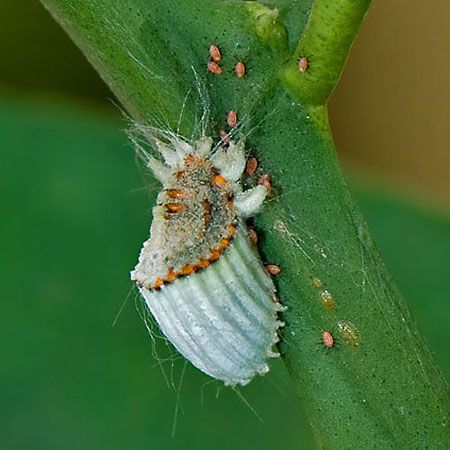
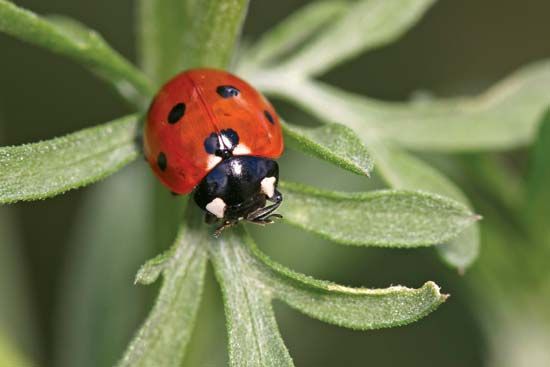
Many insect larvae act as active predators, consuming other insects to survive. For example, both the larvae and adults of ladybugs (family Coccinellidae) are highly beneficial to humans because they feed on plant-sucking insects like aphids and scale insects. Similarly, certain window flies (family Scenopinidae), such as Scenopinus fenestralis, help control populations of carpet beetles and clothes moths by feeding on their larvae.17
Parasitoid Larvae
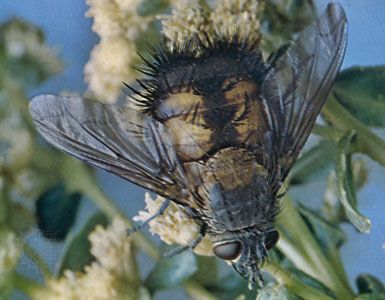
Parasitoids are insects whose larvae develop within or on the bodies of other arthropods, eventually killing their host. This group includes many species of wasps and tachinid flies. These larvae have a significant impact on population dynamics, often exerting more control over caterpillar numbers than direct predators do. Because each parasitoid larva typically consumes a single host, they are highly effective at limiting the abundance of specific species.89
These natural processes are fundamental to biological control, where humans encourage or introduce these organisms to manage pest populations in agricultural and home environments.10
Why do many types of flies tend to gather on windows?
Many types of flies are frequently observed on windows due to their natural behavioral responses to light, rather than a specific attraction to the glass itself.
The Dorsal Light Response
A primary reason for this behavior is the dorsal light response, a reflexive mechanism used by many insects to maintain stability and orientation. Under natural conditions, insects use light from the sky to determine which way is up. When they encounter artificial light sources—such as a bright window—they reflexively orient their backs toward the light. This can cause them to fly in circles, stall, or become trapped in erratic flight patterns as they attempt to keep the light source in their field of vision, eventually landing on the window pane as they struggle to maintain balance.2
Stereotyped Responses
Insects exhibit various stereotyped responses, which are unlearned, genetically determined behaviors. For many flies, movement toward light is a form of taxis—an oriented locomotory reaction. While some species may move toward a light source (positive phototaxis), others may be trapped by the light’s interference with their navigation, leading them to congregate on windows where the light is brightest.212
Window Flies
It is worth noting that the term “window fly” specifically refers to members of the family Scenopinidae. These small, black flies are commonly found on windows, though they are generally less common than the typical housefly and are primarily known for their role as predators of other insects.131
Sources
- window fly — Encyclopædia Britannica
- window fly — Merriam-Webster
- cluster fly — Merriam-Webster
- Scenopinidae — Merriam-Webster
- housefly — Encyclopædia Britannica
- Diptera - Larvae — Encyclopædia Britannica
- Lepidoptera - Environmental hazards — Encyclopædia Britannica
- Coleoptera - As predators — Encyclopædia Britannica
- Biological control — Encyclopædia Britannica
- parasitoid — Encyclopædia Britannica
- Coleoptera - Beetles as prey — Encyclopædia Britannica
- Why are bugs attracted to light? — Encyclopædia Britannica
- Stereotyped response — Encyclopædia Britannica
Published on · 3 min read