Wren-warbler
The term wren-warbler refers to a group of small, Old World birds characterized by their habit of carrying their tails cocked upward, similar to the behavior…
What is Wren-warbler?
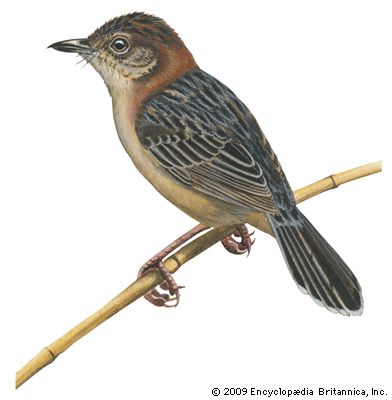
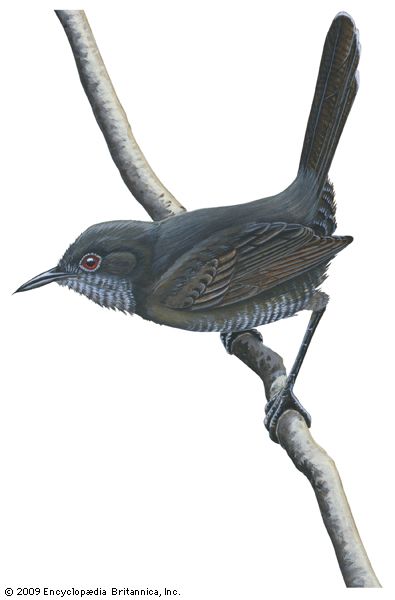
The term wren-warbler refers to a group of small, Old World birds characterized by their habit of carrying their tails cocked upward, similar to the behavior of true wrens.1
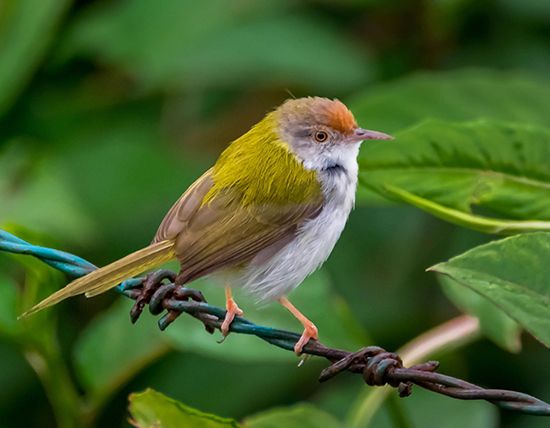
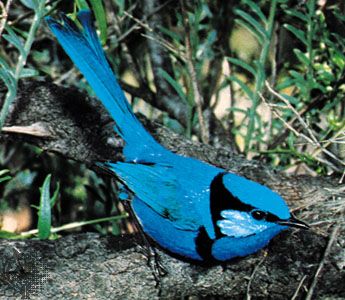
These birds are primarily classified within the family Sylviidae, specifically including species in the genus Prinia found in Africa and Asia, as well as the African genus Calamonastes (sometimes categorized under Camaroptera). Some of these species are known for their unique nesting habits, such as the barred wren-warbler (C. fasciolatus), which constructs its nest by sewing leaves together in a manner similar to a tailorbird. Additionally, the name is sometimes used to describe certain birds belonging to the family Maluridae located in Australia and New Zealand.12
What makes a bird’s tail behavior ‘wrenlike’?
A bird’s tail behavior is described as “wrenlike” when it is habitually carried in a cocked, or upward-pointing, position. This distinctive posture is a hallmark of the wren family (Troglodytidae), which typically features small, chunky bodies and short, rounded wings alongside this characteristic tail carriage.21
While this trait is most closely associated with true wrens, the term “wrenlike” is also applied to various unrelated species—such as certain Old World warblers in the family Sylviidae and birds in the family Maluridae—that exhibit this same upward-cocked tail behavior. Because many of these birds are small and brownish in appearance, the combination of their size and their tail posture leads to them being colloquially grouped under the “wren” label, despite often belonging to entirely different taxonomic families.21
How do tailorbirds construct their unique nests?
Tailorbirds, which belong to the Old World warbler family, are renowned for their sophisticated nest-building technique. To construct their nests, these birds use their long, slender bills to pierce a series of holes along the edges of one or more large leaves.4
Once the holes are made, the bird acts as a literal tailor by drawing materials—such as plant fibers, insect silk, or even scavenged household thread—through the perforations. These materials are pulled through to form separate loops, which are then knotted on the outer side to secure the leaves together. This ingenious process creates a protective, hidden cradle for the nest, effectively shielding the eggs and young from predators.45
Other members of the Sylviidae family, such as the cisticola, prinia, and wren-warbler, also exhibit similar sewing behaviors.4
What are the main differences between Old World warblers and New World warblers?
Old World warblers and New World warblers are distinct groups of songbirds that share a name due to superficial similarities in form and behavior, despite being distantly related.6
Key Differences
- Taxonomy and Family: Old World warblers belong to the family Sylviidae and are closely related to thrushes and Old World flycatchers. New World warblers, or woodwarblers, belong to the family Parulidae and are more closely related to tanagers.6
- Distribution: Old World warblers are primarily found across Europe, Asia, Africa, and Australia. New World warblers are native to North and Central America.6
- Appearance: Old World warblers are generally drab, featuring colors like green, olive, brown, buff, and black. New World warblers are typically more brightly colored.6
- Diversity: The Sylviidae family is larger, comprising nearly 350 species, whereas the Parulidae family includes approximately 120 species.6
While they differ in lineage and appearance, both groups are small, active insect-eaters with similar feeding and nesting habits.6
Sources
- Wren — Encyclopædia Britannica
- Wren-warbler — Encyclopædia Britannica
- wren warbler — Merriam-Webster
- Tailorbird — Encyclopædia Britannica
- tailorbird — Merriam-Webster
- Warbler — Encyclopædia Britannica
Published on · 3 min read