Cryptolithus
Cryptolithus is a genus of trilobites, which are extinct arthropods that lived during the Ordovician period, approximately 505 million to 438 million years…
What is Cryptolithus?
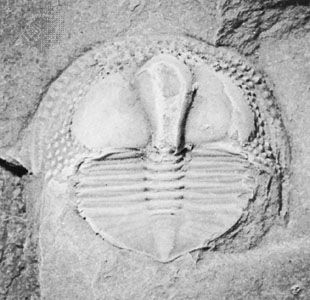
Cryptolithus is a genus of trilobites, which are extinct arthropods that lived during the Ordovician period, approximately 505 million to 438 million years ago. These fossils are found in Europe and North America.1
Because of their unique physical characteristics, they serve as an important guide fossil for identifying Ordovician rock layers1. Key features of the genus include:
- Cephalon: A large head region characterized by a distinctively pitted margin.1
- Spines: Two long spines that extend backward from the lateral margins of the head.1
- Eyes: Adult specimens of Cryptolithus are notable for lacking eyes.1
What are trilobites?
Trilobites are a group of extinct fossil arthropods that lived exclusively in marine environments. They first appeared approximately 521 million years ago during the Cambrian Period and persisted until the Permian Period.2
These animals are easily recognized by their distinctive three-lobed, three-segmented form. Their bodies were divided longitudinally into a central axial lobe with two side lobes, and segmented into three regions from head to tail: the cephalon (head), the thorax, and the pygidium (tail).2
Key characteristics include:
- Exoskeleton: They possessed a chitinous external skeleton that they shed as they grew, which is why their fossilized remains are relatively common.2
- Appendages: Each body segment featured a pair of jointed appendages, with the forwardmost ones modified for sensing and feeding.2
- Eyes: Most species had a pair of compound eyes, though some were eyeless.2
Because they evolved rapidly and were widely distributed, trilobites are essential guide fossils used by scientists for stratigraphic correlation and dating rock layers.23
Why are guide fossils important to paleontologists?
Guide fossils, also known as index fossils, are essential tools for paleontologists and geologists because they allow for the precise correlation of rock strata across different geographic locations. By identifying these fossils within separated outcrops, scientists can determine that the rock layers were formed during the same interval of geologic time.56
To be considered an effective guide fossil, a species should ideally possess the following characteristics:
- Short temporal range: The species existed for a relatively brief moment in geologic history, ensuring that its presence marks a specific time period.6
- Wide distribution: The organism was cosmopolitan, meaning it was found across large geographic areas and various rock types.6
- Abundance: The fossils are sufficiently common to be easily discovered.56
- Distinctiveness: They are easily recognizable, which helps prevent misidentification.56
These fossils serve as the foundation for defining boundaries in the geologic time scale and provide a reliable method for dating sedimentary deposits based on the principle of faunal succession.56
What was the environment like during the Ordovician period?
The Ordovician Period (485.4 to 443.8 million years ago) was a time of profound environmental transformation characterized by high sea levels, a warm greenhouse climate, and significant tectonic activity.89
Paleogeography and Climate
During this period, Earth’s landmasses were organized into four major continents—Laurentia, Siberia-Kazakhstania, Baltica, and the supercontinent Gondwana—separated by three major oceans. Rapid seafloor spreading at oceanic ridges caused global sea levels to rise to some of the highest points in the Phanerozoic Eon, flooding continents to an unprecedented degree.1089
Atmospheric carbon dioxide levels were estimated to be 14–16 times higher than today, driven by widespread volcanic activity and limited silicate weathering due to the lack of land vegetation. This created a warm, greenhouse climate from the Equator to the poles. However, the period ended with a brief but intense glacial interval, likely triggered by the movement of Gondwana over the South Pole and a drawdown of atmospheric carbon dioxide.118
Biological Impact
The Ordovician was marked by the “Ordovician radiation,” an intense diversification of marine life that saw the rise of almost every modern phylum of marine invertebrate. Seas were dominated by brachiopods, bryozoans, trilobites, mollusks, echinoderms, and graptolites. On land, the first plants and potentially the first terrestrial arthropods appeared. This period concluded with the second-largest mass extinction in Earth’s history, which claimed roughly 85 percent of species, largely due to rapid cooling and falling sea levels associated with the end-period glaciation.891213
Sources
- Cryptolithus — Encyclopædia Britannica
- trilobite — Encyclopædia Britannica
- Cambrian Period - Correlation of Cambrian strata — Encyclopædia Britannica
- trilobite — Merriam-Webster
- index fossil — Encyclopædia Britannica
- dating - Principles and techniques — Encyclopædia Britannica
- guide fossil — Merriam-Webster
- A Journey Through Time Since the Precambrian - Ordovician Period: 485.4 million to 443.4 million years ago — Encyclopædia Britannica
- Ordovician Period - Invertebrates — Encyclopædia Britannica
- Ordovician Period - Mass extinction at the end of the Ordovician — Encyclopædia Britannica
- Ordovician Period — Encyclopædia Britannica
- Ordovician Period - Paleoclimate — Encyclopædia Britannica
- Ordovician Period - Paleogeography — Encyclopædia Britannica
Published on · 3 min read