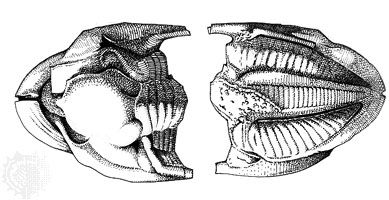
Ceraurus
Ceraurus is a genus of trilobites, which are extinct arthropods. These organisms are found as fossils in rocks dating to the Ordovician Period, approximately…
What is Ceraurus?
Ceraurus is a genus of trilobites, which are extinct arthropods. These organisms are found as fossils in rocks dating to the Ordovician Period, approximately 505 to 438 million years ago, in Europe and North America.1
Ceraurus is characterized by its distinctive morphology, specifically the presence of two large spines located at the end of the tail and along the margins of the head shield.1
What are trilobites?
Trilobites are a group of extinct fossil arthropods that lived exclusively in marine environments. They are easily recognized by their distinct three-lobed, three-segmented body form.3
Physical Characteristics
The body of a trilobite was divided into three longitudinal regions: a central axial lobe and two side lobes. From head to tail, the body was further segmented into three distinct parts:3
- Cephalon: The head region, which typically featured a pair of compound eyes and antennae.34
- Thorax: The middle section, consisting of multiple segments.34
- Pygidium: The tail region.34
Trilobites possessed a chitinous exoskeleton that they shed periodically to grow, which explains why their fossilized remains are relatively common. Each body segment bore a pair of jointed, branched appendages used for movement, sensing, or feeding.34
History and Significance
Trilobites first appeared approximately 521 million years ago during the Cambrian Period, where they dominated the seas. While they became less abundant over time, some species persisted until the Permian Period3. Because of their widespread distribution and rapid evolution, they are frequently used by scientists for stratigraphic correlations.3
What defines the Ordovician period?
The Ordovician Period was the second period of the Paleozoic Era, spanning from 485.4 million to 443.8 million years ago. It was a time of profound transformation in Earth’s plate tectonics, climate, and biological systems.56
Geological and Climatic Context
Rapid seafloor spreading led to some of the highest global sea levels in the Phanerozoic Eon, causing extensive flooding of the continents. While atmospheric carbon dioxide levels were significantly higher than today—creating a warm, greenhouse climate—the period ended with a brief, intense interval of glaciation in the Southern Hemisphere.657
Biological Evolution
The period is defined by the Ordovician radiation, an intense diversification of marine life that saw the emergence of almost every modern phylum of marine invertebrate of almost every modern phylum of marine invertebrate. Common organisms included brachiopods, bryozoans, trilobites, mollusks, echinoderms, and graptolites, alongside the rise of fish. On land, the first plants appeared.568
The period concluded with the second-largest mass extinction in Earth’s history, which claimed roughly 85 percent of species, likely driven by the late-period ice age and falling sea levels.659
How do fossils help us understand extinct animals?
Fossils are the primary source of information regarding the history of life on Earth, providing essential data about extinct animals through their remains, impressions, or traces. By studying the fossil record, scientists can reconstruct the lives of ancient organisms in several ways:10
- Evolutionary History: By observing progressive changes within animal groups across different rock strata, paleontologists can map the evolution of species over time.1011
- Environmental Context: Fossils provide clues about the climate and environment of the past. For example, the presence of specific organisms can indicate whether a site was once a warm, shallow sea or a different habitat.1011
- Biological Function: An animal’s anatomy, such as its teeth or body structure, offers insights into its diet and behavior. For instance, the specialized dental batteries of hadrosaurs suggest they were adapted for grinding tough vegetation, while stomach contents occasionally provide direct evidence of an animal’s last meal.12
- Geologic Dating: Index fossils allow geologists to assign relative ages to rock layers, helping to establish the geologic time scale.1011
Sources
- Ceraurus — Encyclopædia Britannica
- Ceratosaurus — Encyclopædia Britannica
- trilobite — Encyclopædia Britannica
- arthropod - Annotated classification — Encyclopædia Britannica
- A Journey Through Time Since the Precambrian - Ordovician Period: 485.4 million to 443.4 million years ago — Encyclopædia Britannica
- Ordovician Period - Invertebrates — Encyclopædia Britannica
- Ordovician Period — Encyclopædia Britannica
- Ordovician Period - Paleoclimate — Encyclopædia Britannica
- Silurian Period - Late Ordovician mass extinction — Encyclopædia Britannica
- fossil — Encyclopædia Britannica
- dating - Principles of isotopic dating — Encyclopædia Britannica
- dinosaur - The plant eaters — Encyclopædia Britannica
- law of faunal succession — Encyclopædia Britannica
Published on · 3 min read