Cypress Hills
The Cypress Hills are an isolated range located in southeastern Alberta and southwestern Saskatchewan, Canada. Extending 100 miles (160 km) north of the…
What is Cypress Hills?
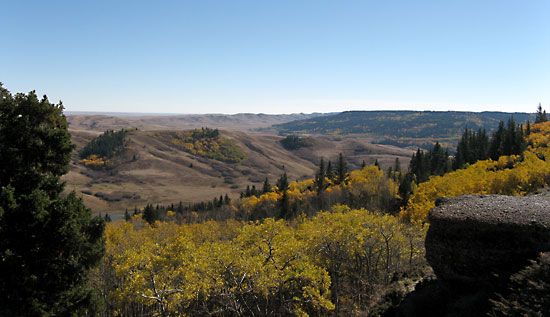
The Cypress Hills are an isolated range located in southeastern Alberta and southwestern Saskatchewan, Canada. Extending 100 miles (160 km) north of the Montana border, they reach an elevation of 4,816 feet (1,468 m), marking the highest point in Saskatchewan.1
The name “Cypress” is actually a misnomer; the hills were incorrectly named by surveyor John Palliser in 1857, who mistook the jack pine trees covering the slopes for cypress trees. Today, the heavily wooded area serves primarily as a recreational destination featuring two provincial parks. Beyond their scenic value, the hills are scientifically significant for containing unique pre-Ice Age fossils, rocks, and flowers of a subtropical variety not found elsewhere in Canada.1
Why are the Cypress Hills called an ecological island?
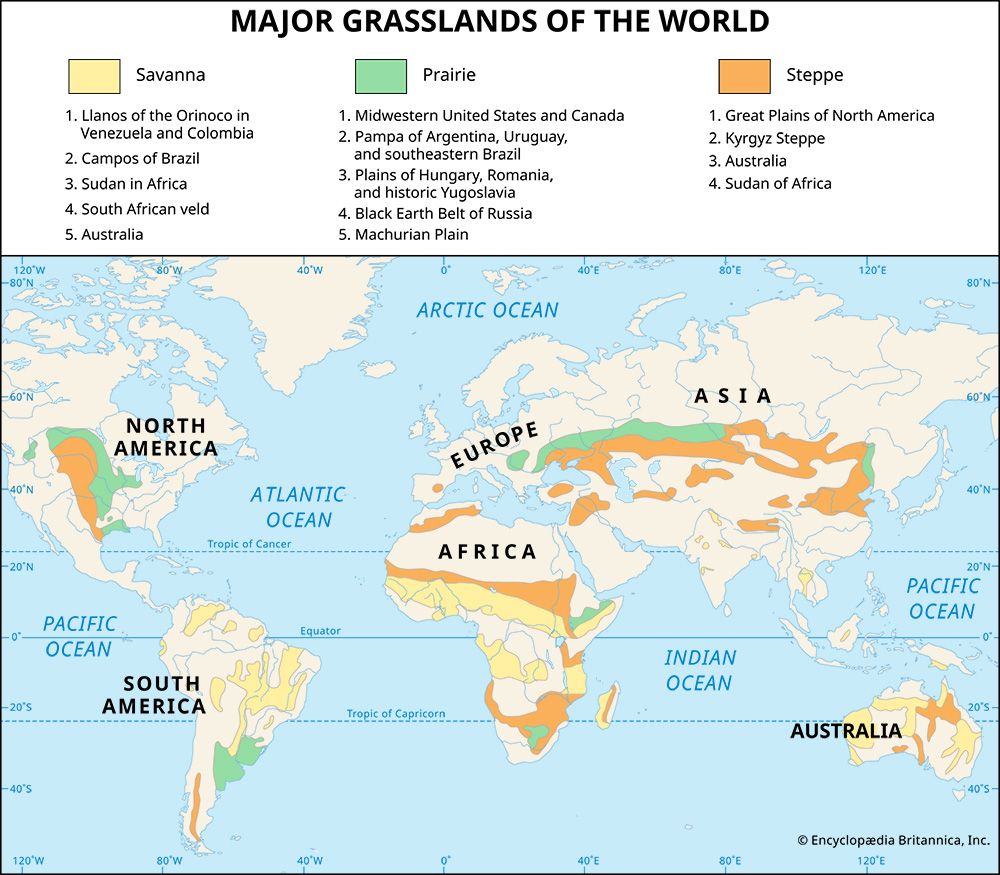
The Cypress Hills are often described as an ecological island because they represent a distinct, elevated habitat that stands in stark contrast to the surrounding southern prairies. Rising to 4,816 feet (1,468 m), this isolated range creates a unique environment that supports a variety of fossils, rocks, and plant life—including subtropical varieties—that are not found elsewhere in the region.1
By providing a high-altitude, heavily wooded refuge amidst the flat, open plains, the hills function as a biological sanctuary. This separation from the surrounding landscape allows the area to maintain a specialized ecosystem that differs significantly from the typical prairie environment, effectively acting as an “island” of biodiversity.1
What kind of pre-Ice Age fossils have been found there?
The provided search results confirm that the Cypress Hills contain pre-Ice Age fossils of a subtropical variety found nowhere else in Canada. However, the specific types of these fossils are not detailed in the available information.
While the search results discuss various Cenozoic Era fossils found in other parts of the world—such as mammals, reptiles, and early hominoids in Africa—they do not provide a list of the specific prehistoric species discovered within the Cypress Hills region.
How did the last Ice Age shape the landscape of the Canadian prairies?
The last Ice Age, specifically the Pleistocene Epoch, profoundly transformed the landscape of the Canadian prairies through the movement of massive continental ice sheets, such as the Laurentide Ice Sheet.
Landscape Transformation
- Scouring and Deposition: Glaciers acted as powerful agents of erosion, scouring the northern Canadian Shield to create rocky outcrops, basins, and smoothed hills. In the southern plains, the ice sheets and their subsequent meltwaters deposited a thick veneer of sediments, which today provide the foundation for the region’s important agricultural areas.45
- River Systems: Many of the region’s prominent river valleys, such as those of the South Saskatchewan River and the Qu’Appelle River, were carved by the massive volumes of meltwater released during the retreat of the ice sheets.5
- Glacial Refugia: Notably, the Cypress Hills are recognized as the only part of Saskatchewan that escaped glaciation, allowing them to remain as an elevated, unglaciated refuge that preserved unique biological characteristics.5
The legacy of this era remains visible in the contrast between the rocky, lake-strewn north and the sediment-rich, rolling plains of the south.5
Sources
- Cypress Hills — Encyclopædia Britannica
- Big Cypress National Preserve — Encyclopædia Britannica
- Africa - Continental formations — Encyclopædia Britannica
- North America - The lowlands of North America — Encyclopædia Britannica
- Laurentide Ice Sheet — Encyclopædia Britannica
- Canadian Shield: Top Questions — Encyclopædia Britannica
- Saskatchewan - Relief — Encyclopædia Britannica
- North America - The past 2.5 million years — Encyclopædia Britannica
Published on · 2 min read