Dromaeosaur
Dromaeosaurs were a group of agile, bipedal theropod dinosaurs that lived during the Cretaceous Period. They are defined by several distinct physical…
What are the key physical characteristics that define dromaeosaurs?
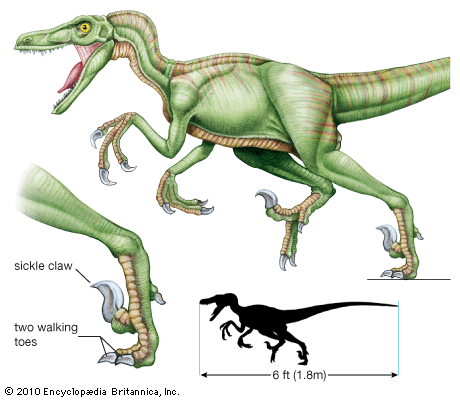
Dromaeosaurs were a group of agile, bipedal theropod dinosaurs that lived during the Cretaceous Period. They are defined by several distinct physical characteristics:
- Specialized Foot Claws: Each foot featured a large, sickle-shaped talon on the second toe. This claw was held off the ground while walking and was used as a primary weapon for slashing or raking prey.123
- Stiffened Tails: Their unusually long tails were reinforced by bundles of slim, bony rods—extensions of the tail vertebrae—which acted as a counterbalance for complex movements and high-speed maneuvers.123
- Unique Wrist Joint: Like birds, dromaeosaurs possessed a specialized wrist joint that allowed their hands to flex sideways, facilitating the grasping of prey.142
- Grasping Arms: They had long arms ending in slender, three-clawed hands designed for seizing and holding prey.13
- Skull and Brain: They possessed large heads with many sharp, serrated teeth and relatively large brains, which supported the coordination required for their active predatory lifestyle.12
Some species, such as Microraptor and Sinornithosaurus, also exhibited feathers, highlighting their close evolutionary relationship to birds.14
What hunting and feeding behaviors were typical of dromaeosaurs?
Dromaeosaurs were highly effective, agile predators that utilized specialized physical adaptations to hunt small- to medium-sized herbivores. Their hunting strategy typically involved running down prey, seizing it with their three-clawed hands, and delivering powerful, slashing kicks using the large, sickle-shaped talon on their second toe.1
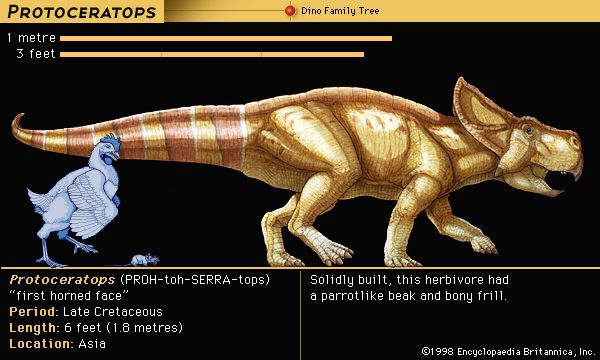
To maintain balance during these complex, high-energy attacks, dromaeosaurs likely used their stiffened, rod-reinforced tails as a counterbalance. Their relatively large brains allowed for the high level of coordination required for such maneuvers. Fossil evidence, such as the famous “fighting dinosaurs” specimen, confirms these behaviors; a Velociraptor was discovered with its hands clutching a Protoceratops and its killing claw embedded in the prey’s throat.16
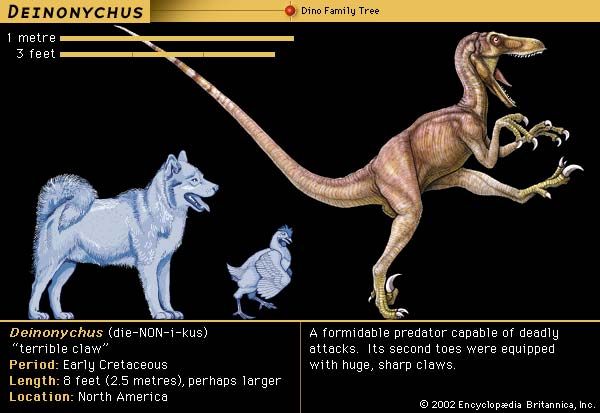
Furthermore, there is evidence suggesting that some dromaeosaurs, such as Deinonychus, may have hunted in packs. This is supported by the discovery of multiple Deinonychus skeletons associated with the remains of a single, much larger Tenontosaurus victim, indicating a social, cooperative approach to predation.6
How did dromaeosaurs’ brain structure compare to other dinosaurs and modern birds?
Dromaeosaurs possessed relatively large brains compared to most other dinosaurs, a trait that enabled them to execute complex, coordinated predatory movements. This neurological capacity allowed for the high level of agility and balance control required for their active, bipedal hunting style, which involved using their stiffened tails as a counterbalance while grasping or striking prey with their specialized foot talons.1
This brain development is particularly significant because dromaeosaurs are considered the closest relatives of birds. Their brain size and the resulting behavioral coordination are described as unusual for reptiles but are considered quite expected given their evolutionary proximity to the avian lineage. While the provided information highlights this evolutionary link and the functional importance of their brain size for predation, it does not offer a direct, detailed anatomical comparison of brain structures between dromaeosaurs and modern birds.1
How were dromaeosaurs related to modern birds?
Dromaeosaurs are considered the closest relatives of modern birds, as both groups belong to the theropod lineage of dinosaurs. While there is no direct ancestral link between specific dromaeosaurs like Velociraptor and living birds, they share a common evolutionary history and numerous anatomical features.892
Key similarities that highlight this relationship include:
- Wrist Structure: Both dromaeosaurs and birds possess a unique, specialized wrist joint that allows the hand to flex sideways. In dromaeosaurs, this motion was likely used for grasping prey, whereas in birds, it is essential for the flight stroke for the flight stroke.29
- Feathers: Many dromaeosaurs, such as Sinornithosaurus, possessed featherlike, filamentous structures. These structures were not originally evolved for flight but likely served purposes such as insulation, camouflage, or display.89
- Skeletal Anatomy: Dromaeosaurs and birds share several skeletal traits, including hollow, thin-walled bones, a wishbone, and a similar pelvis structure.81
- Neurology: The relatively large brains of dromaeosaurs provided a level of coordination that is unusual for reptiles but expected in the closest relatives of birds.9
These shared characteristics place dromaeosaurs within the Paraves, a group that includes both birds and deinonychosaurs.1
Sources
- dromaeosaur — Encyclopædia Britannica
- dinosaur - Dinosaur descendants — Encyclopædia Britannica
- Deinonychus — Encyclopædia Britannica
- Diplodocus — Encyclopædia Britannica
- dinosaur - Tetanurae — Encyclopædia Britannica
- dinosaur - The flesh eaters — Encyclopædia Britannica
- dinosaur - Herding behaviour — Encyclopædia Britannica
- How Do We Know That Dinosaurs May Have Had Feathers? — Encyclopædia Britannica
- Did Dinosaurs Really Have Feathers? — Encyclopædia Britannica
- Velociraptor: Top Questions — Encyclopædia Britannica
- Archaeopteryx — Encyclopædia Britannica
Published on · 3 min read