Flour
Commercial flour is often treated with various additives to enhance its performance and appearance during baking. These additives generally fall into two…
What are some common additives in commercial flour, and why are they used?
Commercial flour is often treated with various additives to enhance its performance and appearance during baking. These additives generally fall into two categories: bleaching agents and “improvers.”
Bleaching Agents
Bleaching agents are used to whiten flour and speed up the aging process, which naturally occurs through oxidation over several weeks or months. By using chemicals such as chlorine dioxide, benzoyl peroxide, and chlorine gas, manufacturers can achieve a consistent, lighter-colored product much faster. This process also alters the proteins and starches in the flour, resulting in a softer, more tender crumb ideal for cakes and pastries.12
Flour Improvers
Improvers are oxidizing substances added in small amounts—often just a few parts per million—to improve the baking quality of the flour, allowing for the production of larger, better-structured loaves. Common improvers include:2
- Bromates
- Chlorine dioxide
- Azodicarbonamide
While these additives are permitted in many regions, regulations vary globally due to health concerns, leading to the banning of certain substances like potassium bromate in some jurisdictions.12
What are the main types of flour used in cooking and baking?
In modern culinary usage, flour typically refers to products derived from wheat, though it can be made from various starchy plant materials. The suitability of wheat flour for specific tasks is largely determined by its protein content, which forms gluten—an elastic network that allows dough to rise.45
Common Types of Wheat Flour
- All-Purpose Flour: A refined, versatile flour suitable for most recipes that do not require a specialized type.4
- Bread Flour: A high-protein (12–15%) flour made from hard wheats, ideal for products requiring a strong, elastic structure like bread and rolls.45
- Cake Flour: A refined, low-protein, and finely textured flour made from soft wheats, perfect for cakes and pastries.45
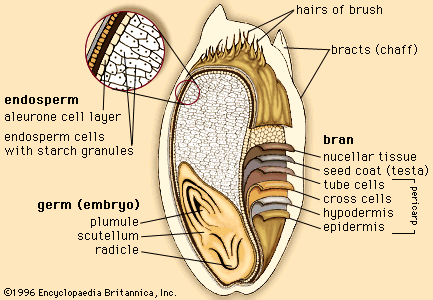
- Whole Wheat (Graham) Flour: Made from the entire wheat kernel, including the bran and germ.46
- Self-Rising Flour: Refined flour that includes added leavening agents and salt.4
- Durum Flour: Derived from durum wheat, this is primarily used to produce pasta.6
Other Flour Sources
Flours are also produced from non-wheat sources, including barley, buckwheat, oats, rice, rye, potatoes, and various legumes. Notably, rye is the only other cereal besides wheat that contains enough gluten to produce a loaf of bread on its own, though it lacks the same elasticity.47
How does the protein content in different flours affect their uses in baking?
The protein content of flour is the primary factor determining its behavior in baking because it forms gluten—an elastic network that traps gas and provides structure to baked goods.548
High-Protein Flour (12–15%)
Derived from hard wheats, high-protein flour is essential for products that require a strong, elastic structure capable of significant expansion. The robust gluten network allows the dough to hold carbon dioxide gas, making it ideal for:54
Low-Protein Flour (8–12%)
Derived from soft wheats, low-protein flour produces a weaker, less extensible gluten network. This is preferred for items where a tender, crumbly, or delicate texture is desired rather than a strong, elastic rise. It is commonly used for:495
In chemically leavened products, the lower protein content prevents the structure from becoming too tough, resulting in the softer, higher-density crumb characteristic of these goods.9
What is flour and how is it typically produced?
Flour is a finely ground powder produced from cereal grains or other starchy plant materials, serving as a fundamental ingredient in many food products and baked goods. While it can be derived from various sources like barley, rye, oats, and rice, wheat is the most common type used in Western countries due to its ability to form a spongy structure when mixed with water.11
The Production Process
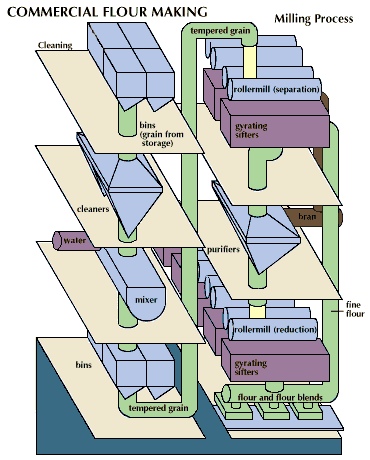
Modern flour production primarily utilizes a method known as the gradual reduction process. The objective is to separate the starchy endosperm from the bran (outer layers) and the germ (embryo).41211
- Cleaning and Tempering: The grain is screened to remove impurities and then dampened or dried to ensure the kernel reaches the optimal moisture level for efficient grinding.127
- Breaking: The kernels are passed through a series of grooved steel cylinders that tear the grain open.111213
- Sieving and Reduction: The resulting mixture is sieved to separate the coarse endosperm, known as semolina, from the bran. The semolina is then passed through a series of smooth reduction rolls, which gradually grind it into fine flour.111213
- Refining: This process is repeated across multiple stages to maximize the extraction of the endosperm. The final product is often bleached or treated to improve baking quality.1112
Sources
- baking - Ingredients — Encyclopædia Britannica
- Why is flour bleached? — Encyclopædia Britannica
- Cereal processing - Treatment of flour — Encyclopædia Britannica
- flour — Encyclopædia Britannica
- baking - Flour — Encyclopædia Britannica
- Rye — Encyclopædia Britannica
- Wheat — Encyclopædia Britannica
- Gluten — Encyclopædia Britannica
- baking - Chemically leavened products — Encyclopædia Britannica
- Cereal processing - Protein content — Encyclopædia Britannica
- Cereal processing - Wheat flour — Encyclopædia Britannica
- Cereal processing - Milling — Encyclopædia Britannica
- Grain mill — Encyclopædia Britannica
Published on · 4 min read