Grampus
The term grampus most commonly refers to Risso’s dolphin (Grampus griseus), a member of the dolphin family (Delphinidae) found in tropical and temperate…
What is grampus?
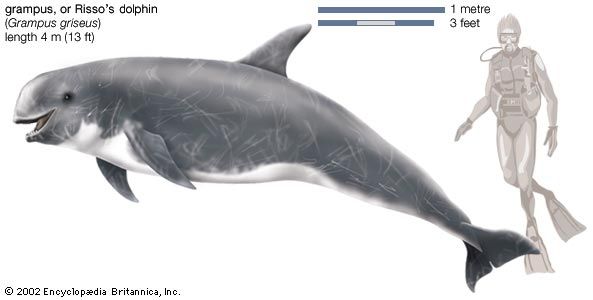
The term grampus most commonly refers to Risso’s dolphin (Grampus griseus), a member of the dolphin family (Delphinidae) found in tropical and temperate ocean waters.123
Measuring about 4 meters (13 feet) in length, this species is distinguished by a blunt head, a longitudinal forehead crease, and a unique dental structure: it typically lacks upper teeth and possesses only zero to seven teeth in the lower jaw. Older individuals are often heavily scarred from social interactions with others of their species.13
Historically, the name has been applied broadly to various large marine animals, including other cetaceans such as the killer whale and pilot whales. Additionally, in some contexts, the term is used to describe the giant whip scorpion (Mastigoproctus giganteus). The name itself is derived from Latin roots meaning “great fish”.12
Why do older Risso’s dolphins have so many scars?
Older Risso’s dolphins are frequently covered in extensive scarring, which is a hallmark of their appearance. While your query suggests these scars are solely the result of social interactions, the reality is more complex.
These markings are primarily caused by two factors:
- Intraspecific Interactions: Risso’s dolphins often engage in social behaviors involving their teeth, which can leave long, linear rake marks on their skin. As these dolphins age, these cumulative interactions result in a dense network of scars across their bodies.3
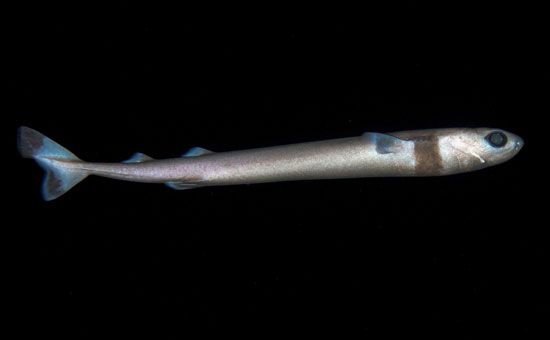
- Predation: Some circular scars observed on these dolphins are caused by the cookie-cutter shark. This small, parasitic shark removes small, hemispherical plugs of blubber and skin, leaving behind distinct, crater-like wounds that eventually heal into permanent scars.4
Because Risso’s dolphins have relatively few teeth—limited only to the lower jaw—their social biting behavior is a significant contributor to the visible scarring that characterizes older individuals.3
What are the main differences between dolphins and whales?
Dolphins and whales are both members of the order Cetacea, which includes aquatic mammals that share a basic body plan, such as flippers and horizontal tail flukes. While all dolphins are technically classified as toothed whales, the primary differences between these groups are categorized by their suborder and physical characteristics.567
Key Differences
- Suborder Classification: Cetaceans are divided into two main living suborders: Odontoceti (toothed whales) and Mysticeti (baleen whales).5
- Feeding Structures:
- Toothed Whales (Odontocetes): This group includes all dolphins, porpoises, and sperm whales. They possess simple, conical teeth used to grasp prey, which they swallow whole.65
- Baleen Whales (Mysticetes): These whales lack teeth. Instead, they have baleen plates made of keratin that hang from the upper jaw, allowing them to filter small organisms like plankton and krill from the water5.5
- Physical Traits: Dolphins are generally smaller, typically measuring less than 3 meters (10 feet) in length, and often feature a distinct beaklike snout and a dorsal fin. In contrast, many other whale species are significantly larger and may lack a dorsal fin or possess different skull structures.75
While the term “dolphin” specifically refers to members of the family Delphinidae and related families, it is worth noting that some species, such as the killer whale and pilot whales, are commonly called whales despite being dolphins.7
How do deep-diving dolphins like the grampus hunt for food?
The grampus, also known as Risso’s dolphin (Grampus griseus), is a member of the dolphin family that utilizes echolocation to hunt for food.110
As a toothed whale, the grampus relies on this physiological process to locate prey, especially in environments where visibility is poor or during nighttime hunting. Echolocation involves the emission of high-frequency sound pulses—primarily rapid series of clicks—that reflect off distant or invisible objects and return to the animal. These clicks, which can reach frequencies as high as 200,000 hertz, allow the dolphin to discriminate objects and procure food with high precision.1110
The grampus is unique among dolphins for having a reduced number of teeth, typically possessing no upper teeth and only a few in the lower jaw. Despite this, their reliance on sophisticated sound-based navigation and detection remains a critical adaptation for their survival in deep-water habitats.11110
Sources
- grampus — Encyclopædia Britannica
- grampus — Merriam-Webster
- Risso's dolphin — Merriam-Webster
- cetacean - Diseases and parasitism — Encyclopædia Britannica
- Do whales have teeth? — Encyclopædia Britannica
- dolphin — Encyclopædia Britannica
- cetacean - Annotated taxonomy — Encyclopædia Britannica
- How intelligent are dolphins? — Encyclopædia Britannica
- cetacean - Social behaviour — Encyclopædia Britannica
- sound reception - Echolocation in other mammals — Encyclopædia Britannica
- Echolocation — Encyclopædia Britannica
Published on · 3 min read