Sunda Islands
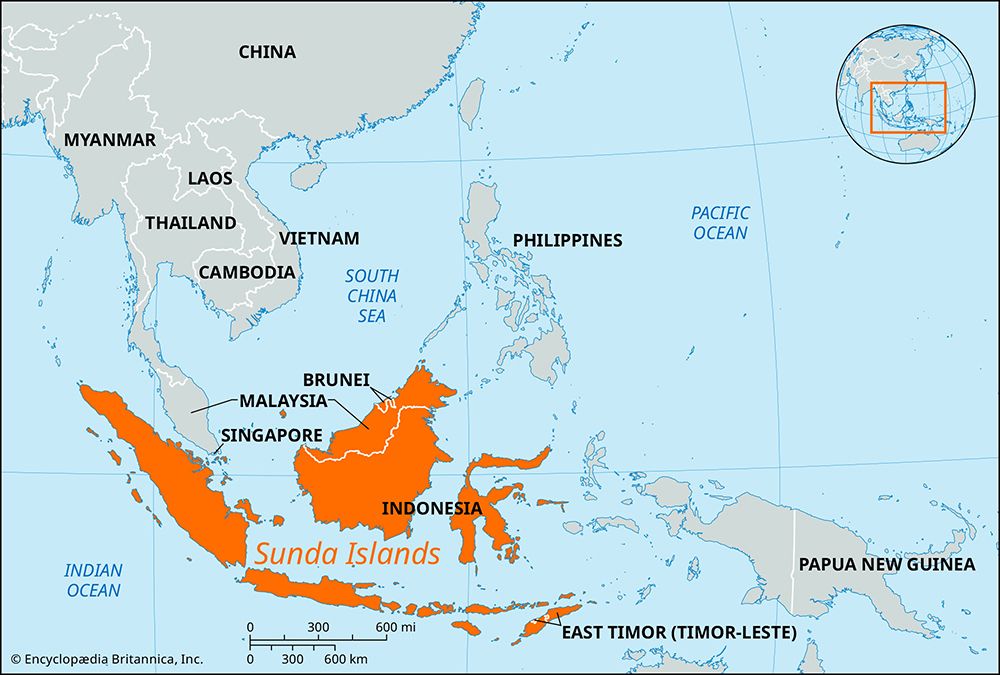
The Sunda Islands are a major island group in Southeast Asia that extend from the Malay Peninsula southeast toward New Guinea. Geographically, they are…
What are the Sunda Islands and where are they located in Southeast Asia?
The Sunda Islands are a major island group in Southeast Asia that extend from the Malay Peninsula southeast toward New Guinea. Geographically, they are bounded by the Indian Ocean to the south and west, and by the Strait of Malacca, the South China Sea, and the Celebes Sea to the north and east.1
The group is divided into two primary categories:
- Greater Sunda Islands: Includes Sumatra, Java, Borneo, and Celebes (Sulawesi), along with adjacent smaller islands.12
- Lesser Sunda Islands: A chain extending eastward from Bali through Lombok, Sumbawa, Flores, Sumba, and Timor.13
Most of these islands are part of Indonesia, with the exception of northern Borneo and parts of Timor. Geologically, most of the region sits on the Sunda Shelf and is characterized by significant volcanic activity and crustal instability.124
What are some of the unique flora and fauna found in the Sunda Islands?
The Sunda Islands are home to an extraordinary range of biodiversity, largely due to their location within the Malesian subkingdom and their position relative to the Wallace Line, a boundary that separates distinct Asian and Australian faunal regions.56
Unique Flora
The region is characterized by lush tropical rainforests containing approximately 40,000 species of flowering plants. Notable flora includes:1
- Rafflesia arnoldii: Known as the monster flower, it is the world’s largest flower.17
- Dipterocarpaceae: These trees dominate the western rainforests, including commercially valuable species like Shorea.76
- Economic Plants: The islands are rich in durian, sandalwood, teak, and ironwood, alongside abundant rattan vines.1
Unique Fauna
The islands host many endemic species that have evolved in relative isolation.1
- Mammals: Iconic species include the orangutan (native to Borneo and Sumatra), the proboscis monkey, the babirusa, and the tamarau of Celebes. The Javan rhinoceros is a critically endangered endemic species.17
- Reptiles: The Komodo dragon, the world’s largest lizard, is found only on a few islands between Sumbawa and Flores.1
- Insects and Fish: The region features giant walkingsticks, atlas beetles, and diverse endemic fish, such as the flying gurnard.1
How are the Sunda Islands divided into Greater Sunda Islands and Lesser Sunda Islands?
The Sunda Islands are categorized into two primary groups based on their size, geography, and location within the Southeast Asian archipelago.1
Greater Sunda Islands
The Greater Sunda Islands comprise the largest landmasses in the region. This group includes:
Lesser Sunda Islands
The Lesser Sunda Islands consist of a chain of smaller islands extending eastward from Java. This group includes:
While the Greater Sunda Islands are generally larger and more densely populated, the Lesser Sunda Islands form a narrowing spine of volcanic islands that loop toward the Banda Islands.12
What are some of the major languages and ethnic groups found in the Sunda Islands?
The Sunda Islands are characterized by a rich tapestry of ethnic and linguistic diversity, primarily rooted in the Austronesian language familyronesian language](https://www.britannica.com/topic/Austronesian-languages) family.111
Major Ethnic Groups
The ethnic landscape is often categorized by traditional social and agricultural patterns:
- Wet-Rice Societies: The most populous group, historically Hinduized but now primarily Muslim, includes the Javanese—Indonesia’s largest ethnic group—the Sundanese, the Madurese, and the Balinese.11
- Coastal Peoples: These groups are ethnically heterogeneous and include the Malays of Sumatra, as well as the Makassarese and Bugis of southern Celebes, who are renowned for their maritime traditions.11
- Inland Shifting Cultivators: These communities, often living in more isolated regions, include the Batak of Sumatra, the Toraja of Celebes, and the various groups collectively known as the Dayak in the interior of Borneo.11
- Unique Groups: The Minangkabau of Sumatra are notable for their matrilineal society.11
Languages
While hundreds of local languages are spoken, Indonesian (Bahasa Indonesia) serves as the national language and a primary force for unification. It evolved from a literary style of the Malay language. On islands like Java, major regional languages such as Javanese, Sundanese, and Madurese remain central to local identity.12
Sources
- Sunda Islands — Encyclopædia Britannica
- Indonesia - Islands of the Sunda Shelf — Encyclopædia Britannica
- Sunda Islands — Merriam-Webster
- Southeast Asia - Insular Southeast Asia — Encyclopædia Britannica
- Wallace Line — Encyclopædia Britannica
- Indonesia - Plant and animal life — Encyclopædia Britannica
- Wallace's line — Merriam-Webster
- Borneo - Land — Encyclopædia Britannica
- biogeographic region - Components of species diversity: species richness and relative abundance — Encyclopædia Britannica
- biogeographic region - Malesian subkingdom — Encyclopædia Britannica
- Indonesia - Languages — Encyclopædia Britannica
- Austronesian languages — Encyclopædia Britannica
- Indonesia - Western islands — Encyclopædia Britannica
- Austronesian languages - Size and geographic scope — Encyclopædia Britannica
- Sundanese — Encyclopædia Britannica
- Indonesia - Eastern islands — Encyclopædia Britannica
- Sumbawa — Encyclopædia Britannica
Published on · 3 min read