Piddock
Sorry, the Britannica knowledge base does not contain information regarding the conservation status or endangerment of specific piddock species.
Are there any species of piddocks that are considered endangered or of conservation concern?
Sorry, the Britannica knowledge base does not contain information regarding the conservation status or endangerment of specific piddock species.
What is the ecological role of piddocks in marine ecosystems?
Piddocks, which belong to the family Pholadidae, play a distinct role in marine ecosystems primarily through their specialized ability to bore into various substrates, including rock, hard clay, shells, and wood. By drilling into these materials, they contribute to the physical breakdown and erosion of geological and organic structures within the intertidal zone and deeper waters.1
Their ecological impact is characterized by several key behaviors:
- Substrate Modification: By boring into limestone, sandstone, and other hard materials, piddocks alter the physical landscape of their environment.1
- Biological Interaction: Some species, such as those in the genera Penitella and Diplothyra, bore into the shells of other mollusks, such as oysters and abalone, which can influence the health and survival of those populations.1
- Nutrient Cycling: Like most bivalves, piddocks feed on minute organisms in the water column, particularly phytoplankton, thereby participating in the transfer of energy within the marine food web.1
What is the geographic distribution of piddocks around the world?
Piddocks of the family Pholadidae are found in marine environments worldwide. While they are globally distributed, their specific ranges vary significantly by species and habitat preference.1
- Atlantic Ocean: The great piddock (Zirfaea crispata) is found on both sides of the Atlantic Ocean, ranging from the intertidal zone to depths of 75 metres. Smith’s martesia (M. smithi) inhabits the Atlantic from New York to the Gulf of Mexico.1
- Americas: The wood piddock (Martesia striata) and related species like M. pusilla and M. cuneiformis are distributed from North Carolina to BrazilNorth-Carolina-state) to Brazil. On the Pacific coast, the flat-topped piddock (Penitella penita) ranges from the Arctic Ocean to Lower California, while Pholas chiloensis is found along the Pacific coast of South America the Pacific coast of South America.1
- Europe: Certain species, such as the luminescent Pholas dactylus, are historically noted in European waters.1
Most species are concentrated in the intertidal zone, though some are found in deeper waters.1
What is a piddock and which family of mollusks does it belong to?
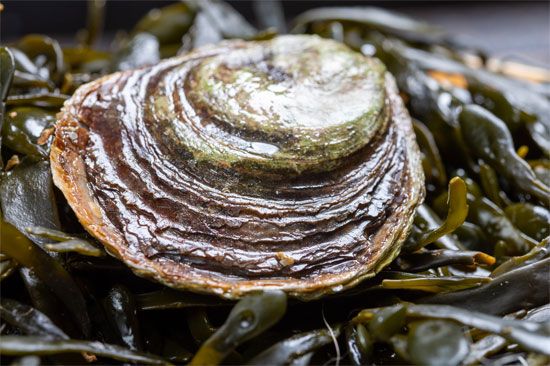
A piddock is any marine bivalve mollusk belonging to the family Pholadidae (order Myoida).12
These mollusks are globally distributed and are uniquely adapted for boring into various hard substrates, including rock, shells, peat, hard clay, mud, and wood. To achieve this, one end of their two-part shell is equipped with rows of serrated cutting edges. While most species inhabit the intertidal zone, some are found in deeper waters. Like most bivalves, piddocks feed on minute organisms, particularly phytoplankton, which they filter from the water.12
Sources
- piddock — Encyclopædia Britannica
- piddock — Merriam-Webster
- pholadid — Merriam-Webster
- bivalve - Annotated classification — Encyclopædia Britannica
- clam — Encyclopædia Britannica
Published on · 2 min read