Rat Kangaroo
Rat kangaroos are small marsupials native to Australia and Tasmania, belonging to the families Potoroidae and Hypsiprymnodontidae. There are 11 living…
What are the main species of rat kangaroos and where are they found?
Rat kangaroos are small marsupials native to Australia and Tasmania, belonging to the families Potoroidae and Hypsiprymnodontidae. There are 11 living species, which are generally rabbit-sized and known for their prehensile tails.12
Main Species and Distribution
- Bettongs (Bettongia):
- Tasmanian (Eastern) bettong: Found in eastern Tasmania.1
- Brush-tailed bettong (woylie): Located in isolated pockets of Western Australia.1
- Burrowing rat kangaroo (boodie): Restricted to a few offshore islands of Western Australia and South Australia.1
- Northern bettong: Inhabits small patches of northeastern Queensland.1
- Potoroos (Potorous):
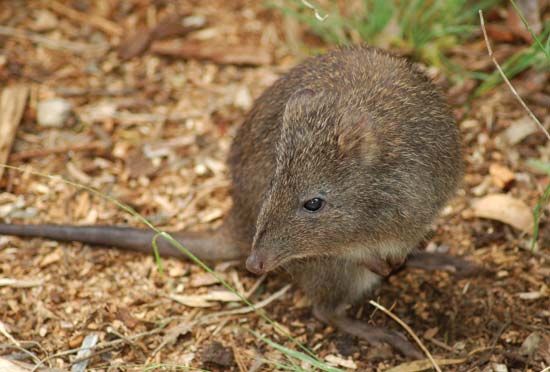
- Long-nosed potoroo: Found in forests of Tasmania and the eastern mainland (South Australia to Queensland).1
- Gilbert’s potoroo: A tiny population exists near Albany, Western Australia.1
- Long-footed potoroo: Limited to forested areas in northeastern Victoria and southeastern New South Wales.1
- Other Species:
- Rufous rat kangaroo: Lives in open woodlands from eastern Queensland to New South Wales.1
- Musky rat kangaroo: Inhabits tropical rainforests of northeastern Queensland.1
Several species, such as the broad-faced potoroo and desert rat kangaroo, are considered extinct.1
How have rat kangaroos been portrayed in popular culture and literature?
Sorry, the Britannica knowledge base does not contain information regarding the portrayal of rat kangaroos in popular culture and literature.
What is the evolutionary history of rat kangaroos and how long have they existed?
Rat kangaroos, which comprise the families Potoroidae and Hypsiprymnodontidae, are marsupials that share a common ancestry with the kangaroo family, Macropodidae.1
The evolutionary history of these groups indicates that the Potoroidae had already diverged from the Macropodidae by the late Oligocene Epoch, approximately 25 million years ago. While these 11 living species represent the extant members of the group, other potoroids are known exclusively through the fossil record.1
Rat kangaroos are distinguished from other kangaroos by specific anatomical features, including differences in skull structure, jaw musculature, and urogenital anatomy, as well as the presence of large canine teeth. Additionally, they exhibit faster development within the mother’s pouch compared to other kangaroo species.1
What are rat kangaroos and how are they different from regular kangaroos?
Rat kangaroos are a group of 11 living species of Australian and Tasmanian marsupials belonging to the families Potoroidae and Hypsiprymnodontidae1. They are distinct from the larger members of the kangaroo family (Macropodidae) in several key ways:
- Size and Anatomy: Rat kangaroos are rabbit-sized or smaller. Unlike other kangaroos, they possess large canine teeth and have differences in their skull, jaw musculature, and urogenital anatomy1.12
- Tails: Many rat kangaroos have prehensile tails, which they use to grasp and transport nesting material.1
- Development: They develop more rapidly within the mother’s pouch than other kangaroo species.1
- Behavior: Most are ground-living, nocturnal foragers that feed on grass, tubers, fungi, and occasionally insects.1
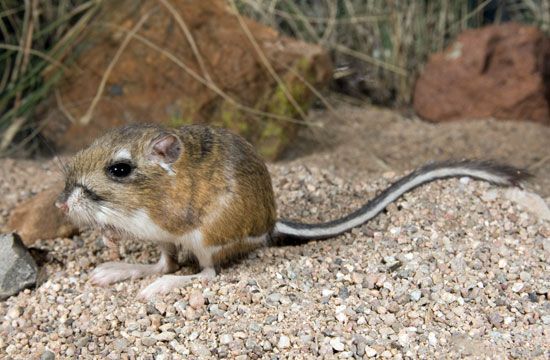
It is important not to confuse these marsupials with the kangaroo rat (Dipodomys), which is a completely unrelated, bipedal rodent native to North American deserts.3
Sources
- rat kangaroo — Encyclopædia Britannica
- rat kangaroo — Merriam-Webster
- kangaroo rat — Encyclopædia Britannica
- Australia - Animal life — Encyclopædia Britannica
- pterosaur — Encyclopædia Britannica
- Caprimulgiform - Evolution and paleontology — Encyclopædia Britannica
Published on · 2 min read