Pollen
Pollen is a mass of microspores produced in the male structures of seed plants, such as the anthers of flowers in angiosperms or the microsporophylls of…
What is pollen and what role does it play in plant reproduction?
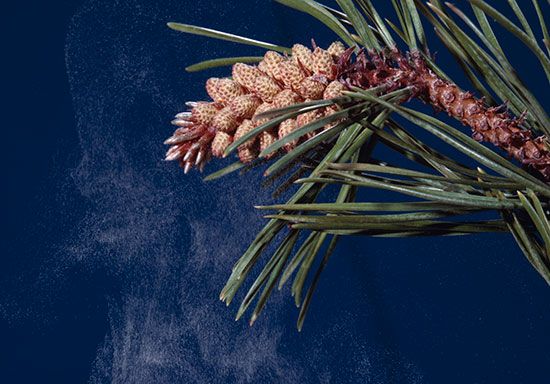
Pollen is a mass of microspores produced in the male structures of seed plants, such as the anthers of flowers in angiosperms or the microsporophylls of gymnosperm cones. Each pollen grain contains vegetative cells and a reproductive cell, serving as the vehicle for male gametes.1
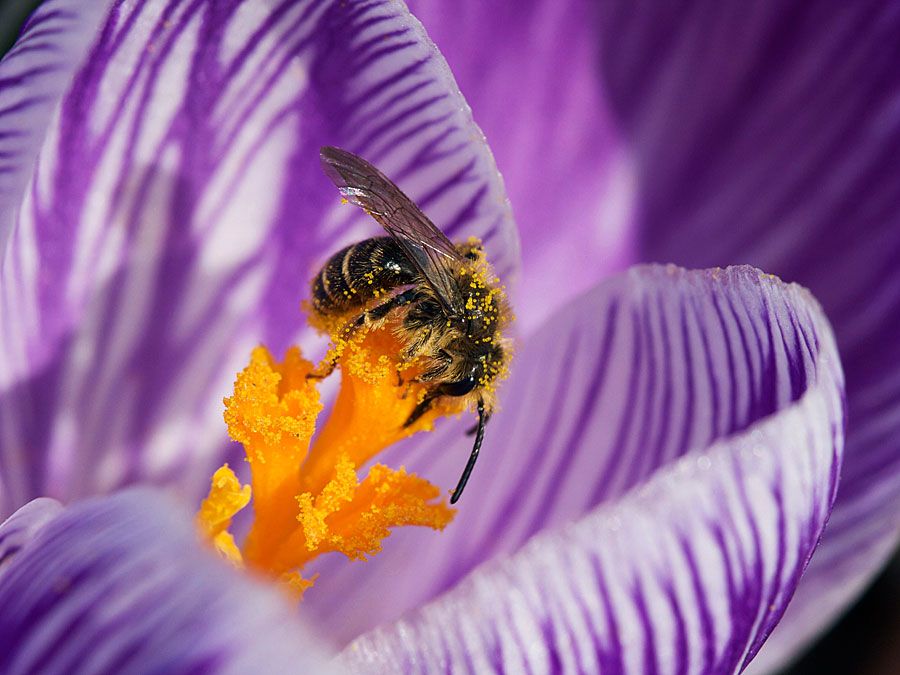
Pollen plays a critical role in plant reproduction through pollination, the transfer of pollen to the female ovule-bearing organs. Once deposited on a receptive surface like the stigma, the pollen grain germinates and produces a pollen tube. This tube grows toward the ovule, allowing the sperm to reach and fertilize the egg. This process is essential for the development of seeds and the perpetuation of plant species. Because plants are sedentary, they rely on external agents—including insects, wind, birds, and water—to transport pollen.234
What techniques are used to study and analyze pollen grains in scientific research?
Scientific research on pollen grains is conducted through the field of palynology. Because pollen grains possess a highly durable outer wall called the exine—composed of resistant sporopollenins—they are frequently preserved in sedimentary rocks and peat deposits, allowing researchers to study them much like living plant components.76
Key techniques and analytical methods include:
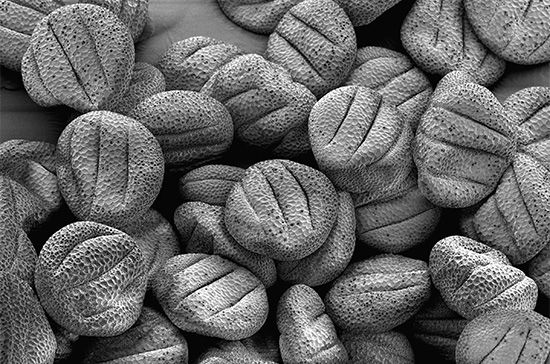
- Microscopy: Researchers use microscopes to examine the symmetrical structures and surface patterns of pollen. Advanced tools, such as electron microscopes, are used to analyze detailed morphology.76
- Taxonomic Identification: By observing characteristics like size, the number of apertures, and exine sculpturing, scientists can identify plant families and genera, often down to the species level.6
- Statistical Analysis: In pollen analysis, researchers determine the frequency and relative abundance of different pollen types within specific layers of soil or sediment. These statistical assemblages help reconstruct past forest compositions and climatic changes.78
- Extraction: Microfossils are extracted from rock samples, often obtained through drilling, to aid in stratigraphy and petroleum exploration.7
How has plant pollen evolved over time, and what can it tell us about plant evolution?
The evolution of plant pollen is a central narrative in the history of land plants, marking a critical transition that allowed plants to colonize diverse environments by decoupling reproduction from a reliance on external water for sperm transport.97
Evolutionary Milestones
- Transition from Water Dependency: Early non-seed plants relied on flagellated sperm that required water to reach the egg. The evolution of the pollen grain and the pollen tube allowed non-flagellated sperm to be delivered directly to the ovule, a major terrestrial adaptation.107
- Gymnosperm Dominance: During the Mesozoic Era, gymnosperms radiated and became dominant. These plants developed various mechanisms for pollination, including wind dispersal, which promoted genetic recombination across wide geographic areas.97
- Angiosperm Radiation: The rise of angiosperms in the Cretaceous Period introduced complex coevolutionary relationships. Angiosperms developed showy flowers to attract specific animal pollinators, moving away from the imprecise nature of wind pollination.119
- Pollen Tube Competition: As flowers evolved, pollen tube competition emerged as a selective mechanism. Grains that grew tubes faster were more likely to fertilize the egg, favoring the transmission of genes that produced more vigorous offspring.11
Insights from the Fossil Record
Because pollen grains are coated in sporopollenin—a highly decay-resistant chemical—they are exceptionally well-preserved in the fossil record well-preserved in the fossil record. Palynology allows scientists to use these microfossils to:712
- Delineate Evolutionary History: Pollen fossils help track the emergence and diversification of plant groups, sometimes revealing that certain lineages, such as angiosperms, evolved earlier than macrofossils alone would suggest.113
- Reconstruct Past Environments: Changes in the types and abundance of pollen in sedimentary rocks provide a record of shifting forest compositions and climatic changes over millions of years.312
- Understand Coevolution: The morphology of pollen—such as the development of spines or sticky projections—offers direct evidence of the historical interactions between plants and their animal pollinators.12
What are the different types of pollen grains, and how do they vary among plant species?
Pollen grains are highly diverse, minute structures that serve as the male gametophytes of seed-bearing plants. Their morphology—including size, shape, and surface ornamentation—is so distinctive that it is often used to identify plants at the family, genus, or even species level.1210
Structural Components
Most pollen grains consist of three primary parts:
- Cytoplasmic Core: Contains the nuclei responsible for fertilization.10
- Intine: The inner wall layer, composed primarily of cellulose and pectins.1210
- Exine: The outer, highly durable wall layer composed of sporopollenin. This layer is resistant to decay, heat, and chemicals, which allows pollen to be well-preserved in the fossil record.1210
Variations Among Species
Pollen grains vary significantly based on their pollination strategy and evolutionary lineage:
- Sculpturing Patterns: The exine is often highly “sculptured” with patterns such as spines, hooks, or sticky threads. These features are common in plants pollinated by animals (insects, birds, mammals), as they help the pollen adhere to the pollinator’s body. Conversely, wind-pollinated plants, such as oaks and grasses, typically produce small, smooth pollen grains that are easily dispersed by air currents.126
- Apertures: The exine contains thin areas called pores or furrows through which the pollen tube germinates. The number and position of these apertures are characteristic of specific plant groups.1210
- Aggregation: While most pollen grains are shed individually, some species exhibit unique groupings. For example, Rhododendron pollen remains in groups of four called tetrads, while orchids and milkweeds produce waxy, clustered masses known as pollinia.6
Sources
- Pollination — Encyclopædia Britannica
- Pollination - Types: self-pollination and cross-pollination — Encyclopædia Britannica
- Angiosperm - Pollination — Encyclopædia Britannica
- Angiosperm - General features — Encyclopædia Britannica
- Pollination - Wind — Encyclopædia Britannica
- Pollen — Encyclopædia Britannica
- palynology — Encyclopædia Britannica
- pollen analysis — Merriam-Webster
- Angiosperm - Paleobotany and evolution — Encyclopædia Britannica
- Plant - Variations involving seed plants — Encyclopædia Britannica
- Plant - Evolution of seed plants and plant communities — Encyclopædia Britannica
- Angiosperm - Anthers — Encyclopædia Britannica
- Plant - Seed plants — Encyclopædia Britannica
- Plant reproductive system - Angiosperms — Encyclopædia Britannica
Published on · 5 min read