Scrub Oak
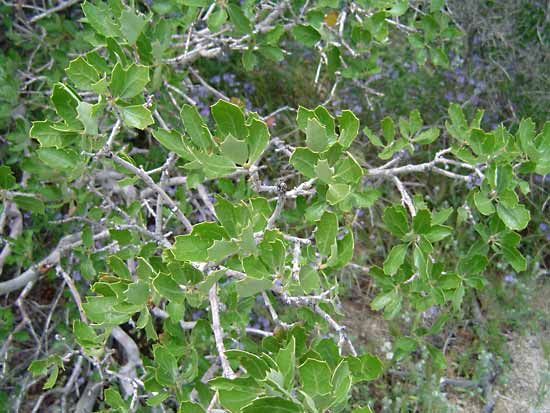
Scrub oak is a collective term for several small, shrubby trees within the genus Quercus (the oak genus) of the beech family (Fagaceae). These plants are…
What is scrub oak?
Scrub oak is a collective term for several small, shrubby trees within the genus Quercus (the oak genus) of the beech family (Fagaceae). These plants are typically native to dry soils across North America.1
Specific varieties include:
- Bear oak (Q. ilicifolia): An intricately branched ornamental shrub native to the eastern United States, reaching about 6 meters (20 feet) in height with hollylike leaves and small striped acorns.1
- California scrub oak (Q. berberidifolia): A species found in the west.1
- Nuttall’s scrub oak (Q. dumosa): An endangered species and low evergreen shrub of the California chaparral, noted for its resilience to fire and intense drought.12
- Gambel oak (Q. gambelii): Also known as the Rocky Mountain scrub oak, which can grow up to 9 meters (30 feet) tall.1
What is the California chaparral ecosystem?
The California chaparral is a scrubland biome characterized by broad-leaved, evergreen shrubs and small trees typically less than 2.5 meters (about 8 feet) tall. It is the signature vegetation of coastal and inland mountain regions in southwestern North America, thriving in a Mediterranean climate defined by hot, dry summers and mild, wet winters.34
Key Characteristics
- Vegetation: The ecosystem is dominated by sclerophyll plants, which possess hard, leathery foliage to minimize water loss. Common species include evergreen oaks, manzanita, mountain mahogany, and sagebrush.3
- Fire Adaptation: Chaparral is pyrophytic, meaning it is fire-adapted. Periodic wildfires are essential for clearing dense growth and triggering seed germination, though they pose significant environmental hazards to nearby human settlements, especially during Santa Ana winds.43
- Biodiversity: The region is highly biodiverse, supporting year-round residents like lizards, rabbits, chipmunks, and quail, while larger animals like deer often migrate through the area seasonally.35
Beyond its ecological value, chaparral is vital for watershed protection on steep, erosion-prone slopes.3
How do plants adapt to survive in dry, drought-prone environments?
Plants adapted to dry, drought-prone environments are known as xerophytes. These plants have evolved a variety of physiological and structural mechanisms to conserve water and survive in arid conditions.
Structural Adaptations
- Water Storage: Many xerophytes, such as cacti and agaves, are succulents that store water in their thick, fleshy stems or leaves.67
- Leaf Modifications: To minimize water loss, these plants may feature waxy coatings, dense hairy coverings, or the ability to fold or drop leaves to reduce sunlight absorption. Xeromorphic leaves often have a high volume-to-surface ratio, making them small and compact.68
- Root Systems: Many succulents possess broad or deep root systems to maximize water uptake from the soil.7
Physiological Adaptations
- Metabolic Efficiency: Many succulents utilize crassulacean acid metabolism (CAM). Unlike most plants, CAM plants keep their stomata closed during the hot day to prevent transpiration and open them at night to collect carbon dioxide.79
- Dormancy: Some plants enter a state of dormancy, reducing their metabolic activity to survive periods of extreme environmental stress.1011
Why are some species of oak considered endangered?
Sorry, the Britannica knowledge base does not contain specific information regarding why certain species of oak are considered endangered.
While the provided text discusses the Fagaceae family—which includes oaks—in the context of their susceptibility to the chestnut blight, it does not explicitly detail the conservation status or specific threats facing oak species.
Sources
- scrub oak — Encyclopædia Britannica
- California scrub oak — Merriam-Webster
- Chaparral — Encyclopædia Britannica
- United States - The Humid Pacific Coast — Encyclopædia Britannica
- North America - The Western sclerophyllous scrub forest — Encyclopædia Britannica
- Xerophyte — Encyclopædia Britannica
- Succulent — Encyclopædia Britannica
- Angiosperm - Leaves — Encyclopædia Britannica
- Photosynthesis - Differences in carbon fixation pathways — Encyclopædia Britannica
- Photosynthesis - Carbon fixation via crassulacean acid metabolism (CAM) — Encyclopædia Britannica
- Dormancy - Value of dormancy — Encyclopædia Britannica
- Dormancy — Encyclopædia Britannica
- Tree - Tree roots — Encyclopædia Britannica
- Plant - Dispersal and colonization — Encyclopædia Britannica
Published on · 2 min read