Sea Lavender
Sea lavender refers to any of the approximately 300 species within the genus Limonium, which belongs to the Plumbaginaceae family. These perennial herbaceous…
What is sea lavender?
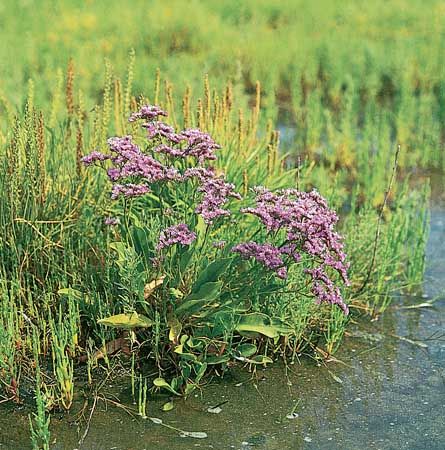
Sea lavender refers to any of the approximately 300 species within the genus Limonium, which belongs to the Plumbaginaceae family. These perennial herbaceous plants are widely distributed across North America, Eurasia, Africa, and Australia, often thriving in saline coastal soils.1
Despite their name, they are not related to true lavender or rosemary, which are members of the mint family (Lamiaceae). Sea lavenders are characterized by basal leaves arranged in rosettes and dense clusters of small, colorful flowers. Because these flowers retain their color well, they are frequently used in dried floral arrangements. While most are herbs, some species, such as the tree sea lavender, exhibit a tall, shrubby growth habit.1
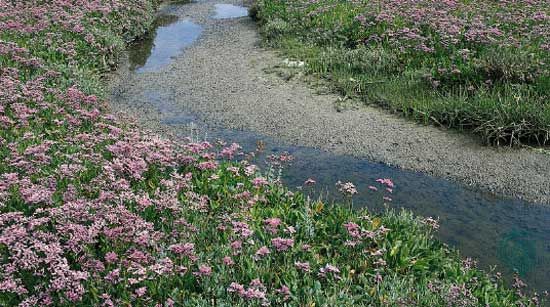
How do plants adapt to grow in salty coastal soil?
Plants that thrive in saline coastal environments are known as halophytes. These plants have evolved specialized mechanisms to survive in habitats where high salt concentrations in the soil typically cause dehydration in most other vegetation.34
In standard soil conditions, water enters plant roots through osmosis. However, when soil salinity is high, the osmotic pressure can cause water to flow out of the roots and into the soil, leading to plant dehydration and a lack of nutrient uptake. To counter this, halophytes employ several strategies:3
- Salt Accumulation: Certain species, such as glassworts, are capable of accumulating high concentrations of salts within their own leaves and stems. By maintaining a high internal salt concentration, they can continue to draw water from the saline environment through osmosis.4
- Osmotic Regulation: These plants manage their internal water balance to prevent the cellular damage that excessive ion concentrations would otherwise cause.5
- Specialized Habitats: Halophytes often dominate areas like salt marshes and mangrove forests, where they are adapted to survive in poorly drained, periodically flooded, or brackish substrates.46
What is the difference between perennial and annual plants?
The primary difference between annual and perennial plants lies in the duration of their life cycles.
- Annuals: These plants complete their entire life cycle—from germination to seed production and death—within a single growing season. The only part of an annual that survives to the next season is its dormant seed. Common examples include many cereal grains, lettuce, and garden flowers like marigolds.77
- Perennials: These plants persist for several years. While their aboveground portions may die back in autumn, they regrow and rebloom year after year from a perennating part, such as an underground root or stem modification (e.g., bulbs or rhizomes). All trees and shrubs are perennials, as are many herbaceous plants like chrysanthemums and asparagus.89
While some crops are technically biennials or tender perennials, they are often managed as annuals in agricultural settings for efficiency.7
Why are some flowers better suited for drying than others?
Flowers that are best suited for drying typically possess a naturally dry, stiff surface quality, which allows them to retain their structure and appearance as they lose moisture. Examples of such flowers include strawflowers, globe amaranth, and statice.10
In contrast, many other plants are less suitable for simple air-drying due to their high moisture content or fleshy substance, which can lead to decay or wilting rather than preservation. While some garden flowers—such as hydrangeas, celosia, and alliums—can be successfully dried by hanging them upside down in a dark, dry place, others require more intensive techniques. For instance, flowers with delicate petals may need to be buried in moisture-absorbing materials like silica gel or sand to maintain their shape during the drying process.10
Ultimately, the suitability of a flower for drying depends on its ability to withstand the loss of water without losing its aesthetic integrity.10
Sources
- sea lavender — Merriam-Webster
- sea lavender — Encyclopædia Britannica
- salinity — Encyclopædia Britannica
- Biosphere - Salinity — Encyclopædia Britannica
- Salt marsh — Encyclopædia Britannica
- estuary - Salt wedge estuaries — Encyclopædia Britannica
- Is That Plant 'Perennial' or 'Annual'? — Merriam-Webster
- Perennial — Encyclopædia Britannica
- Annual — Encyclopædia Britannica
- Floral decoration - Techniques — Encyclopædia Britannica
- Floral decoration - Materials — Encyclopædia Britannica
Published on · 3 min read