Shoveler
Shoveler birds, which are a type of dabbling duck, possess large, long, spoon-shaped bills that are highly specialized for feeding. These bills are lined…
How do shoveler birds use their uniquely shaped bills for feeding?
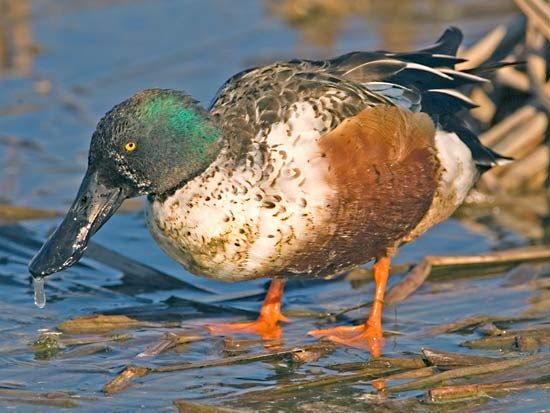
Shoveler birds, which are a type of dabbling duck, possess large, long, spoon-shaped bills that are highly specialized for feeding. These bills are lined with extremely fine, comblike structures known as lamellae.12
In shallow marshes and lagoons, shovelers use these bills to sift through mud to collect small organisms and seeds. In deeper waters, they utilize their bills to skim the surface film for plankton utilize their bills to skim the surface film for plankton. The fine nature of their lamellae is a key evolutionary development that enables them to filter and consume particles as small as diatoms from the water’s surface.12
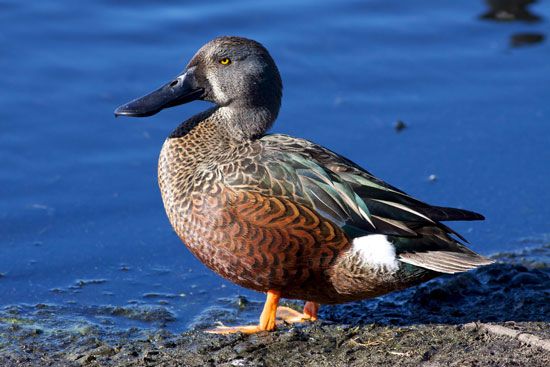
What are the different species of shoveler birds, and how do they differ?
There are four recognized species of shoveler birds, all of which are dabbling ducks belonging to the genus Anas. While they share the characteristic large, long, spoon-shaped bill used for filtering food, they are distinguished primarily by their geographic distribution:
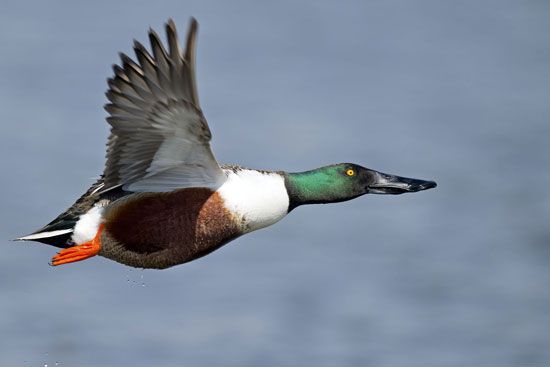
- Northern Shoveler (A. clypeata): This species has the widest range, nesting across North America, Europe, and northern Asia. It is known for the male’s distinct green head, white breast, and chestnut-colored belly and sides.
- Red Shoveler (A. platalea): This species is native to South America.
- Cape Shoveler (A. smithii): Also known as Smith’s shoveler, this species is found in South Africa.
- Australasian Shoveler (A. rhynchotis): Also referred to as the blue-winged shoveler, this species inhabits Australia and New Zealand.
These birds are generally found in shallow marshes and lagoons, where they use their specialized bills to sift through mud or skim the water’s surface for small organisms and seeds.1
How do shoveler birds compare to other duck species in terms of behavior and adaptations?
Shoveler birds are a specialized group within the dabbling duck tribe, sharing many general characteristics with other ducks while exhibiting unique evolutionary adaptations for feeding.18
Behavioral and Physical Adaptations
Like other dabbling ducks, shovelers are swift fliers that inhabit shallow inland waters, such as marshes and lagoons. While many dabbling ducks feed by “tipping-up” to reach vegetation on the bottom, the shoveler’s primary adaptation is its highly specialized, spoon-shaped bill.182
- Advanced Filtering: While typical duck bills are used for sifting mud or picking up food items, the shoveler’s bill features extremely fine, comblike lamellae. This allows them to filter microscopic organisms, such as diatoms, directly from the water’s surface film—a capability that exceeds the filtering efficiency of most other dabbling species.12
- Foraging Strategy: In addition to sifting through mud, shovelers are unique in their ability to skim deeper waters for plankton, a behavior less common among other dabblers that rely more heavily on aquatic plants or seeds.1
Comparison to Other Waterfowl
Unlike diving ducks, which submerge completely to forage, shovelers remain on the surface, maintaining the characteristic buoyancy of dabblers. Furthermore, while mergansers have evolved toothlike projections for catching fish and geese have developed heavy bills for grazing or digging for roots, the shoveler’s anatomy is exclusively optimized for fine-particle filtration.892
What are the distinctive physical features of shoveler birds?
The most distinctive physical feature of shoveler birds is their large, long, and spoon-shaped bill. This specialized structure is lined with extremely fine, comblike teeth known as lamellae, which allow the birds to filter microscopic organisms, such as diatoms, directly from the water’s surface film.12
Beyond their unique bills, these dabbling ducks exhibit other notable characteristics:
- Body Shape: In flight, shovelers often appear somewhat humpbacked, despite being rapid fliers.1
- Plumage: In the northern shoveler, males are particularly striking, featuring a green head, a white breast, chestnut-colored belly and sides, and a distinct blue patch on the forewing.1
- Anatomy: Like other members of the family Anatidae, they possess a thick, fleshy tongue and a specialized tracheal structure, including an asymmetrical chamber called a bulla at the base of the male’s trachea.2
Sources
- Shoveler — Encyclopædia Britannica
- Anseriform - Anatomy — Encyclopædia Britannica
- Ciconiiform - Bill shape — Encyclopædia Britannica
- What do ducks eat? — Encyclopædia Britannica
- spatula — Merriam-Webster
- Anseriform - Annotated classification — Encyclopædia Britannica
- spatuliform — Merriam-Webster
- Dabbling duck — Encyclopædia Britannica
- Duck — Encyclopædia Britannica
- Charadriiform - Adaptations for feeding — Encyclopædia Britannica
Published on · 3 min read