Tuatara
Tuataras (Sphenodon punctatus) exhibit a unique reproductive cycle characterized by slow development and specific behavioral adaptations. Unlike most other…
How do tuataras reproduce, and what makes their reproductive cycle unusual?
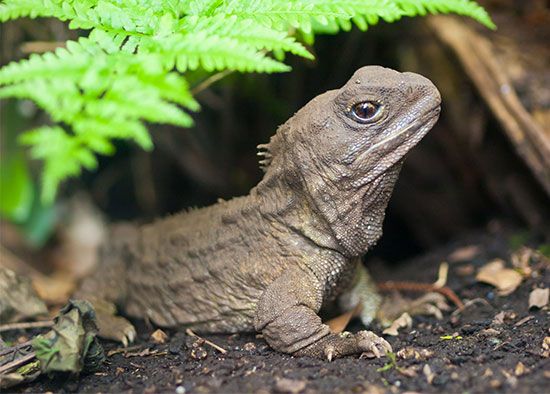
Tuataras (Sphenodon punctatus) exhibit a unique reproductive cycle characterized by slow development and specific behavioral adaptations. Unlike most other reptiles that possess a penis or hemipenes for copulation, tuataras lack these organs. Instead, they reproduce through cloacal apposition, where the male and female align their cloacal vents to transfer sperm.12
Several aspects of their reproductive cycle are particularly unusual:
- Slow Maturation and Longevity: Tuataras grow slowly, requiring 9–13 years to reach sexual maturity. They are long-lived, often surviving 60 years or more, and remain capable of reproduction well into their later decades.1
- Extended Cycles: For most females, egg deposition occurs on a four-year cycle.1
- Prolonged Incubation: Once laid, the 8–15 eggs require an exceptionally long incubation period of 11–16 months in the ground before hatching.1
- Behavioral Displays: During the mating season (January to March), males engage in territorial displays, including body inflation, crest erection, and vocalizations, to compete for access to females.1
How long have tuataras existed, and what is their evolutionary history?
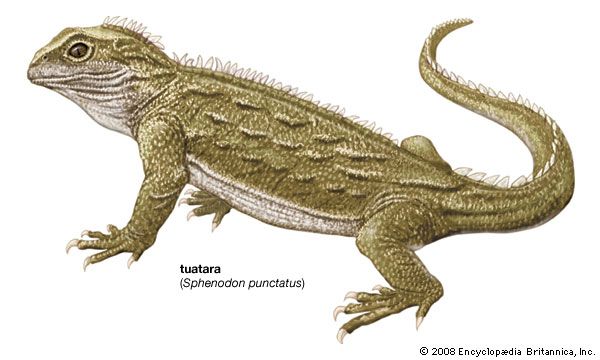
Tuataras (Sphenodon punctatus) are the sole surviving members of the ancient reptilian order Rhynchocephalia (or Sphenodontida), a lineage that first appeared in the fossil record during the Middle Triassic Period.1
Evolutionary History
The evolutionary lineage of the tuatara diverged from that of lizards and snakes approximately 250 million years ago. While rhynchocephalids were never highly diverse, they did experience a period of radiation between the Early Jurassic and Early Cretaceous periods—roughly 200 to 100 million years ago—when a group known as pleurosaurs adapted to an aquatic, fish-eating lifestyle.1
Following the Jurassic period, the presence of rhynchocephalids in the fossil record declined significantly. The oldest fossils comparable to the modern genus Sphenodon are jaw fragments found in New Zealand dating back 16 to 19 million years, though most known fossils of the genus are less than 10,000 years old. Today, they are considered a unique evolutionary relic, sharing certain traits with squamates while maintaining distinct anatomical features, such as gastralia (abdominal ribs) and a specialized beaklike premaxillary bone.1
What role do tuataras play in Maori culture and New Zealand’s ecosystem?
The tuatara (Sphenodon punctatus) holds a significant place in both the natural history of New Zealand and the cultural heritage of the Maori people.
Cultural Significance
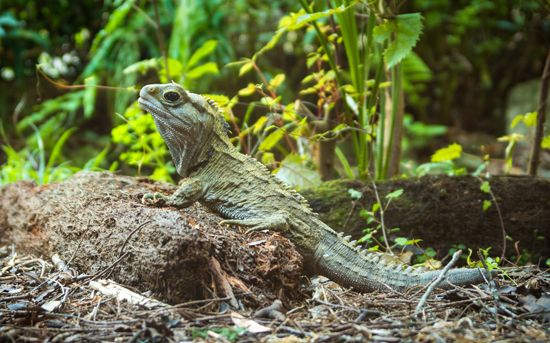
The name “tuatara” is derived from the Maori language, meaning “peaks on the back,” a reference to the series of spines that extend along the midline of the reptile’s body. Before the arrival of the Maori in the 13th century, these reptiles inhabited the main islands of New Zealand; however, their populations were significantly impacted by the introduction of the kiore, or Polynesian rat (Rattus exulans).1
Ecological Role
In New Zealand’s ecosystem, the tuatara functions as a unique evolutionary relic, representing the only surviving member of the ancient order Rhynchocephalia. Their ecological interactions are closely tied to burrow-nesting seabirds, such as the fairy prion:14
- Burrow Symbiosis: Tuataras often inhabit the tunnel systems of fairy prions. These burrows provide the reptiles with essential protection and access to food.1
- Nutrient Cycling: Excreta from the seabirds support a diverse community of [arthropods], which in turn serves as a primary food source for the tuatara.1
- Predatory Dynamics: While they primarily consume arthropods and smaller [lizards], tuataras may also prey on the eggs and chicks of the fairy prions with whom they share their habitat.1
Today, due to the impact of introduced predators like rats, cats, and pigs, tuataras are primarily restricted to protected offshore islets.15
What is the lifespan of a tuatara, and how does their growth rate compare to other reptiles?
Tuataras are remarkably long-lived reptiles, commonly reaching 60 years of age or more. Many individuals remain capable of reproduction well into their 20s and 30s, and some are even able to reproduce after 60 years of age.1
Their growth and development are notably slow compared to many other reptiles. This slow pace is evident throughout their life cycle:
- Incubation: Each egg requires 11–16 months of incubation in the ground before hatching occurs.1
- Sexual Maturity: In most populations, individuals require 9–13 years to attain sexual maturity.1
- Activity and Metabolism: Tuataras are adapted to function at low body temperatures, typically hovering around 18–19 °C (64–66 °F). This reduced activity level, which allows them to remain active even when body temperatures dip as low as 13–14 °C (55–57 °F), is likely an adaptation to their environment and contributes to their slow growth rate.1
Sources
- tuatara — Encyclopædia Britannica
- reptile - Embryonic development and parental care — Encyclopædia Britannica
- reptile - Courtship and fertilization — Encyclopædia Britannica
- tuatara — Merriam-Webster
- New Zealand - Plant and animal life — Encyclopædia Britannica
Published on · 4 min read