What Happened to the Megalodon?
The megalodon (Carcharocles megalodon) went extinct between 3.6 million and 2.58 million years ago. While scientists previously attributed this demise to…
What Happened to the Megalodon?
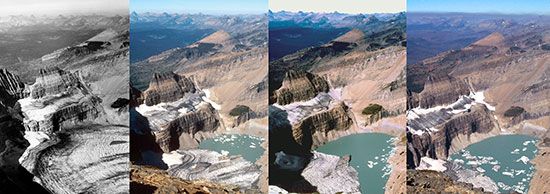
The megalodon (Carcharocles megalodon) went extinct between 3.6 million and 2.58 million years ago. While scientists previously attributed this demise to climate change and shifting ocean temperatures, more recent research suggests that environmental fluctuations alone were not the primary cause.12
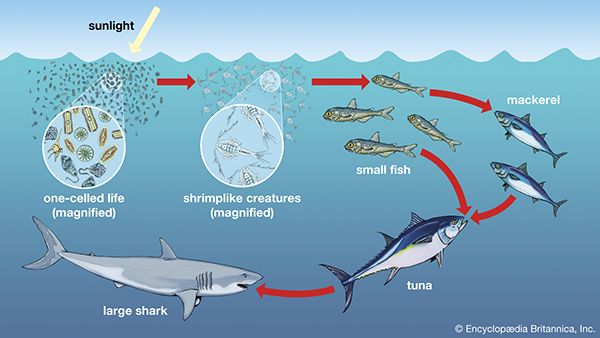
Instead, the species’ extinction is now largely linked to shifting food-chain dynamics. As the availability of its primary food source, baleen whales, declined, the megalodon faced increased pressure from competitors. These competitors included smaller predatory sharks, such as the great white shark, and various whales, including members of the killer whale genus Orcinus. These factors combined to reduce the population of this apex predator until it disappeared from the fossil record.13
How do scientists estimate the size of the Megalodon from fossils?
Because sharks have skeletons made of cartilage rather than bone, they do not fossilize well, leaving scientists to rely primarily on fossil teeth and a limited number of vertebrae to estimate the size of the megalodon.45
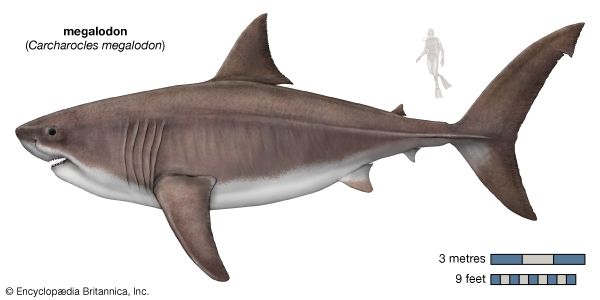
To calculate body length, researchers use the statistical relationship between the size of megalodon teeth and the teeth and body mass of modern great white sharks and other living relatives. By applying these mathematical models, scientists estimate that mature adult megalodons typically reached lengths of 13 to 14 meters (about 43 to 46 feet), with the largest specimens potentially measuring up to 24.3 meters (nearly 80 feet).5
Estimates for body mass are similarly derived, suggesting that adults ranged from roughly 30 metric tons to more than 65 metric tons, with females generally being larger than males. Some researchers argue that if the megalodon possessed a sleeker, more slender body shape rather than the bulky, torpedo-like frame traditionally assumed, its total length and weight could have been even greater than these standard estimates.5
What are some other prehistoric marine predators that lived alongside the Megalodon?
During the Miocene and Pliocene epochs, the megalodon shared the seas with a variety of other formidable marine predators. While the megalodon was an apex predator, it faced increasing competition from other carnivores that occupied similar ecological niches.
Key predators and competitors included:
- Early Killer Whales: Members of the genus Orcinus emerged as significant competitors, challenging the megalodon for food resources as their populations increased.39
- Great White Sharks: These smaller predatory sharks (Carcharodon carcharias) evolved to become formidable rivals, competing for the same prey as the megalodon.59
- Great Hammerhead Sharks: Evidence suggests that the ranges and nurseries of great hammerhead sharks overlapped with those of the megalodon, potentially posing a threat to juvenile or newly birthed megalodons.3
- Other Large Marine Carnivores: Historically, other massive predators such as basilosaurids, mosasaurs, and pliosaurs were also among the largest marine carnivores in Earth’s history, though their temporal overlap with the megalodon varied.3
How do modern great white sharks compare to the Megalodon?
While the megalodon and the modern great white shark share certain physical characteristics, they differ significantly in scale and evolutionary history.
Physical Comparison
- Size: The megalodon was the largest fish known, with mature adults averaging 13 to 14 meters (about 43 to 46 feet) and potentially reaching up to 24.3 meters (nearly 80 feet). This makes them roughly three times larger than the largest modern sharks.610
- Teeth: Both species possess triangular, serrated teeth. However, megalodon teeth are much thicker and larger, with the longest reaching 17.8 cm (6.9 inches)—nearly three times the size of a typical great white shark tooth.610
- Bite Force: With a mouth nearly 3 meters (9.8 feet) wide, the megalodon possessed a significantly more powerful bite than the great white shark.610
- Physiology: Both sharks are thought to have utilized regional endothermy, a form of warm-bloodedness that allows them to generate heat through muscle contraction, enabling them to hunt in colder waters.610
Evolutionary Relationship
There is ongoing debate regarding their lineage. While some scientists once grouped them together due to similar tooth structures, many researchers now classify the megalodon in the extinct family Otodontidae (megatooth sharks), suggesting that similarities to the great white shark may be a result of convergent evolution rather than a direct ancestral link.114
Sources
- megalodon - Extinction — Encyclopædia Britannica
- megalodon — Encyclopædia Britannica
- megalodon - Predators and prey — Encyclopædia Britannica
- 10 Fascinating Facts About Megalodon — Encyclopædia Britannica
- What Happened to the Megalodon? — Encyclopædia Britannica
- megalodon - Physical features — Encyclopædia Britannica
- chondrichthyan - Growth — Encyclopædia Britannica
- megalodon - Reproduction and territoriality — Encyclopædia Britannica
- killer whale — Encyclopædia Britannica
- megalodon - Paleontology — Encyclopædia Britannica
- white shark - Evolution — Encyclopædia Britannica
Published on · 3 min read