Wolf Herring
The wolf herring (Chirocentrus dorab) is a predatory marine fish belonging to the family Chirocentridae. Unlike typical members of the herring family…
What is wolf herring?
The wolf herring (Chirocentrus dorab) is a predatory marine fish belonging to the family Chirocentridae. Unlike typical members of the herring family (Clupeidae) that feed on plankton, the wolf herring is a carnivore that uses its fanglike teeth to hunt and consume other fish.12
Physically, these fish are characterized by their elongated, silvery bodies and forked tails, reaching an average length of approximately 1.5 meters (5 feet). They are found throughout the Indian Ocean and the western Pacific, ranging from Japan to eastern Australia. While they are considered a threat to other fish species due to their size and predatory nature, they are also esteemed as a food source in certain regions, despite being fierce and difficult to handle.12
How do wolf herrings differ from common herrings?
While both the wolf herring and common herrings belong to the order Clupeiformes, they differ significantly in their biology, diet, and physical characteristics.
Diet and Behavior
The most fundamental difference lies in their feeding habits. Common herrings (family Clupeidae) are planktivores that consume minute organisms such as copepods and pteropods. In contrast, the wolf herring (family Chirocentridae) is a carnivore that actively hunts and consumes other fish.
Physical Specializations
- Dentition: To support their predatory lifestyle, wolf herrings possess specialized, fanglike teeth on their jaws, tongue, and mouth, including large “canine” teeth on the lower jaw. Common herrings have much smaller teeth or denticles limited to the mouth cavity.13
- Size: While most clupeiforms are small, common herrings typically reach lengths of 20 to 38 centimeters (8 to 15 inches). The wolf herring is exceptional in size, reaching lengths of up to 3.6 meters (12 feet).45
- Fin Position: In adult Clupeidae, the dorsal fin is generally positioned directly above the pelvic fins. In Chirocentridae, the dorsal fin is located much further back on the body, positioned above the anal fin.3
What makes the Chirocentridae family unique?
The family Chirocentridae, which consists of the single genus Chirocentrus and two living species, is distinguished from other members of the order Clupeiformes by several unique biological and physical traits:
- Predatory Nature: Unlike the plankton-feeding common herrings (family Clupeidae), members of this family are carnivores that actively hunt and consume other fish.16
- Specialized Dentition: Their jaws are equipped with large, fanglike teeth, including prominent canine teeth on the lower jaw, which are adapted for catching and holding prey.16
- Physical Morphology: They possess elongated, laterally compressed bodies with a sharp, keeled ventral margin. Their lower jaw is strongly projecting, and they are characterized by small scales.6
- Size: They are significantly larger than most other clupeiforms, capable of reaching lengths of at least 3.6 meters (12 feet).6
These fish are widely but sparsely distributed across the Indian and Pacific oceans, including the Sea of Japan, the Red Sea, and off the coasts of Africa and Australia. While they are utilized as a food source in some regions, they are generally considered less palatable than other related species.16
What other predatory fish live in the Indian Ocean?
The Indian Ocean hosts a diverse array of predatory fish, ranging from large, open-ocean hunters to those found in coastal and reef environments. Notable examples include:
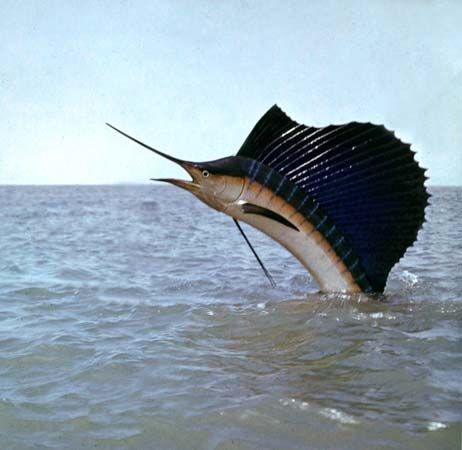
- Sailfish: Recognized by their large, sail-like dorsal fins and long, spear-like snouts, these fish are swift predators that feed primarily on other fish.1011
- Tunas: These powerful, fast-swimming predators are abundant in the tropical reaches of the Indian and Pacific oceans and are significant components of the marine food web.1112
- Sharks: Various species of sharks inhabit the Indian Ocean, with large predatory varieties often serving as apex predators within their ecosystems.1113
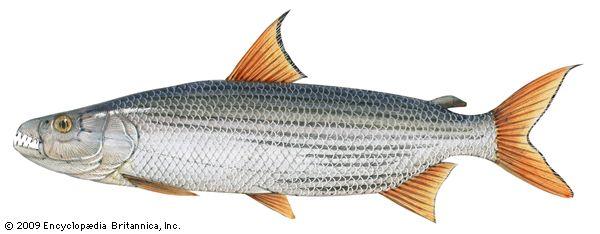
- Tigerfish: In the Indo-Pacific region, members of the family Theraponidae are known as tigerfishes. These are generally smaller than their African freshwater counterparts and are often marked with bold stripes.14
These predators play a vital role in maintaining the balance of marine communities by regulating the populations of smaller fish and invertebrates.13
Sources
- wolf herring — Encyclopædia Britannica
- wolf herring — Merriam-Webster
- herring — Encyclopædia Britannica
- clupeiform - Distinguishing characteristics — Encyclopædia Britannica
- clupeiform - General features — Encyclopædia Britannica
- clupeiform - Annotated classification — Encyclopædia Britannica
- bat - Distinguishing taxonomic features — Encyclopædia Britannica
- caddisfly - Annotated classification — Encyclopædia Britannica
- Chirocentrus — Merriam-Webster
- sailfish — Encyclopædia Britannica
- Indian Ocean - Biological resources — Encyclopædia Britannica
- Indonesia - Plant and animal life — Encyclopædia Britannica
- Pacific Ocean - Biological resources — Encyclopædia Britannica
- apex predator — Encyclopædia Britannica
- ostariophysan - Feeding habits — Encyclopædia Britannica
- tigerfish — Encyclopædia Britannica
Published on · 3 min read