Amazing Mangroves
"Amazing Mangroves" is an article by Melissa Petruzzello published in Encyclopædia Britannica that explores the vital ecological and protective roles of…
What is Amazing Mangroves?
“Amazing Mangroves” is an article by Melissa Petruzzello published in Encyclopædia Britannica that explores the vital ecological and protective roles of mangroves.12
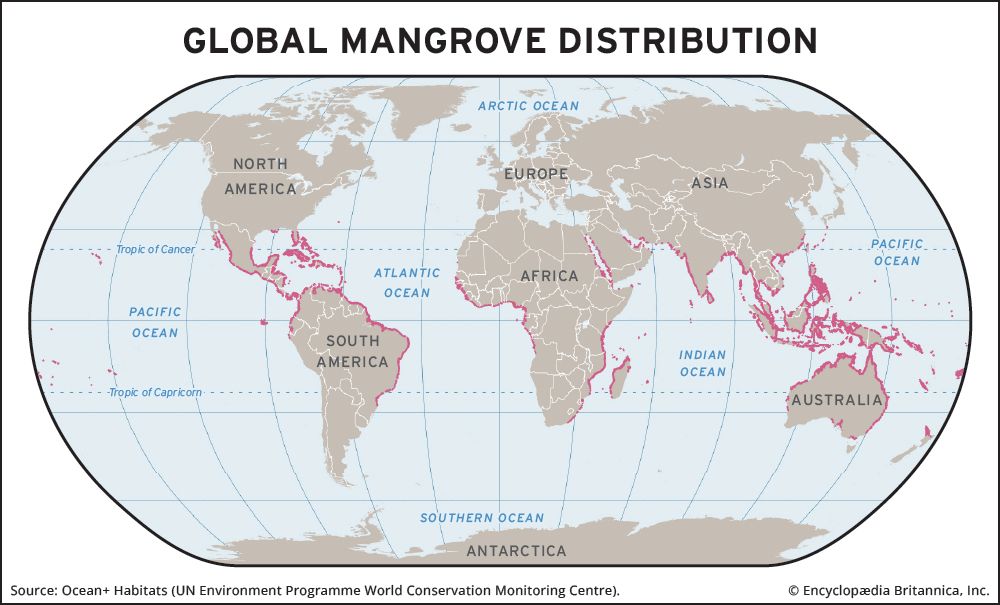
These salt-tolerant trees and shrubs, which thrive in tropical and subtropical coastal regions, serve as essential buffers between marine and terrestrial environments. The article highlights several key functions of these ecosystems:31
- Coastal Protection: Mangroves trap sediments, reduce erosion, and shield shorelines from damaging winds, waves, and floods. Research indicates that communities preserving these forests experience significantly lower storm impacts and mortality rates during hurricanes.1
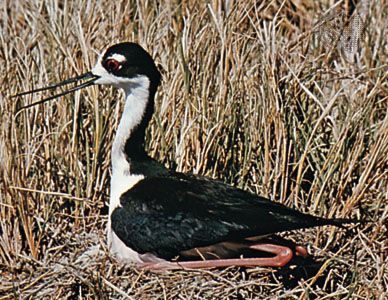
- Ecological Importance: They provide critical habitats for diverse organisms, including nesting sites for birds and essential nurseries for coastal fish and shellfish.1
Despite their importance, mangrove populations are declining globally due to human development. The article emphasizes that their preservation is vital for both environmental health and human safety.1
How do mangrove roots help them survive in salty water?
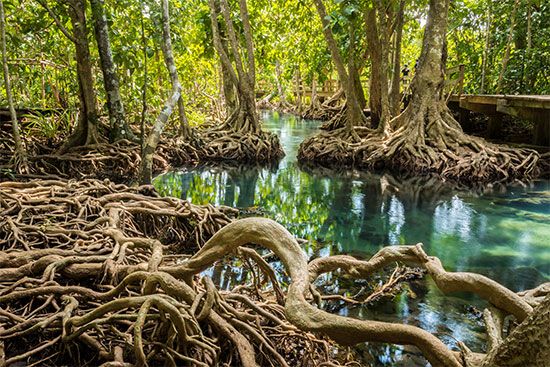
Mangroves are uniquely adapted to survive in the challenging, oxygen-poor, and saline environments of coastal wetlands through specialized root systems. These structures allow the plants to stabilize themselves and facilitate essential gas exchange.1
Key root adaptations include:
- Pneumatophores: These are specialized lateral roots that grow upward from the primary root system, protruding above the mud or water. They are perforated with small openings called lenticels, which allow air to enter and pass through spongy tissue to the submerged roots, enabling respiration in waterlogged, saline soils.45
- Stilt Roots: Found in species such as the red mangrove, these roots provide both structural support and assist in aeration.5
- General Stabilization: Beyond gas exchange, the complex root networks of mangroves trap sediments, which helps reduce erosion and stabilizes the trees in shallow, saturated coastal soils.52
These modifications are critical for the survival of hydrophytic trees in environments where oxygen is scarce and salinity is high.5
What animals rely on mangrove forests as nurseries?
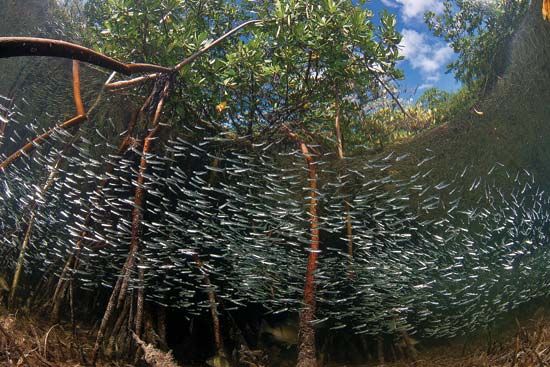
Mangrove forests serve as essential nursery habitats, providing a protected environment for a wide variety of marine life to breed, spawn, and hatch. Because of the complex, tangled root systems that offer shelter from predators, these areas are critical to the survival of many species.127
Animals that rely on these ecosystems as nurseries include:
- Fish: Many coastal and offshore fish species depend on the safety of mangrove roots during their early life stages.127
- Crustaceans: Various crabs and shrimp utilize these forests as vital hatchery sites.1
- Shellfish: Many shellfish rely exclusively on the protected waters within mangrove thickets for their breeding and spawning grounds.27
The role of mangroves as a nursery is so significant that local fisheries would likely collapse without these safe havens. By supporting such high levels of biodiversity, mangroves are considered keystone species within their coastal environments.217
How do mangroves help protect coastlines from storms?
Mangrove forests act as a vital natural buffer between marine and terrestrial environments, providing essential protection for coastlines against the destructive forces of storms. By forming dense, tangled thickets, these trees physically obstruct and dissipate the energy of incoming waves, storm surges, and high winds.13
Their complex root systems play a critical role in this defense by trapping sediments, which helps to stabilize the shoreline and significantly reduce erosion. Research indicates that coastal communities with intact mangrove forests fare significantly better during a hurricane than those where these trees have been removed; in some instances, the presence of these forests has been linked to lower mortality rates and reduced economic damage from flooding. Beyond their role in storm mitigation, mangroves improve water quality and protect the integrity of the coastline, making their preservation a matter of both environmental health and human safety.13
Sources
- mangrove: Top Questions — Encyclopædia Britannica
- Amazing Mangroves — Encyclopædia Britannica
- Mangroves Matter - Learn more — Encyclopædia Britannica
- Pneumatophore — Encyclopædia Britannica
- Tree - Tree roots — Encyclopædia Britannica
- Salt marsh — Encyclopædia Britannica
- crustacean - Distribution and abundance — Encyclopædia Britannica
- 14 Questions About Aquatic Animals Answered - Are there certain fish that can live without water? — Encyclopædia Britannica
- mangrove — Encyclopædia Britannica
Published on · 3 min read