Dumb Gulper Shark
The dumb gulper shark (Centrophorus harrissoni) is a deepwater shark belonging to the family Centrophoridae, closely related to dogfishes. Typically found…
What is dumb gulper shark?
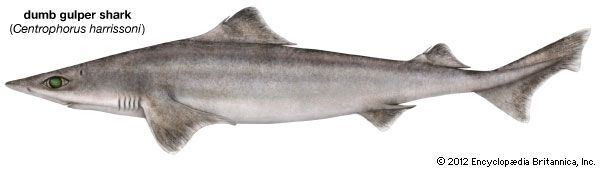
The dumb gulper shark (Centrophorus harrissoni) is a deepwater shark belonging to the family Centrophoridae, closely related to dogfishes. Typically found off the eastern coast of Australia and near seamounts in the Tasman Sea, this species inhabits depths between 220 and 1,050 metres. It is characterized by its large green eyes and reaches a maximum length of approximately 1.1 metres.1
The species faces significant survival challenges due to its slow population growth. Females do not reach sexual maturity until age 23, and they produce very small litters every two years. Because of these biological constraints and the impact of commercial fishing, the shark is currently classified as an endangered species. While conservation efforts and fishing restrictions have helped slow its decline, the species remains vulnerable to accidental capture.1
What are seamounts and why are they important to deep-sea life?
A seamount is a large, typically conical submarine volcano that rises at least 1,000 metres (3,300 feet) above the surrounding abyssal plain or deep-sea floor2. While some are flat-topped—a variation known as a guyot—most are formed by basaltic lava flows and are found in all major ocean basins, often occurring in linear clusters or chains.23
Regarding their importance to deep-sea life, while the provided search results define the geological nature and abundance of these features, they do not explicitly detail the biological interactions or ecological roles seamounts play in supporting marine life. Consequently, I cannot provide information on their specific biological significance based on the current data.
How do deep-sea sharks adapt to living in such dark environments?
Deep-sea sharks have evolved a suite of specialized sensory and physiological adaptations to thrive in the darkness of the ocean depths.
Sensory Adaptations
While sharks are often characterized by their keen sense of smell, which allows them to detect minute concentrations of substances like blood, they rely on a highly integrated system of senses to navigate and hunt in low-light environments.56
- Vision: In many deep-diving species, the eyes are well developed to maximize the detection of ambient light.5
- Mechanoreception and Electroreception: Sharks utilize a lateral line system to detect low-frequency vibrations in the water. Additionally, they possess a network of pores called ampullae, which allow them to sense the weak electrical impulses generated by the muscles of nearby prey.56
Bioluminescence
Some deep-sea sharks, such as the kitefin shark (Dalatias licha) and certain lanternsharks, have evolved the ability to produce their own light through bioluminescence. Unlike some other marine organisms that rely on symbiotic bacteria, these sharks generate light through internal chemical reactions controlled by hormones. This adaptation can serve various purposes, including species recognition, mating signals, or potentially camouflaging the shark’s silhouette against the faint light penetrating from above.78
What are the main differences between dogfish and other shark families?
The term “dogfish” refers to a diverse group of relatively small, often bottom-dwelling sharks belonging to the order Squaliformes, which includes families such as Squalidae, Centrophoridae, and Dalatiidae. While they share the general characteristics of sharks—such as a cartilaginous skeleton and internal fertilization—they are distinguished from many other shark families by several key traits:910
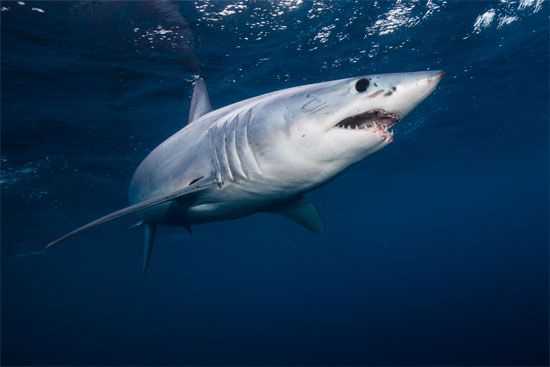
- Physical Morphology: Many dogfish are small, typically ranging from 60 to 120 cm (2 to 4 feet) in length. Unlike the large, streamlined open-ocean predators like mako or thresher sharks, dogfish are often stout and blunt-headed, reflecting their bottom-dwelling habits.911
- Dorsal Fin Spines: Members of the family Squalidae, such as the spiny dogfish, are specifically distinguished by the presence of a sharp, prominent spine located in front of each of their two dorsal fins. These spines are associated with small venom glands and can inflict painful wounds, a defensive feature not found in many other shark families.129
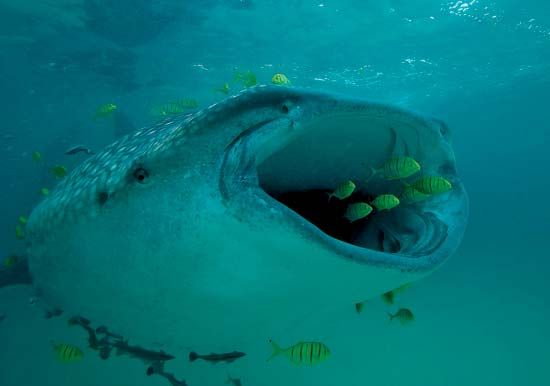
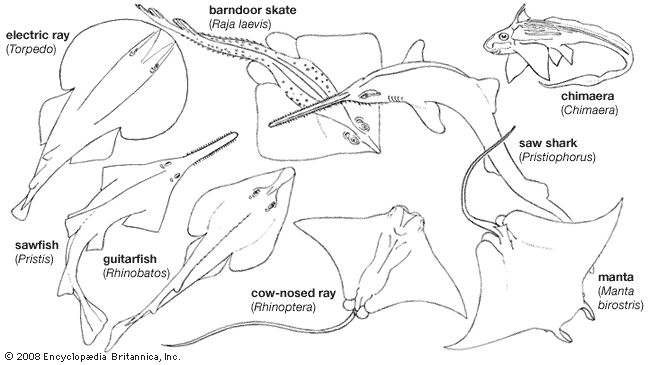
- Behavioral Patterns: Dogfish are frequently found in dense schools, a social behavior that contrasts with the solitary nature of many larger, more aggressive shark species. They are primarily opportunistic feeders, consuming a variety of small fish and invertebrates, whereas other families have evolved highly specialized feeding mechanisms, such as the plankton-straining apparatus of whale sharks or the bladelike snouts of saw sharksike snouts of saw sharks.91312
Sources
- dumb gulper shark — Encyclopædia Britannica
- seamount — Encyclopædia Britannica
- seamount — Merriam-Webster
- Indian Ocean - Seamounts of the Indian Ocean — Encyclopædia Britannica
- Bioluminescence - The role of bioluminescence in behavior — Encyclopædia Britannica
- Bioluminescence - The range and variety of bioluminescent organisms — Encyclopædia Britannica
- chondrichthyan - Senses — Encyclopædia Britannica
- chondrichthyan - Sharks — Encyclopædia Britannica
- spiny dogfish — Merriam-Webster
- dogfish — Encyclopædia Britannica
- chondrichthyan - Reproductive behaviour — Encyclopædia Britannica
- shark - Description and habits — Encyclopædia Britannica
- dogfish — Merriam-Webster
Published on · 3 min read