Gerenuk
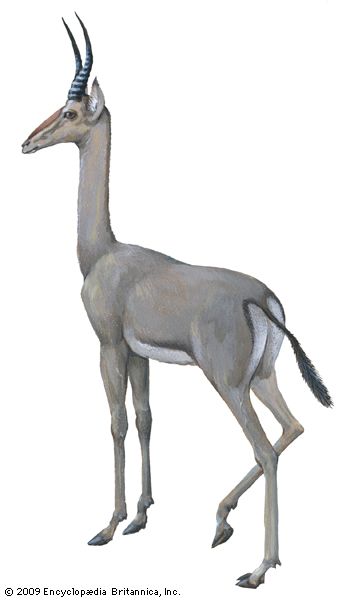
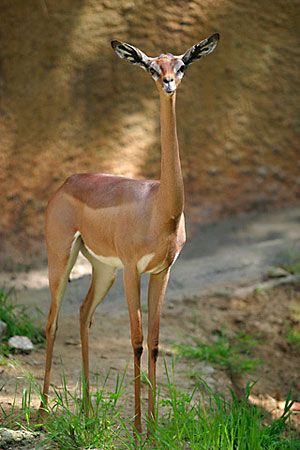
The gerenuk (Litocranius walleri) is a unique, long-necked antelope native to the arid thornbush regions of the Horn of Africa. While specific data regarding…
How long do gerenuk typically live, and what is their reproductive cycle like?
The gerenuk (Litocranius walleri) is a unique, long-necked antelope native to the arid thornbush regions of the Horn of Africa. While specific data regarding their maximum lifespan in the wild is not detailed in the provided information, their reproductive cycle is well-documented.1
The gerenuk is capable of breeding year-round, although the majority of births typically occur during the rainy season. The reproductive process is characterized by the following:
- Gestation: The gestation period lasts approximately seven months.1
- Post-birth: Mothers often conceive again within weeks of giving birth.1
- Offspring Development: Following birth, the young remain hidden for several weeks, a behavior that helps them avoid detection by predators.1
The species maintains a fluid social structure where the only constant association is between a mother and her dependent offspring.1
What are the social structures and behaviors of gerenuk herds?
The gerenuk is notably less sociable than most other gazelles, a trait that aligns with its preference for semiclosed habitats and its low population density. Their social structure is characterized by fluidity rather than rigid, permanent groups.
Social Organization and Behavior
- Group Size: While sightings of single animals are common, normal groupings consist of two to eight individuals. Herds exceeding a dozen are considered unusual.
- Group Dynamics: Groupings are highly fluid. The only constant, stable association is between a mother and her dependent offspring. Small groups of two or three females may be found together, with or without their young.
- Male Behavior: Before reaching adulthood and becoming territorial, males often associate in small groups of two or three. When possible, these males will attach themselves to groups of adult females.
- Territoriality: Adult males are territorial, typically maintaining areas of about 2 square kilometers (0.7 square miles). They mark these properties by depositing tarlike secretions from their preorbital glands onto twigs at frequent intervals. While female home ranges are of a comparable size, territorial males rarely venture outside their established property.
How does the gerenuk’s diet and feeding behavior differ from other antelopes?
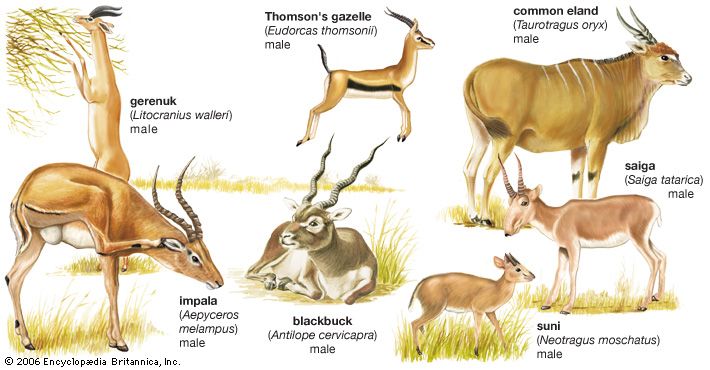
The gerenuk (Litocranius walleri) possesses specialized physical adaptations that distinguish its feeding behavior from most other antelopes. While many antelopes are grazers that feed on grass in open habitats, the gerenuk is a dedicated browser adapted to the arid thornbush of the Horn of Africa.12
Key differences in their feeding behavior include:
- Vertical Reach: The gerenuk is the only antelope capable of standing unsupported on its hind legs to reach foliage. This is made possible by its modified lumbar vertebrae, powerful hind legs, and wedge-shaped hooves.1
- Selective Browsing: Its elongated neck and pointed snout allow it to perform selective nibbling of small leaves on thorny shrubs and trees at heights inaccessible to other antelopes.1
- Resource Independence: Because its diet is enriched with moisture from the leaves it consumes, the gerenuk can thrive in areas far from permanent water sources. This allows it to exploit ecological niches that are unavailable to water-dependent herbivores. ecological niches that are unavailable to water-dependent herbivores.1
How do gerenuk adapt to their environment, particularly in terms of water conservation?
The gerenuk (Litocranius walleri) is highly adapted to life in the arid thornbush of the Horn of Africa, primarily through its specialized feeding habits that allow it to remain independent of permanent water sources.1
Unlike many other herbivores that are water-dependent, the gerenuk obtains sufficient moisture directly from the vegetation it consumes. Its unique physical structure—including an elongated neck, a pointed snout, and the ability to stand unsupported on its hind legs—enables it to perform selective nibbling of small leaves on thorny shrubs and trees at heights that are inaccessible to other antelopes. Because its diet is enriched with the moisture found in this high-growing foliage, the gerenuk can thrive in dry environments and even increase its population density in areas located far from standing water.1
This dietary strategy is a primary mechanism for water conservation, allowing the species to exploit ecological niches that are otherwise unavailable to less specialized animals.1
Sources
- gerenuk — Encyclopædia Britannica
- antelope — Encyclopædia Britannica
- Grassland - Biota — Encyclopædia Britannica
- dik-dik — Encyclopædia Britannica
- Excretion - Principal excretory structures — Encyclopædia Britannica
Published on · 3 min read