Pearlfish
A pearlfish is any of approximately 32 species of slim, eel-shaped marine fish belonging to the family Carapidae. These fish are primarily found in tropical…
What is pearlfish?
A pearlfish is any of approximately 32 species of slim, eel-shaped marine fish belonging to the family Carapidae. These fish are primarily found in tropical, shallow waters around the world.12
Physically, pearlfishes are characterized by their elongated, scaleless, and often transparent bodies, typically measuring 15 cm (6 inches) or less in length. They possess long dorsal and anal fins that meet at a pointed tail, with an anus positioned near the throat.1
These fish are notable for their unique symbiotic behavior, as they often live inside the bodies of various invertebrates, including sea cucumbers, starfishes, and pearl oysters. In the case of sea cucumbers, the pearlfish may enter through the host’s anus, sometimes feeding on the host’s internal reproductive and respiratory organs.12
How do sea cucumbers protect themselves from pearlfish?
Sea cucumbers do not have specific, documented defense mechanisms evolved solely to protect themselves from the pearlfish, which often resides within their anal cavity. Instead, sea cucumbers utilize general defensive strategies to deter predators and threats, which may incidentally affect the fish.
These defensive behaviors include:
- Evisceration: Many species can expel their internal organs through the anus and subsequently regenerate them. This process is often used as a mechanism to escape predators or for physiological reasons.1
- Sticky Filaments: Some species possess the ability to discharge specialized, sticky filaments designed to ensnare or confuse potential enemies.1
- Toxin Secretion: A number of sea cucumber species exude a toxin that is lethal to small animals. These substances are potent enough that they have historically been used by humans to kill or stupefy fish in water.1
While the pearlfish occupies the sea cucumber’s anal cavity—an area also used for respiration and waste discharge—the relationship is often described as symbiotic, with the fish’s head typically extruding from the host.31
What other animals have unique symbiotic relationships?
Many animals engage in unique symbiotic relationships, which are categorized based on how the participants interact and benefit. These relationships are fundamental to the structure of biological communities.4
Mutualism
In mutualism, both species involved derive benefits from the association.54
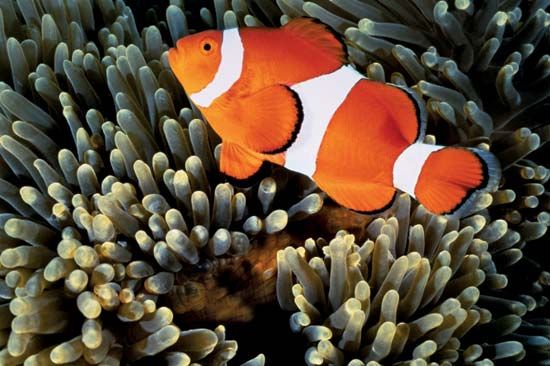
- Common Clown Fish and Sea Anemones: The fish receives protection from predators among the anemone’s stinging tentacles, while the fish cleans parasites from the anemone and deters predators like butterfly fishes from eating the anemone’s tentacles.67
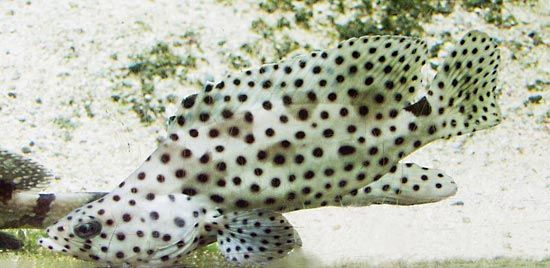
- Cleaner Fishes (Labroides): These fish maintain “cleaning stations” where they remove parasites from larger carnivorous fish, such as groupers and eels, which in turn allow the cleaner fish to enter their mouths safely.7
- Insects and Endosymbionts: Many insects rely on internal prokaryotic endosymbionts to provide essential nutrients, such as amino acids, that are missing from their specialized diets.8
Commensalism
In commensalism, one species benefits while the other remains unaffected.5
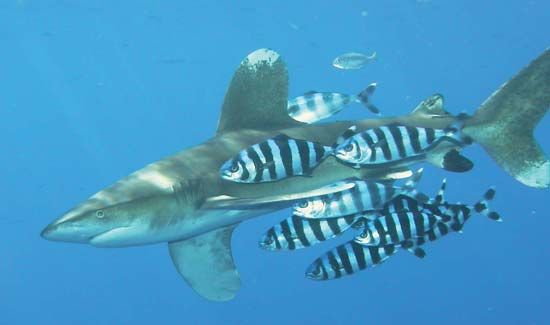
- Remoras: These fish use a specialized sucking disk on their heads to attach to sharks and other large fish, gaining transportation and access to food scraps.5
- Great Egrets: These birds often follow grazing mammals to feed on insects stirred up by the animals’ movement.5
Other Associations
- Blind Goby: This fish depends entirely on the burrows created by ghost shrimp for shelter.7
Why do some pearlfish feed on their host’s organs?
Some species of pearlfish are known to feed on the internal organs of their hosts, such as sea cucumbers, specifically targeting their respiratory and reproductive systems. While these fish typically use the host’s anal cavity as a shelter, this feeding behavior represents a shift toward a parasitic relationship, where the fish derives nutrition at the expense of the host’s health.110
It is important to note that while some pearlfish exhibit this behavior, the relationship between pearlfish and their hosts is often described as commensal, where the fish simply uses the host for protection without necessarily causing harm. When pearlfish do consume host tissue, it aligns with the definition of parasitism, a biological interaction where one organism benefits while the other is harmed.310
Sources
- pearlfish — Encyclopædia Britannica
- pearlfish — Merriam-Webster
- sea cucumber — Encyclopædia Britannica
- common clown fish — Encyclopædia Britannica
- commensalism — Encyclopædia Britannica
- Endosymbiosis — Encyclopædia Britannica
- perciform - Interspecific relationships — Encyclopædia Britannica
- community ecology - The evolution of mutualism — Encyclopædia Britannica
- community ecology - Mutualism — Encyclopædia Britannica
- parasitism — Encyclopædia Britannica
- perciform - Feeding behaviour — Encyclopædia Britannica
Published on · 3 min read