Tiger-flower
The tiger-flower refers to the genus Tigridia, which consists of approximately 35 species of flowering plants belonging to the iris family (Iridaceae).…
What is Tiger-flower?
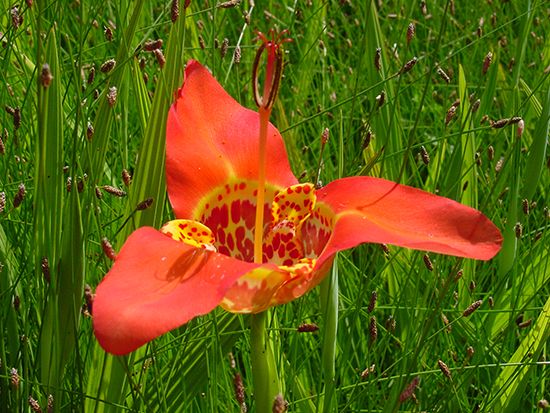
The tiger-flower refers to the genus Tigridia, which consists of approximately 35 species of flowering plants belonging to the iris family (Iridaceae). Native to regions ranging from Mexico to Chile, these perennial plants grow from bulbs or corms.1
The plants are characterized by their swordlike leaves and distinct flowers, which feature three large lower floral parts alternating with three smaller petals, all surrounding a spotted cup at the center. One notable species, the Mexican shell flower (Tigridia pavonia), is widely cultivated for its aesthetic appeal. Historically, this plant was valued by the Aztecs, who prized its bulblike corms for their chestnut-like flavor.1
What are other common plants in the iris family?
The Iridaceae family, commonly known as the iris family, comprises approximately 2,200 species of flowering plants. Beyond the tiger-flower, several other genera are widely recognized for their horticultural and economic importance:
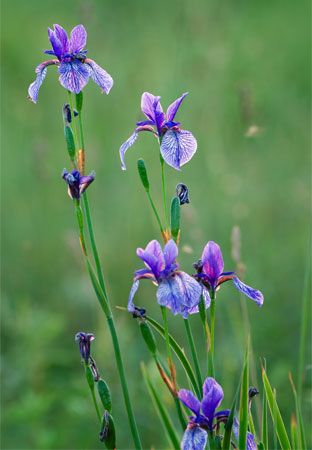
- Iris: This genus includes about 300 species, such as the common bearded iris, the Japanese iris, and the blue flag. Some species are also the source of orrisroot, used in perfumes and soaps.3
- Crocus: Known for both spring and autumn blooms, this genus includes the spring crocus. Notably, the stigmas of Crocus sativus provide saffron, a valuable spice and food coloring.3
- Gladiolus: Featuring about 300 species, these plants are highly popular as cut flowers and garden ornamentals.3
- Sisyrinchium: Commonly known as blue-eyed grasses, these are often used in naturalistic garden settings.3
- Freesia: These plants are grown extensively for the commercial cut-flower market.3
How did the Aztecs use different plants in their daily lives?
The Aztec civilization relied on a diverse array of plants to sustain their dense population and support their daily needs. Their agricultural success was anchored by a staple crop complex, with corn (maize) serving as the primary food source and beans providing essential protein.5
Beyond these staples, the Aztecs cultivated a wide variety of secondary crops, including chili peppers, tomatoes, squashes, sweet potatoes, avocados, and cacao. They also utilized specific plants for materials and medicinal purposes:5
- Fiber and Textiles: Cotton and maguey were vital for weaving textiles. Maguey was particularly versatile; its fermented sap was used to produce pulque, an alcoholic beverage, and its fibers were used for clothing and other household items.5
- Medicine: The Aztecs utilized chili peppers to soothe toothaches.6
- Paper: The amate (paper fig) tree was used to produce paper.5
- Ritual Significance: Plants held deep cultural meaning, with some, such as reeds, serving as symbols in their ritual calendar.7
These resources were managed through intensive farming techniques, most notably the chinampa system, which transformed lake environments into highly productive agricultural land.8910
What is the difference between a bulb and a corm?
While both bulbs and corms are underground storage structures that help plants survive unfavorable conditions, they are botanically distinct.
A bulb is a modified stem consisting of a short base with fleshy, overlapping leaves or leaf bases that store food. If you cut a true bulb in half, you will see these distinct, concentric rings. Common examples include onions, tulips, and lilies.11
A corm is a solid, fleshy, underground stem. Unlike a bulb, it does not have visible rings when sliced. It is covered by a fibrous tunic, and its roots grow from a smooth base called a basal plate. Because they are solid, corms are sometimes referred to as “solid bulbs.” Typical examples include the crocus, gladiolus, and taro.12
In short, while bulbs are composed of layered leaves, corms are solid, swollen stem tissue.1211
Sources
- tiger-flower — Encyclopædia Britannica
- Tigridia — Merriam-Webster
- Iridaceae — Encyclopædia Britannica
- Iridaceae — Merriam-Webster
- Pre-Columbian civilizations - Agriculture — Encyclopædia Britannica
- Pre-Columbian civilizations - Society, culture, and technology — Encyclopædia Britannica
- Aztec - Aztec agriculture — Encyclopædia Britannica
- Chinampa — Encyclopædia Britannica
- Pre-Columbian civilizations - Aztec ritual calendar — Encyclopædia Britannica
- 10 everyday items invented by Indigenous Americans - Pain relievers — Encyclopædia Britannica
- Corm — Encyclopædia Britannica
- Bulb — Encyclopædia Britannica
Published on · 3 min read