Triglav
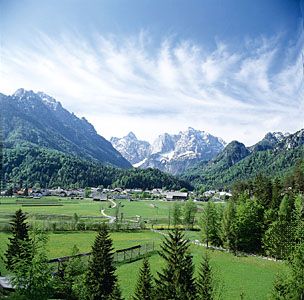
Triglav is the highest mountain peak in Slovenia and the Julian Alps, reaching an elevation of 9,396 feet (2,864 meters). Located 40 miles northwest of…
What is Triglav?
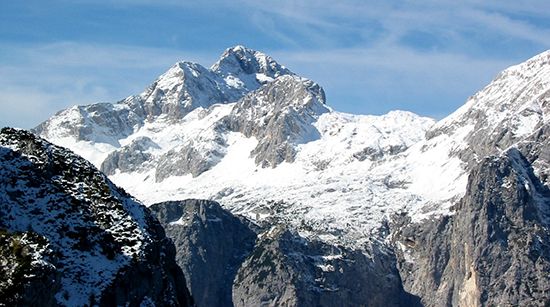
Triglav is the highest mountain peak in Slovenia and the Julian Alps, reaching an elevation of 9,396 feet (2,864 meters). Located 40 miles northwest of Ljubljana, the mountain is renowned for its massive limestone north wall, which spans nearly 2 miles in width.1
Since its first ascent in 1778, the summit has been a popular destination for climbers, offering expansive views that reach into Austria and toward the Adriatic Sea. The surrounding area is protected as Triglav National Park, a region celebrated for its glacial lakes and diverse Alpine flora. Historically, the peak served as a landmark on the Yugoslavian-Italian border until the 1947 Treaty of Paris.1
What makes the Julian Alps unique?
The Julian Alps are a distinct range within the Eastern Alps, characterized by several unique geographical and structural features:
- Composition: The range is composed primarily of limestone, which gives the mountains their rugged appearance, most notably seen in the massive, 2-mile-wide north wall of Triglav, the highest peak in Slovenia.23
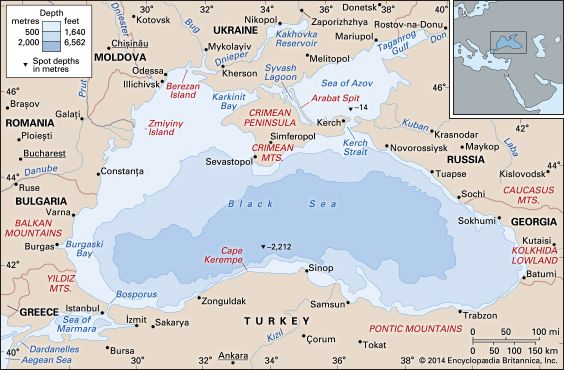
- Watershed Divide: The mountains serve as a critical hydrological boundary, forming part of the divide between the watersheds of the Adriatic Sea and the Black Sea.2
- Location and Extent: Stretching from northeastern Italy to near Ljubljana, the range is bounded by significant river systems, including the Sava River to the north and east.2
- Recreational Significance: The region is well-known for its diverse Alpine flora, numerous glacial lakes, and popular destinations for climbing and winter sports, much of which is protected within Triglav National Park.23
What kind of wildlife lives in Triglav National Park?
Triglav National Park, which encompasses the high-altitude terrain of the Julian Alps, serves as a vital sanctuary for diverse Alpine fauna. Many of these species have adapted to the rugged, craggy landscape through specialized behaviors, such as vertical migration or hibernation.78
Notable wildlife found within the region includes:
- Large Mammals: The ibex and the goatlike chamois are well-known for their agility on steep, rocky slopes. Other significant mammals include the brown bear, the lynx, wild boar, and various deer species, such as roe deer7.719
- Small Mammals: Marmots are common in the park and spend the winter months hibernating in underground galleries. The mountain hare is also present, often changing its coat to white during the winter for camouflage.781
- Birds: The ptarmigan, a type of grouse, is adapted to the cold environment, while the rare bearded vulture (lammergeier) has been a focus of successful reintroduction efforts.71
How do glacial lakes form in mountain regions?
Glacial lakes in mountain regions are primarily formed through the mechanical action of ice, which carves basins into the landscape or creates natural dams that trap water.11
Key Formation Processes
- Cirque Basins: Glaciers often form in amphitheater-shaped hollows at the heads of mountain valleys known as cirques. Through glacial abrasion and plucking, these glaciers scour out deep, circular basins in the bedrock. When the ice retreats, these depressions often fill with water to form small, deep lakes called tarns lakes called tarns.1112
- Valley Scouring: As valley glaciers move, they reshape existing V-shaped river valleys into characteristic U-shaped profiles. By deepening these valleys and scouring the bedrock, glaciers create long, narrow basins that can become lakes once the ice melts.1112
- Morainic Damming: Glaciers transport and deposit moraine—a mixture of sediment and rock—at their margins. These deposits can act as natural dams, blocking valleys or depressions and confining postglacial waters to create lake basins.11
- Ice-Scour and Kettles: In some areas, glaciers scour level surfaces to create shallow rock basins. Additionally, kettle lakes can form when blocks of stagnant ice are buried in glacial drift and subsequently melt, leaving behind a depression.11
Sources
- Triglav — Encyclopædia Britannica
- Alps - Geology — Encyclopædia Britannica
- Alps - Physiography — Encyclopædia Britannica
- Julian Alps — Encyclopædia Britannica
- Alps - Climate of the Alps — Encyclopædia Britannica
- Julian Alps — Merriam-Webster
- Alps - Plant and animal life — Encyclopædia Britannica
- Slovenia - Plant and animal life — Encyclopædia Britannica
- Tundra - Alpine mammals — Encyclopædia Britannica
- Exploring 7 of Earth’s Great Mountain Ranges - Alps — Encyclopædia Britannica
- lake - Basins formed by glaciation — Encyclopædia Britannica
- glacial landform - Cirques , tarns, U-shaped valleys, arêtes, and horns — Encyclopædia Britannica
Published on · 3 min read