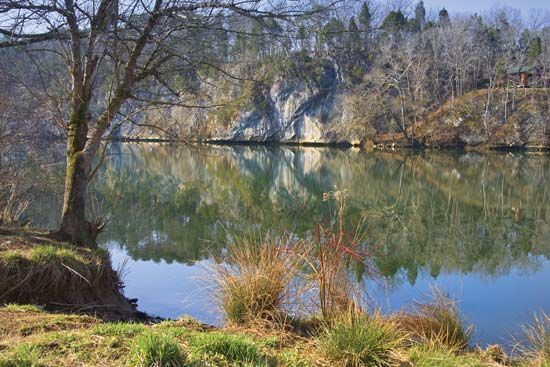
Clinch River
The Clinch River is a 300-mile (480 km) waterway that originates in Tazewell County, southwestern Virginia, and flows generally southwest through the Great…
What is Clinch River?
The Clinch River is a 300-mile (480 km) waterway that originates in Tazewell County, southwestern Virginia, and flows generally southwest through the Great Appalachian Valley into eastern Tennessee.12
As it travels through Tennessee, the river passes through Norris Lake—impounded by the Norris Dam—near its junction with the Powell River. It continues through Watts Bar Lake before eventually joining the Tennessee River. The Clinch River serves as a significant tributary to the Tennessee River and is an integral component of the Tennessee Valley Authority (TVA) system, which manages the region’s water resources for navigation, power generation, and flood control.13
What is the purpose of the Tennessee Valley Authority?
The Tennessee Valley Authority (TVA) was established by the U.S. Congress in 1933 as a public corporation to address the economic and environmental challenges of the Tennessee River basin. Its primary purpose is to manage the region’s natural resources through a unified system of dams and hydroelectric projects.4
The agency’s core objectives include:
- Flood Control: Managing the river system to prevent the severe periodic flooding that historically devastated the region.4
- Navigation: Improving the river channel and installing locks to facilitate commercial transport.4
- Power Generation: Producing and supplying affordable electricity to spur industrial development in a historically depressed economy.4
- Regional Development: Improving living standards for farmers, promoting land conservation, and managing public health initiatives, such as the eradication of malaria.4
By consolidating various government activities under one agency, the TVA transformed the Tennessee River valley into a model for natural-resource planning and regional economic revitalization.4
How do dams affect the local river ecosystem?
Dams significantly alter local river ecosystems by transforming natural flow regimes and physical landscapes. These structures impact the environment in several key ways:
- Disruption of Migratory Species: Dams often block or impede the movement of fish, such as salmon, preventing them from reaching their spawning grounds. While technologies like fish passes (ladders and locks) have been implemented to mitigate these effects, they have not always been sufficient to prevent population declines.56
- Sediment Trapping: Reservoirs act as traps for sediment, preventing it from moving downstream. This leads to the buildup of silt in reservoirs, which reduces their storage capacity, and causes “sediment-starved” water to be released downstream. This released water has renewed erosive power, often leading to the degradation of downstream riverbanks.789
- Habitat Alteration: The creation of reservoirs inundates large areas, destroying terrestrial habitats, cultural homelands, and picturesque landscapes. Conversely, these reservoirs can create new, artificial wetlands that support different aquatic species, though this comes at the cost of the original riverine ecosystem.5108
- Channel Erosion: Below a dam, the change in water flow and sediment load can trigger significant erosion of the stream channel, further altering the local geography and habitat.8
What are the major rivers that feed into the Tennessee River?
The Tennessee River is formed by the confluence of the Holston and French Broad rivers near Knoxville, Tennessee. Throughout its course, it is fed by numerous tributaries that enter from both the north and the south.
The river’s chief tributaries include:
- From the south: The Little Tennessee, Hiwassee, Paint Rock, Duck, and Ocoee (Toccoa) rivers.3
- From the north: The Clinch, Flint, Sequatchie, and Elk rivers.3
These rivers contribute to a vast drainage basin covering approximately 40,910 square miles, ultimately flowing into the Ohio River at Paducah, Kentucky.3
Sources
- Clinch River — Encyclopædia Britannica
- Clinch — Merriam-Webster
- Tennessee River — Encyclopædia Britannica
- Tennessee Valley Authority — Encyclopædia Britannica
- dam - Rise of environmental and economic concerns — Encyclopædia Britannica
- dam - Fish passes — Encyclopædia Britannica
- Why do beavers build dams? — Encyclopædia Britannica
- river - Environments of deposition — Encyclopædia Britannica
- reservoir — Encyclopædia Britannica
- Yangtze River - Human impact on the environment — Encyclopædia Britannica
- Tennessee - Drainage and soils — Encyclopædia Britannica
- Cumberland River — Encyclopædia Britannica
- Caney Fork River — Encyclopædia Britannica
Published on · 3 min read