Floristic Region
A floristic region is one of six major global areas defined by plant geographers based on the presence of distinctive plant life. These regions are often…
What is a floristic region and how does it differ from other ecological classifications?
A floristic region is one of six major global areas defined by plant geographers based on the presence of distinctive plant life. These regions are often grouped with faunal regions as broader biogeographic units, though they are distinct because plants—being less mobile—often reflect more ancient phases of Earth’s history than animal distributions.12
Floristic regions differ from other ecological classifications, such as biomes, in their fundamental criteria:
- Biomes are ecological communities defined by similar climatic conditions, geologic features, and the life strategies of the organisms within them. A single biome, such as a tropical forest, can exist in multiple, disconnected parts of the world, supporting ecologically equivalent species that have adapted to similar environments.3
- Floristic regions are defined by the actual distribution and composition of plant taxa. They serve as a tool for understanding evolutionary history, geologic events like continental drift, and dispersal patterns, rather than just current environmental suitability.132
How are floristic regions determined and what factors influence their boundaries?
Floristic regions are determined by mapping the distribution of plant taxa to identify areas with high levels of endemism—that is, regions that share the fewest taxa with other parts of the world. Boundaries are typically drawn where the outer ranges of many distinct taxa coincide. Because this method assumes that species ranges are stable, researchers also use quantitative approaches, such as Jaccard’s coefficient of biotic similarity, to measure the degree of overlap between different geographic areas.1
Several factors influence these boundaries and the resulting regional classifications:
- Geologic History: Because plants are relatively immobile, their distributions often reflect ancient phases of Earth’s history, including continental drift and the fragmentation of supercontinents like Pangea.35
- Geographic Barriers: Physical obstacles can restrict the dispersal of plant species, leading to the development of unique, isolated floras, such as those found in the Australian or Cape regions.43
- Evolutionary Processes: Regions are used to study how organisms adapt to ecological constraints or respond to random geographic changes over time.3
What are some examples of major floristic regions around the world?
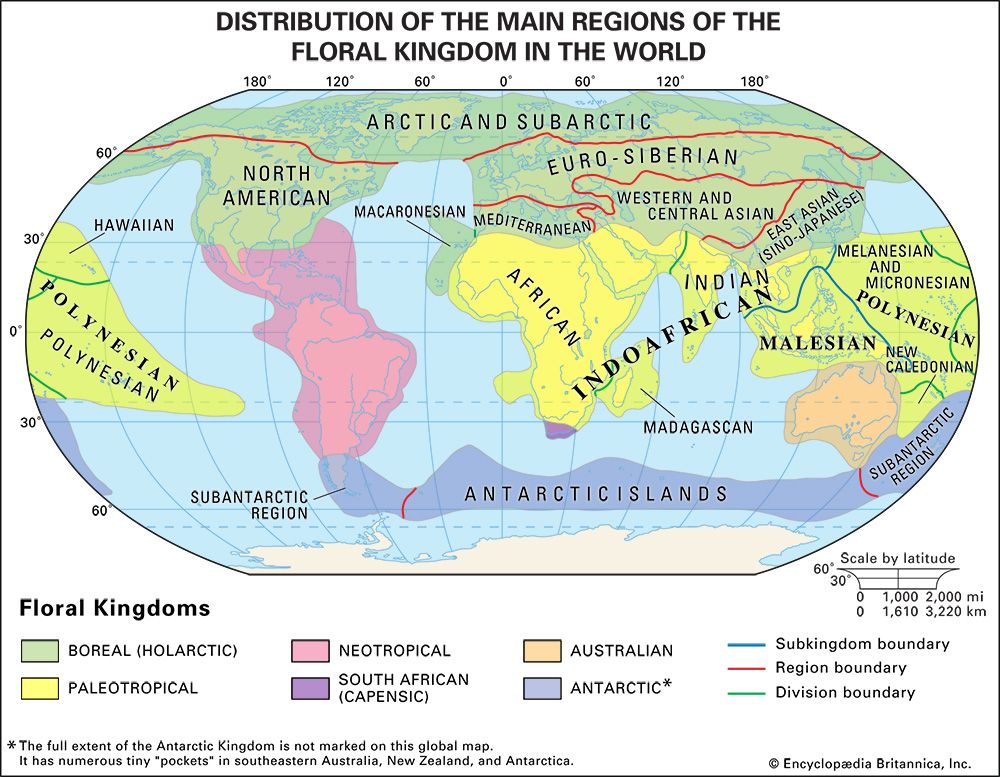
Plant geographers recognize six major floristic regions (or floral kingdoms) globally, each characterized by its unique plant life and evolutionary history. These regions are:19
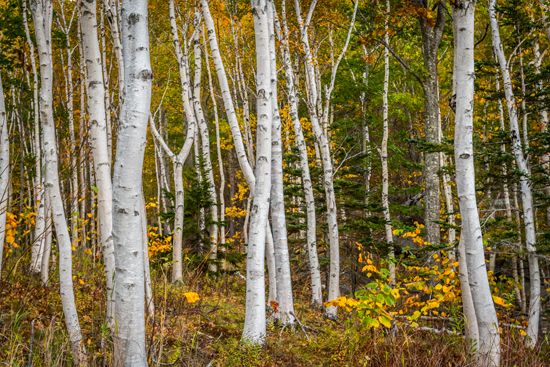
- Boreal (Holarctic) Kingdom: Encompassing North America, Europe, and northern/central Asia, this region represents a vast, historically contiguous landmass. It features widespread temperate families such as Rosaceae (rose) and Betulaceae (birch).16
- Palaeotropical Kingdom: Spanning from Africa through India and Southeast Asia into the Pacific, this diverse region includes subkingdoms like the Indo-Malaysian and Polynesian. It is notable for high levels of island endemism, such as in Hawaii and New Caledonia.110
- Neotropical Kingdom: Covering most of South and Central America, this region ranges from tropical rainforests to savannas. It is home to nearly 3,000 endemic genera, including the Cactaceae (cactus) family.111
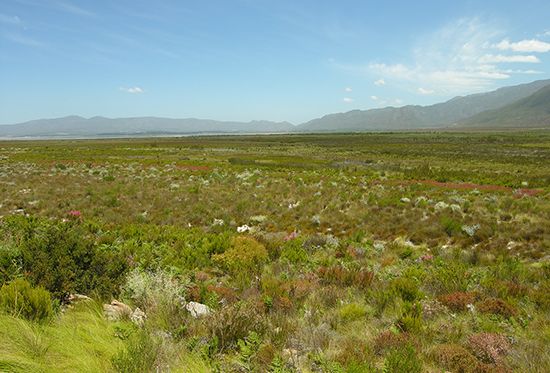
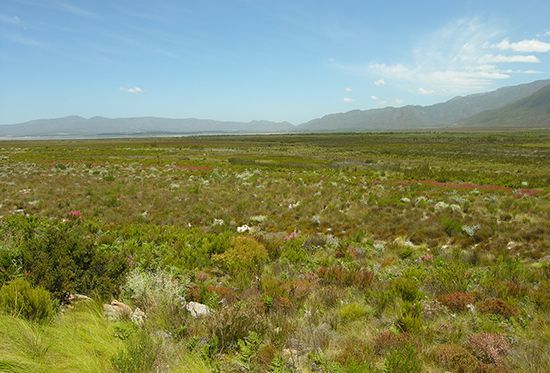
- South African (Capensic) Kingdom: Despite its small size, this region is recognized for its extraordinary floral richness, including the fynbos scrubland, which contains thousands of species found nowhere else.112
- Australian Kingdom: Highly isolated, this region contains a large number of unique plant species that have evolved independently due to long-term geographic separation.1
- Antarctic Kingdom: A distinct unit defined by its unique southern-latitude flora.19
How do floristic regions relate to biodiversity and species distribution?
Floristic regions are essential frameworks for understanding biodiversity and the distribution of plant life. By mapping areas based on their unique plant taxa, scientists can identify regions with high levels of endemism, where a significant portion of species is found nowhere else on Earth. These regions serve as a tool to hypothesize about the evolutionary processes and historical factors that have shaped current biological patterns.1
The relationship between these regions and species distribution is influenced by several key factors:
- Geologic and Evolutionary History: Because plants are relatively immobile, their distribution patterns often reflect ancient phases of Earth’s history, such as the fragmentation of supercontinents. Consequently, major phytogeographic regions often represent older, more stable associations than those seen in zoogeographic realms.1
- Geographic and Ecological Barriers: Physical obstacles, such as mountain ranges or oceans, restrict dispersal and promote allopatric speciation, where populations become genetically isolated and evolve into distinct species.14
- Adaptive Strategies: Distribution is also shaped by ecological constraints. When different taxa exhibit similar distributional patterns, it suggests they have been influenced by the same environmental pressures or climatic corridors.1
While these regions provide a useful outline, they are not absolute; some species possess exceptional dispersal abilities that allow them to “skip” across climatic zones, creating disjunct distributions that remind us of the complexity of biological dispersal.1
Sources
- Floristic region — Encyclopædia Britannica
- botany - Historical background — Encyclopædia Britannica
- biogeographic region — Encyclopædia Britannica
- biogeographic region - The distribution boundaries of flora and fauna — Encyclopædia Britannica
- biogeographic region - Endemism — Encyclopædia Britannica
- biogeographic region - Flora — Encyclopædia Britannica
- plate tectonics - Evidence supporting the hypothesis — Encyclopædia Britannica
- continental drift — Encyclopædia Britannica
- Fynbos — Encyclopædia Britannica
- biogeographic region - Neotropical kingdom — Encyclopædia Britannica
- biogeographic region - Mediterranean region — Encyclopædia Britannica
- biogeographic region - Boreal kingdom — Encyclopædia Britannica
- biogeographic region - Paleotropical kingdom — Encyclopædia Britannica
- Speciation — Encyclopædia Britannica
Published on · 4 min read