Grass Tree
A grass tree refers to any of about 30 species of slow-growing perennial plants belonging to the genus Xanthorrhoea (family Asphodelaceae), which are endemic…
What is Grass tree?
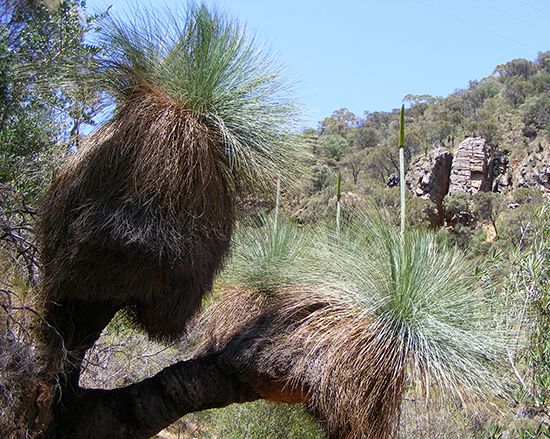
A grass tree refers to any of about 30 species of slow-growing perennial plants belonging to the genus Xanthorrhoea (family Asphodelaceae), which are endemic to Australia.1
These plants are characterized by thick, woody, often palmlike stems that can reach up to 5 metres (16 feet) in height, topped with a tuft of rigid, grasslike leaves. They also produce dense flower spikes that can extend 3 metres or more. Some species are known as “grass gums” because they exude red or yellow resins from the base of old leaves, which are historically used to make varnish.1
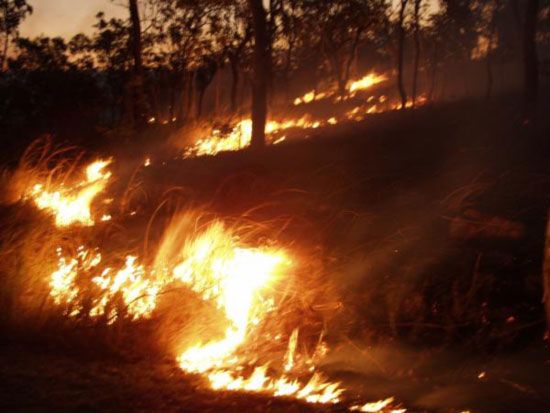
Grass trees are highly adapted to wildfire; they often possess a protective layer of dead leaves around their stems, and many species are stimulated to flower following exposure to fire. In Western Australia, an unrelated plant, Kingia australis, is also sometimes referred to by the name grass tree.1
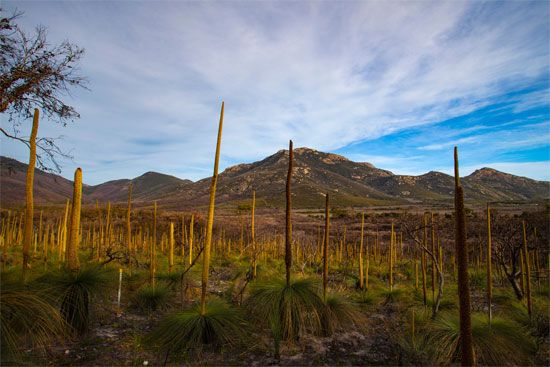
How do grass trees survive and even thrive after wildfires?
Grass trees (Xanthorrhoea) have evolved specialized adaptations that allow them to survive and thrive in fire-prone Australian ecosystems. Their survival and post-fire recovery are primarily driven by two key strategies:
- Thermal Insulation: Grass trees protect their vital internal tissues from the intense heat of a wildfire by retaining a dense, thick layer of dead leaves around their stems. This layer acts as a form of thermal insulation, shielding the plant from flames and high temperatures during a blaze.15
- Prolific Flowering: Fire acts as a powerful environmental trigger for these plants. Many species are stimulated to flower following exposure to fire, often producing conspicuous flower spikes shortly after a burn. This response allows them to take advantage of the nutrient-rich, ash-fertilized soil and reduced competition in the post-fire landscape. In fact, this reaction is so reliable that individuals grown in greenhouses are sometimes subjected to blowtorching to encourage them to bloom.156
What are some other unique plants native to Australia?
Australia is home to a diverse array of unique flora, many of which have evolved specialized characteristics to thrive in the continent’s distinct environments. Beyond the well-known Eucalyptus and Acacia (wattle) genera, several other plants are iconic to the Australian landscape:
- Banksia: These evergreen trees and shrubs of the Proteaceae family are easily recognized by their leathery leaves and distinctive, dense, cylindrical flower heads.48
- Waratah (Telopea speciosissima): Renowned for its showy, crimson flower heads, the waratah is the floral emblem of New South Wales.91011
- Kangaroo Paws (Anigozanthos): These plants, belonging to the Haemodoraceae family, are named for their unique, fuzzy, paw-shaped flowers. The red-and-green kangaroo paw is the floral emblem of Western Australia.410
- Spinifex (Plectrachne and Triodia): These hardy, hummock-forming perennial grasses are widespread across Australian deserts and are essential to the character of the arid landscape.12
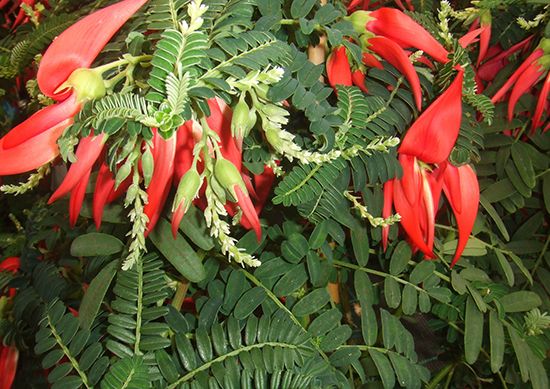
- Sturt’s Desert Pea (Clianthus formosus): A striking, drought-adapted plant known for its vivid red and black flowers, it serves as the floral emblem of South Australia.10
Why are grass trees sometimes referred to as grass gums?
Grass trees, belonging to the genus Xanthorrhoea, are referred to as grass gums because of the distinct red or yellow gumlike resins that exude from the base of their old leaves.14
These resins have historically been utilized in the production of varnish. The botanical name of the genus, Xanthorrhoea, further reflects this characteristic, as it is derived from the Greek words for “yellow” and “flow,” referencing the yellow gum the plants produce.141
Sources
- grass tree — Encyclopædia Britannica
- Poaceae - Characteristic morphological features — Encyclopædia Britannica
- grass tree — Merriam-Webster
- Australia - Plant life — Encyclopædia Britannica
- Plants on Fire - Learn more — Encyclopædia Britannica
- Playing with Wildfire: 5 Amazing Adaptations of Pyrophytic Plants — Encyclopædia Britannica
- Scrubland - Ecological importance of fire to scrubland communities — Encyclopædia Britannica
- eucalyptus — Encyclopædia Britannica
- Desert - Flora — Encyclopædia Britannica
- New South Wales: Country Facts — Encyclopædia Britannica
- Emblems of Australia — Encyclopædia Britannica
- waratah — Merriam-Webster
- banksia — Merriam-Webster
- grass gum — Merriam-Webster
- xanthorrhoea — Merriam-Webster
Published on · 3 min read