Guild
In ecology, a guild is a group of species that exploits the same kinds of resources in comparable ways, regardless of their taxonomic classification. The…
What is an ecological guild and how does it differ from a species?
In ecology, a guild is a group of species that exploits the same kinds of resources in comparable ways, regardless of their taxonomic classification. The term is derived from the concept of craftsmen who use similar techniques to ply their trade; similarly, guild members often employ corresponding methods to forage for food or attract pollinators.12
The primary differences between a guild and a species are:
- Definition: A species is a fundamental unit of biological classification, typically defined by the ability of its members to interbreed. In contrast, a guild is a functional grouping based on resource use and behavior within a community.12
- Composition: While a species represents a single, distinct biological entity, a guild is a collection of multiple species. These species may be closely related through a common ancestor, but guilds can also consist of entirely unrelated organisms.12
- Interaction: Because guild members share resources, they are frequently in direct competition with one another, which helps shape the structure of the community.12
What are some examples of different types of ecological guilds?
Ecological guilds are functional groups of species that utilize similar resources in comparable ways. Because members of a guild perform similar activities, they often compete for the same resources, which helps define the structure of a community.13
Examples of ecological guilds include:
- Nectar-collecting insects: Various insect species that have evolved similar methods to gather nectar from flowers.13
- Insect-foraging birds: Different bird species that employ corresponding techniques to hunt for insects.13
- Pollinator-attracting plants: Diverse plant species that have developed comparable floral shapes to attract the same group of pollinators.13
- Frugivores: Animals, such as certain bats, passerine birds, and fish, that subsist primarily or exclusively on fruit.4
- Insectivores: A wide variety of organisms—including spiders, frogs, lizards, and even insectivorous plants like the Venus flytrap—that rely on insects as a primary food source.2
What role do guilds play in food webs and energy transfer in ecosystems?
In ecology, a guild is defined as a group of species that exploits the same resources in comparable ways, regardless of their taxonomic relationship. While guilds are central to community structure, their primary role is not to dictate the flow of energy itself, but to organize the competitive interactions that occur within food webs.15
Guilds and Community Organization
Energy transfer in an ecosystem is fundamentally driven by trophic levels—producers, consumers, and decomposers—which are interconnected by complex webs of energy flow. Guilds operate within these levels by grouping species that perform similar functional roles, such as nectar-collecting insects or insect-foraging birds.215
Because guild members share the same resources, they often engage in intense competition, especially when those resources are scarce. This competition is a critical non-trophic interaction that, alongside direct consumption, shapes the organization of biological communities. By forming these functional niches, species can coexist in more complex structures, which increases species richness and helps stabilize the community against environmental stress.156
How does competition within a guild affect the survival of its members?
Competition within a guild significantly influences the survival of its members, as species seeking the same resources often face intense pressure when those resources are scarce. According to the principle of competitive exclusion, when two species compete for the same ecological niche, one typically survives while the other is driven to local extinction under specific environmental conditions.17
However, the long-term survival of competing species is often shaped by natural selection, which favors individuals that minimize competition. This leads to several outcomes:
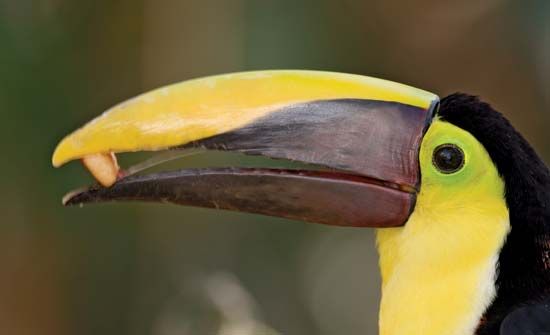
- Character displacement: Species may evolve physical differences, such as variations in bill size or body shape, to exploit slightly different resources and reduce direct competition.8
- Niche divergence: Species may adapt to fill distinct niches within the community, allowing them to coexist.8
- Local extinction: In a specific area, the weaker competitor may be eliminated, though the species may persist regionally across diverse environments.8
Sources
- guild — Encyclopædia Britannica
- community ecology - Guilds and interaction webs — Encyclopædia Britannica
- frugivore — Encyclopædia Britannica
- Did you know? — Merriam-Webster
- Inland water ecosystem - Population and community development and structure — Encyclopædia Britannica
- community ecology - Biodiversity and the stability of communities — Encyclopædia Britannica
- community ecology - The effects of competition — Encyclopædia Britannica
- principle of competitive exclusion — Encyclopædia Britannica
Published on · 3 min read