Humpbacked Fly
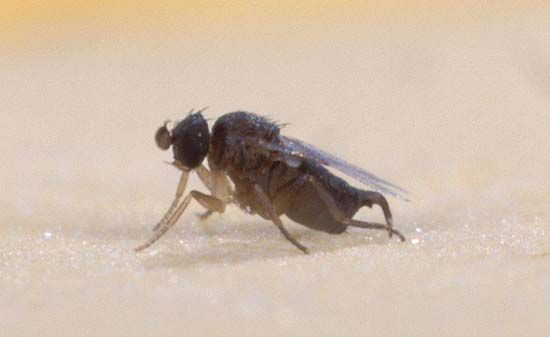
A humpbacked fly is any of numerous species of tiny, dark-colored flies belonging to the family Phoridae within the order Diptera. These insects are…
What is humpbacked fly?
A humpbacked fly is any of numerous species of tiny, dark-colored flies belonging to the family Phoridae within the order Diptera. These insects are characterized by their distinctively humped backs.1
They are frequently found around decaying vegetation, and their larvae may act as scavengers, parasites, or commensals in the nests of ants, termites, wasps, and bees. Some species are known as “coffin flies” because their larvae feed on corpses, including those of humans. Depending on the species, adults may have reduced wings or be entirely wingless.12
Why are some species of Phoridae flies wingless?
In the order Diptera, which includes the family Phoridae, the loss of wings is often an evolutionary adaptation related to specific lifestyles, particularly those involving parasitism or specialized environments.
While many flies are winged, some species—including certain members of the families Hippoboscidae, Streblidae, and Nycteribiidae—have become secondarily wingless. This trait is frequently observed in species that live as ectoparasites on hosts such as mammals or birds. For these insects, the ability to fly is less advantageous than the ability to remain securely attached to a host, where they can feed and reproduce without the need for dispersal through flight.3
Across the broader class of insects, secondary winglessness has evolved independently multiple times. It is often a response to environmental pressures, such as living in confined spaces like termite tunnels or specialized parasitic niches, where wings would be cumbersome or unnecessary.45
How do coffin flies help forensic scientists in investigations?
Coffin flies, which belong to the family Phoridae, are valuable to forensic entomology because their presence and life cycle stages provide critical data for estimating the postmortem interval (PMI).
Forensic entomologists study the succession of insects that inhabit a corpse. Because different species are attracted to a body at specific stages of decomposition—ranging from the newly dead to mummified remains—the presence of coffin fly larvae helps investigators determine how much time has passed since death.8
While many maggots are attracted to decaying organic matter, coffin flies are particularly notable for their ability to access buried or concealed corpses, as their larvae feed on human remains. By analyzing the specific insect populations present, experts can reconstruct the timeline of events, though they must carefully account for environmental variables such as temperature, humidity, and burial conditions to ensure an accurate assessment.198
What are the main differences between scavengers and parasites in the insect world?
In the insect world, the primary distinction between scavengers and parasites lies in their relationship with other organisms and the source of their nutrition.
Scavengers
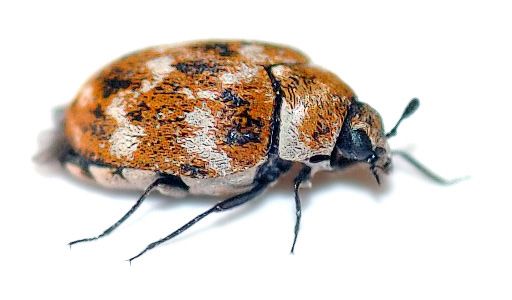
Scavengers are organisms that feed on dead or decaying organic matter, including dead animals, plants, excrement, and other waste products. They play a vital role in ecosystems by breaking down materials and recycling nutrients. Common examples include many Coleoptera (beetles), such as carrion beetles and dermestid beetles, which feed on carcasses or dried animal materials.1011
Parasites
Parasitism is a relationship where one organism benefits at the expense of another, often without immediately killing the host. Insects may be ectoparasites, living on the body surface of a host, or engage in social parasitism, where they depend on the labor of a host species.12
A specialized subset is parasitoidism, where the parasite—typically a wasp or certain flies—always kills the host as the larvae feed on it. Additionally, kleptoparasites steal food or resources from other animals, such as cuckoo bees that lay eggs in the nests of other bees to exploit their stored provisions.1213
Sources
- humpbacked fly — Encyclopædia Britannica
- Diptera - Annotated classification — Encyclopædia Britannica
- heteropteran - Wings — Encyclopædia Britannica
- insect - Annotated classification — Encyclopædia Britannica
- Diptera - General features — Encyclopædia Britannica
- insect - Wings and flight — Encyclopædia Britannica
- insect - Types of metamorphosis — Encyclopædia Britannica
- forensic science - Forensic entomology — Encyclopædia Britannica
- Diptera - Larvae — Encyclopædia Britannica
- Coleoptera - As scavengers — Encyclopædia Britannica
- parasitism — Encyclopædia Britannica
- scavenger — Encyclopædia Britannica
- kleptoparasitism — Encyclopædia Britannica
Published on · 3 min read