Litoptern
Litopterns were not direct ancestors of modern-day mammals; rather, they were a distinct group of extinct hoofed mammals that evolved in isolation in South…
How were litopterns related to modern-day mammals, if at all?
Litopterns were not direct ancestors of modern-day mammals; rather, they were a distinct group of extinct hoofed mammals that evolved in isolation in South America from the Paleocene to the Pleistocene Epochs.1
Their relationship to modern animals is one of convergent evolution rather than direct lineage. Because they developed in a geographically isolated environment, litopterns evolved physical traits that closely paralleled those of unrelated mammals in the Northern Hemisphere. For example:1
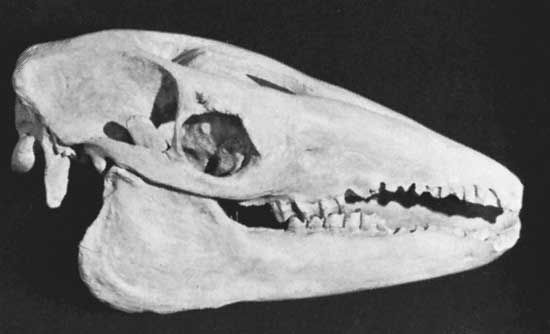
- Proterotheres evolved limbs and teeth that strongly resembled those of horses and deer.1
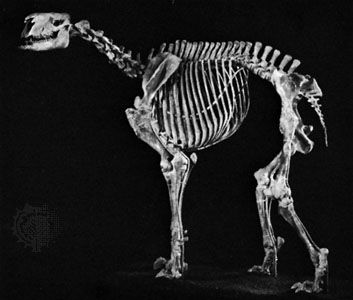
- Macrauchenids developed physical characteristics similar to camels, including a nasal structure that likely supported a short trunk.1
Despite these striking physical similarities, litopterns were not related to these modern groups. They represent a unique evolutionary experiment that ended when the land connection between North and South America allowed more advanced mammals to migrate, eventually leading to the extinction of the litopterns.1
How did the evolution of litopterns contribute to our understanding of convergent evolution?
The evolution of litopterns provides a compelling case study for convergent evolution, a phenomenon where unrelated species develop similar traits due to comparable environmental pressures.1
Because South America was geographically isolated for millions of years, litopterns evolved to fill ecological niches that were occupied by different groups of hoofed mammals in the Northern Hemisphere. This isolation forced them to adapt in ways that mirrored the evolutionary paths of distant relatives:4
- Proterotheres: These animals evolved limbs modified for running and cheek teeth that closely resembled those of horses and deer, despite having no direct ancestral link to them.4
- Macrauchenids: These creatures developed physical characteristics similar to camels, including a unique nasal structure likely supporting a short trunk.4
These parallels demonstrate that when distinct lineages face similar environmental demands, natural selection often drives them toward analogous body plans and functional adaptations. The litoptern fossil record serves as a clear illustration of how nature independently “reinvents” successful biological solutions across different continents.14
What were the key characteristics of litopterns that distinguished them from other mammals?
Litopterns were a unique order of extinct hoofed mammals restricted to South America from the Paleocene Epoch through the Pleistocene Epoch. Their primary distinguishing characteristics were defined by their evolution into two distinct lineages that mirrored the traits of unrelated Northern Hemisphere mammals:1
- Proterotheres: These litopterns were specialized for running. They possessed limbs with unique features for locking their knees, which enabled them to stand for extended periods. Their skulls were long and low, featuring cheek teeth that closely resembled those of deer.1
- Macrauchenids: This group was characterized by a distinct skull structure where the nasal opening was positioned high. This anatomical feature likely supported a short proboscis, or trunk, giving them a physical appearance similar to camels.1
While these traits allowed them to occupy ecological niches similar to horses and camels, they were not related to these modern groups and represent a distinct evolutionary path shaped by South America’s long-term geographic isolation.1
During which geological period did litopterns exist, and when did they go extinct?
Litopterns were an order of extinct hoofed mammals that first appeared during the Paleocene Epoch, which began approximately 65.5 million years ago. They remained a distinct group in South America until their eventual extinction during the Pleistocene Epoch, which concluded about 11,700 years ago.1
The timing of their disappearance varied by lineage:
- Proterotheres: This group became extinct during the Pliocene Epoch (5.3–2.6 million years ago), coinciding with the arrival of true horses in South America.1
- Macrauchenids: These animals were more resilient, surviving the arrival of advanced mammals from North America and persisting until the end of the Pleistocene.1
Sources
- litoptern — Encyclopædia Britannica
- Notoungulata — Encyclopædia Britannica
- artiodactyl - Abundance and distribution — Encyclopædia Britannica
- The rodent that acts like a hippo — Encyclopædia Britannica
Published on · 3 min read