Thylacine
The thylacine (Thylacinus cynocephalus), also known as the Tasmanian tiger, was the largest carnivorous marsupial of recent times. It possessed a slender…
What were the unique physical characteristics of the thylacine?
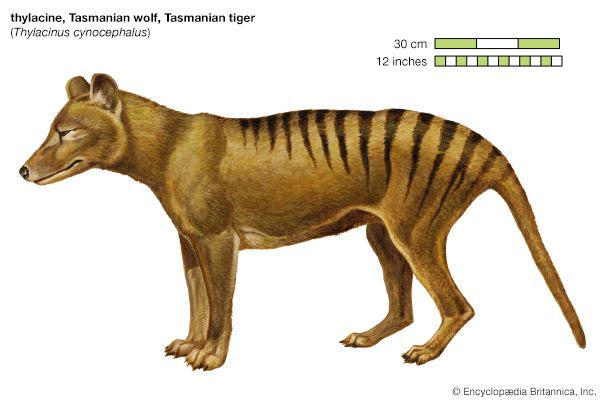
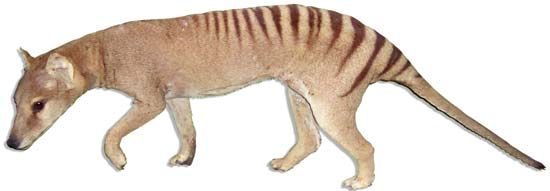
The thylacine (Thylacinus cynocephalus), also known as the Tasmanian tiger, was the largest carnivorous marsupial of recent times. It possessed a slender, fox-like appearance with several distinct physical traits:
- Size and Build: It measured 100 to 130 cm (39 to 51 inches) in length, including its thick, tapering tail, and weighed between 15 and 30 kg (33 to 66 pounds). Its hind legs were notably longer than its forelegs.1
- Coat: The animal had yellowish-brown fur marked by 13 to 19 dark, transverse bars across its back and rump.1
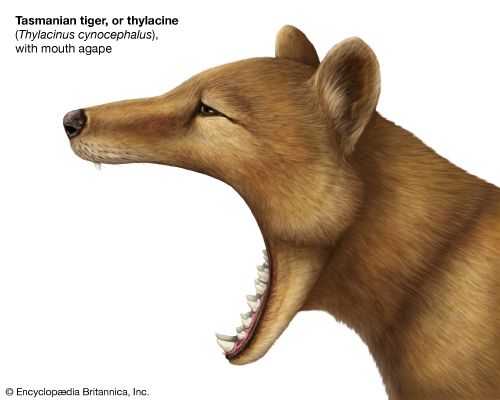
- Skull and Jaws: While its skull resembled that of a dog, it featured a smaller braincase and a remarkable ability to open its jaws to an almost 90-degree gape.1
- Reproduction: As a marsupial, the female carried her young in a shallow pouch that opened toward the rear of her body.1
The species is now considered extinct, with the last known individual dying in 1936.21
How does the thylacine’s extinction relate to other Australian mammal extinctions?
The extinction of the thylacine (Thylacinus cynocephalus) reflects broader patterns of biodiversity loss in Australia, driven by a combination of competition with introduced species and human-led environmental changes.12
Drivers of Extinction
The thylacine’s disappearance from the Australian mainland is attributed to competition with the dingo, an introduced species. Following European settlement, the species faced further pressure in Tasmania due to:13
- Direct Persecution: Settlers hunted the thylacine, viewing it as a threat to introduced domestic sheep.13
- Habitat Alteration: The destruction of natural environments and the introduction of new diseases accelerated its decline.1
Broader Context of Australian Mammal Extinctions
The thylacine is one of many Australian mammals to vanish since European colonization, which has resulted in the world’s highest extinction rate for mammals. Similar to the thylacine, many other native species have suffered from:2
- Invasive Species: Competition with rabbits and predation by red foxes and feral cats have devastated small-to-medium-sized mammal populations.2
- Land Use: The clearing of vegetation for pastures and crops, alongside altered fire regimes, has fragmented habitats and reduced the ranges of numerous species.42
These human-induced factors mirror the pressures that led to the loss of Australia’s prehistoric megafauna, where a combination of environmental stress and human activity likely played a role.45
What conservation lessons have been learned from the thylacine’s extinction?
The extinction of the thylacine serves as a sobering case study in conservation biology, highlighting the catastrophic impact of human intervention on vulnerable species. Several critical lessons have emerged from its loss:
- The Danger of Persecution: The thylacine’s decline was accelerated by widespread hunting based on the perception that it threatened domestic sheep. This underscores the ethical necessity of basing wildlife management on scientific evidence rather than fear or economic bias.
- Impact of Invasive Species: Competition with the dingo on the Australian mainland and the introduction of new diseases demonstrate how non-native species can destabilize ecosystems and displace indigenous predators.
- Habitat Preservation: The destruction of natural environments was a primary driver of the species’ collapse. Protecting intact habitats is essential to preventing the extinction of specialized animals.
- Proactive Monitoring: The thylacine was already rare by 1914, yet protective measures were insufficient. This highlights the importance of early intervention and continuous population monitoring to prevent irreversible loss.
Today, these lessons inform modern efforts, including de-extinction research, which seeks to use DNA sequencing to potentially restore lost biodiversity.12
How did the thylacine’s behavior and hunting habits compare to other marsupial predators?
The thylacine (Thylacinus cynocephalus) was the largest carnivorous marsupial of recent times, distinguished by its nocturnal hunting habits and unique physical adaptations.12
Behavior and Hunting Habits
The thylacine was a slender, fox-faced predator that hunted at night for wallabies, birds, and small rodents. Anatomically, it possessed a skull remarkably similar to that of a dog, though it featured a smaller braincase and jaws capable of an enormous, almost 90-degree gape.12
Comparison to Other Marsupial Predators
While the thylacine is the most well-known modern example, the fossil record reveals other specialized marsupial predators that occupied different ecological niches:
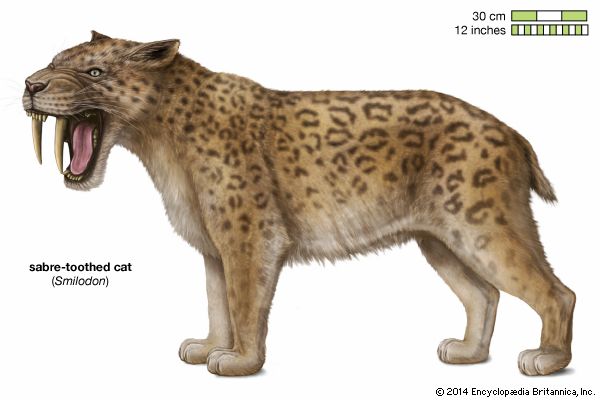
- Thylacosmilus: Found in South America, this extinct genus lived approximately 10 to 3 million years ago. Unlike the thylacine, Thylacosmilus was a sabre-toothed predator roughly the size of a jaguar.7
- Convergent Evolution: Thylacosmilus exhibited a remarkable degree of parallel evolution with sabre-toothed cats, using long, powerful canine teeth to stab prey, a hunting strategy distinct from the thylacine’s more generalized approach.7
The thylacine remains the sole modern representative of the family Thylacinidae, representing a unique evolutionary path among marsupials.2
Sources
- thylacine: Top Questions — Encyclopædia Britannica
- thylacine — Encyclopædia Britannica
- Australia - Animal life — Encyclopædia Britannica
- conservation - Australian mammals — Encyclopædia Britannica
- Pleistocene Epoch - Megafaunal extinctions — Encyclopædia Britannica
- extinction — Encyclopædia Britannica
- Thylacosmilus — Encyclopædia Britannica
Published on · 4 min read