What’s the Difference Between Monkeys and Apes?
While both monkeys and apes are primates, they possess distinct physical and cognitive differences.
What’s the Difference Between Monkeys and Apes?
While both monkeys and apes are primates, they possess distinct physical and cognitive differences.
The most reliable way to distinguish them is by the tail: almost all monkeys have tails, whereas apes do not. Anatomically, monkeys are generally smaller with narrow chests, while apes have broad chests and shoulder joints that facilitate swinging through trees. Additionally, apes possess an appendix, a feature absent in monkeys.123
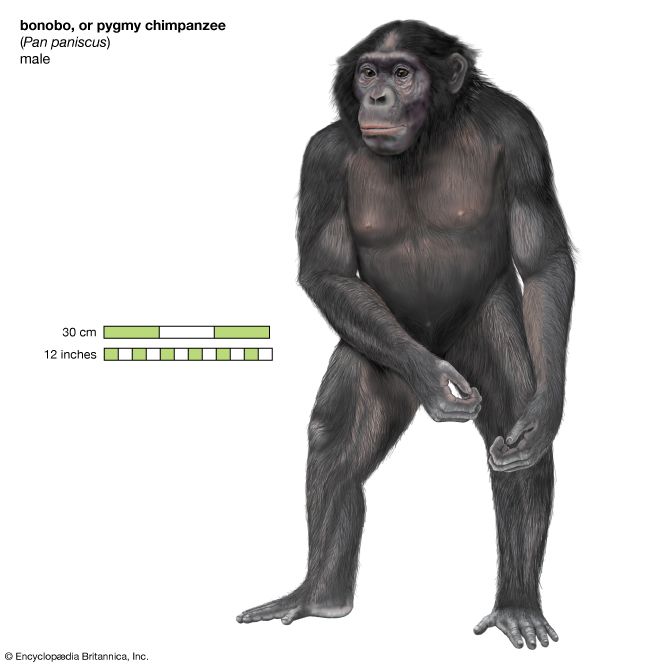
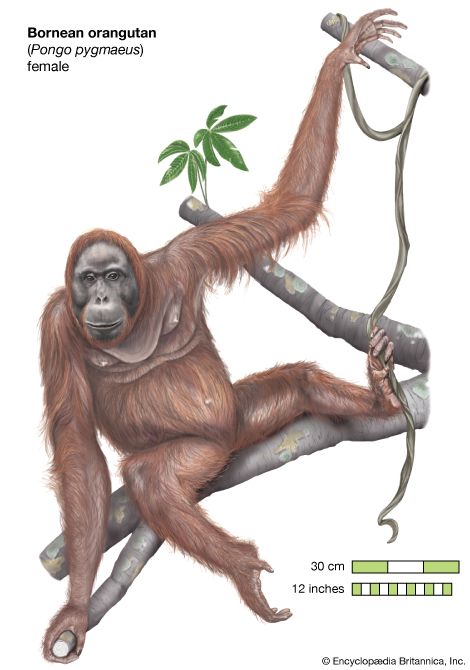
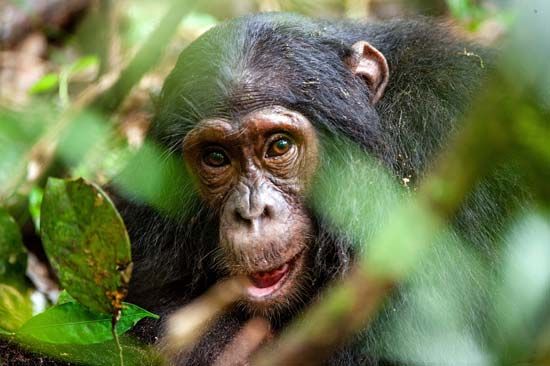
Cognitively, apes are generally more intelligent, often demonstrating the ability to use tools, reason abstractly, and learn quasi-linguistic communication. While monkeys are highly social and capable of solving problems, they typically do not reach the same cognitive levels as the great apes (gorillas, chimpanzees, bonobos, and orangutans).132
A simple rule of thumb is to consider the species: if the primate is not a human, gibbon, chimpanzee, bonobo, orangutan, or gorilla, it is almost certainly a monkey.1
What are the main differences between great apes and lesser apes?
The superfamily Hominoidea is divided into two distinct families: the great apes (Hominidae) and the lesser apes (Hylobatidae, or gibbons). These groups diverged approximately 18 million years ago.34
Key Differences
- Classification and Membership: The family Hominidae includes humans, gorillas, chimpanzees, bonobos, and orangutans. The family Hylobatidae consists of approximately 20 species of gibbons.345
- Cognitive Ability: Great apes exhibit higher cognitive functions, including the ability to reason abstractly, learn quasi-linguistic communication, and recognize themselves in mirrors—a trait not observed in gibbons.35
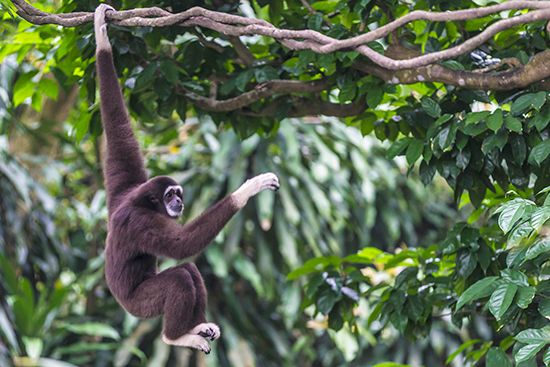
- Physical Characteristics: While both groups lack tails and possess humanlike builds, gibbons are smaller and have distinct physical adaptations, such as longer arms for brachiation (swinging from branches) and a throat sac used for loud, musical vocalizations.35
- Behavior and Social Structure: Great apes vary in their locomotion, with some spending significant time on the ground, whereas gibbons are strictly arboreal. Gibbons typically live in small, monogamous family groups, while some great apes, like chimpanzees, live in much larger, complex social bands.35
How do scientists classify humans within the primate family tree?
Scientists classify humans within the primate family tree by placing them in the suborder Haplorrhini, which also includes monkeys and other apes. Within this suborder, humans are categorized as catarrhines and belong to the superfamily Hominoidea.7
Specifically, humans are members of the family Hominidae, which includes all great apes—orangutans, gorillas, chimpanzees, and bonobos. Within this family, humans are placed in the subfamily [Homininae]. Most modern taxonomists further classify humans into the “tribe” Hominini, a group that encompasses modern human beings (Homo sapiens) and their extinct ancestors, such as Australopithecus and other species of Homo.389
This classification reflects the close evolutionary relationship between humans and African great apes, particularly chimpanzees and bonobos, with whom humans share a more recent common ancestor than with gorillas or orangutans. Distinguishing characteristics of the human lineage, or hominins, include bipedal locomotion, an erect posture, larger brain size, and the development of complex behaviors like tool use and language.9810
What is knuckle-walking and which apes use this method of movement?
Knuckle-walking is a specialized form of quadrupedal locomotion in which an animal supports its upper body weight on its knuckles rather than its palms. This gait is primarily utilized by chimpanzees and gorillas, who are considered the primary knuckle-walking apes.11
While these apes are capable of other forms of movement—including climbing, brachiation, and short periods of bipedalism—knuckle-walking serves as their primary mode of terrestrial travel. The anatomy of these apes, characterized by long arms and flexible wrists, is often associated with this locomotor style, though some researchers argue these features may have evolved from a brachiating ancestor or were influenced by feeding behaviors.1112
The evolutionary significance of this gait remains a subject of scientific debate. Some evidence suggests that the human lineage may have evolved from a knuckle-walking ancestor, a theory supported by studies of human-ape affinities and claims that the wrist anatomy of early hominins like Australopithecus contains remnants of knuckle-walking adaptations.1314
Sources
- What’s the Difference Between Monkeys and Apes? — Encyclopædia Britannica
- monkey — Encyclopædia Britannica
- ape — Encyclopædia Britannica
- great ape — Merriam-Webster
- gibbon — Encyclopædia Britannica
- Hominoidea — Encyclopædia Britannica
- hominin — Encyclopædia Britannica
- primate - Classification — Encyclopædia Britannica
- Hominidae — Encyclopædia Britannica
- Tertiary Period - Primates — Encyclopædia Britannica
- bipedalism — Encyclopædia Britannica
- primate - Four types of locomotion — Encyclopædia Britannica
- brachiation — Encyclopædia Britannica
- primate - Bipedalism — Encyclopædia Britannica
Published on · 3 min read