Wrenthrush
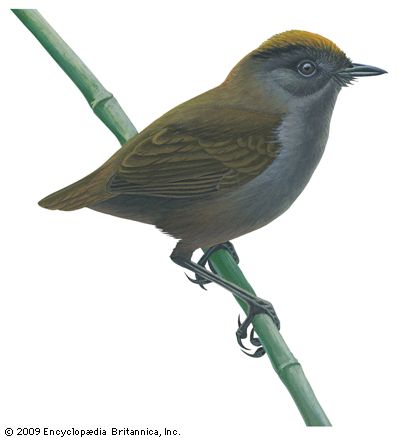
The wrenthrush (Zeledonia coronata) is a small bird, measuring approximately 11 cm (4.5 inches), native to the rain forests of Costa Rica and Panama.
What is Wrenthrush?
The wrenthrush (Zeledonia coronata) is a small bird, measuring approximately 11 cm (4.5 inches), native to the rain forests of Costa Rica and Panama.1
It is characterized by a brownish, short-tailed appearance and a habit of skulking in the undergrowth, which gives it a resemblance to the wren. Despite its name, it possesses a beak and leg structure similar to a thrush. While it was historically classified as a chat-thrush within the family Turdidae, it is currently considered more closely related to the wood-warbler group (Parulidae). Some researchers choose to categorize it provisionally in its own family, Zeledoniidae.1
What makes the wrenthrush’s classification so difficult for scientists?
The classification of the wrenthrush (Zeledonia coronata) is challenging for scientists because the bird exhibits a mosaic of physical traits that align with different avian families, leading to conflicting taxonomic interpretations.1
The difficulty arises from the following factors:
- Conflicting Morphology: While the bird’s overall size, brownish plumage, and short-tailed appearance resemble those of a wren, its beak and leg structure are distinctly thrushlike.1
- Historical vs. Modern Placement: It was historically grouped with the chat-thrush within the family Turdidae. However, modern analysis suggests it is more closely related to the wood-warbler group (Parulidae).1
- Taxonomic Ambiguity: Due to these overlapping characteristics, some researchers find it difficult to place the species definitively within existing families, leading them to provisionally categorize it in its own unique family, Zeledoniidae.1
Because of these resemblances, the wrenthrush is often cited as an example of an unrelated bird that has been labeled a “thrush” primarily due to superficial physical similarities to true turdids.2
How do wood-warblers differ from the thrush family?
Wood-warblers (family Parulidae) and thrushes (family Turdidae) are distinct groups of songbirds that differ in their physical characteristics, evolutionary relationships, and geographic distribution.
Key Differences
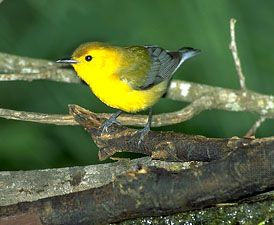
- Family and Classification: Wood-warblers belong to the family Parulidae, which is more closely related to New World tanagers. In contrast, true thrushes belong to the family Turdidae, which is closely related to Old World warblers and flycatchers.
- Physical Appearance: Thrushes are generally larger, ranging from 11.5 to 33 cm (4.5 to 13 inches) in length, and possess “booted” tarsi (the lower leg is covered by a single long scale). Wood-warblers are smaller, typically reaching up to 18 cm (7 inches), and are often more brightly colored than many thrush species.
- Geographic Range: Thrushes are found virtually worldwide, with the greatest diversity in the Old World, particularly Africa. Wood-warblers are primarily native to North and Central America.
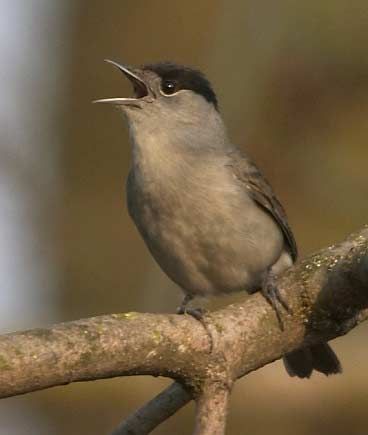
- Taxonomic Confusion: The term “warbler” is applied to two different groups: the Old World warblers (Sylviidae) and the New World wood-warblers (Parulidae). The latter were named for their superficial resemblance to the former, despite being distantly related. Similarly, many birds are incorrectly called “thrushes” due to physical similarities to the Turdidae family, such as the wrenthrush.
What other unique bird species are found in the rain forests of Costa Rica and Panama?
The rain forests of Costa Rica and Panama serve as a critical land bridge, resulting in an exceptionally high diversity of bird species that include both resident populations and migratory visitors.67
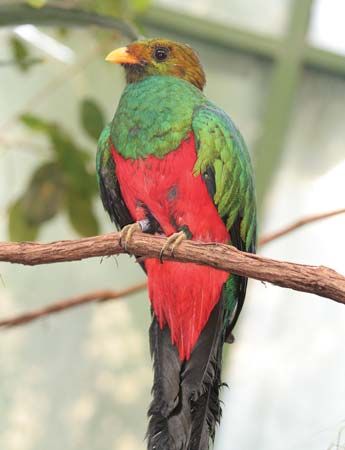
Among the most iconic birds found in these regions are the quetzals. Specifically, the resplendent quetzal and the golden-headed quetzal are the only species of this genus found in Central America. These birds are noted for their striking appearance; for instance, the male resplendent quetzal can possess tail feathers reaching up to 90 cm (35 inches) in length.8
Beyond these, the region is home to a vast array of tropical birds, though specific species lists are extensive due to the area’s role as a biological crossroads. The lush habitats, such as those protected within the Darién region and the Talamanca Range–La Amistad transboundary site, provide essential refuge for this rich avian life.67
Sources
- Wrenthrush — Encyclopædia Britannica
- Thrush — Encyclopædia Britannica
- Warbler — Encyclopædia Britannica
- Turdidae — Encyclopædia Britannica
- Piciform - Annotated classification — Encyclopædia Britannica
- Quetzal — Encyclopædia Britannica
- Panama - Plant and animal life — Encyclopædia Britannica
- Costa Rica - Plant and animal life — Encyclopædia Britannica
- Ecuador - Plant and animal life — Encyclopædia Britannica
Published on · 3 min read