Cusk
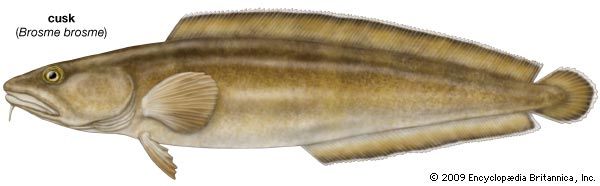
The cusk (Brosme brosme) is a long-bodied, edible fish belonging to the cod family, Gadidae.
What is cusk?
The cusk (Brosme brosme) is a long-bodied, edible fish belonging to the cod family, Gadidae.12
Found along the ocean floor in deep offshore waters on both sides of the North Atlantic, the cusk is characterized by its small scales, large mouth, and a single barbel on its chin. Physically, it features one long dorsal fin and one long anal fin, both of which connect at the base to a rounded tail. These fish typically reach lengths of 90 to 110 cm (3 to 3.5 feet) and exhibit coloration ranging from yellowish or brownish to a slaty hue, with younger specimens sometimes displaying vertical yellow bars. In some contexts, the term is also used to refer to the [burbot]2.1
What are other common fish in the cod family?
The family Gadidae, often referred to as gadids, includes several economically important marine fishes. Beyond the cusk, common members of this family include:34
- Cod (Gadus): This genus includes the Atlantic cod, a cold-water fish known for its three dorsal fins and chin barbel. Other notable species include the Pacific cod (G. macrocephalus) and the Greenland cod (G. ogac), which are similar in appearance.5
- Pollock: The Alaska pollock (G. chalcogrammus), also known as the walleye pollock, is a significant bottom-dwelling species found in the North Pacific, particularly in the Bering Sea.5
- Hake (Merluccius): These are elongated, large-headed, carnivorous fishes. While sometimes classified in their own family (Merlucciidae) due to skeletal differences, they are traditionally associated with the cod family. Species include the European hake, the silver hake, and the South African stockfish.6
- Related Hake-like species (Urophycis): In North America, the name hake is also applied to species such as the white hake and red hake, which are distinguished from Merluccius by a small chin barbel.6
How do deep-sea fish adapt to life on the ocean floor?
Deep-sea fish have evolved specialized physical and behavioral traits to survive the extreme conditions of the ocean floor, including high hydrostatic pressure, near-freezing temperatures, darkness, and limited food availability.78
Physical Adaptations
- Pressure Resistance: To survive the immense pressure of the deep ocean, these fish lack air-filled compartments such as lungs or swim bladders, which would otherwise compress or collapse. Their internal body pressures are equal to the external environment.9108
- Reduced Energy Needs: Many deep-sea species have reduced skeletons and muscles, often appearing gelatinous. This low-energy body structure allows them to survive in food-poor environments.1110
- Sensory and Morphological Changes: Bottom-dwelling (benthic) fish typically have smaller eyes and smaller, down-turned mouths compared to mid-water species. Some species are blind, and many are gray or black in color. To navigate the soft sediment of the ocean floor, some mobile forms have developed long legs, while others are attached to the bottom by stalks to elevate themselves above the oxygen-poor water layer nearest the seafloor.78
Behavioral Adaptations
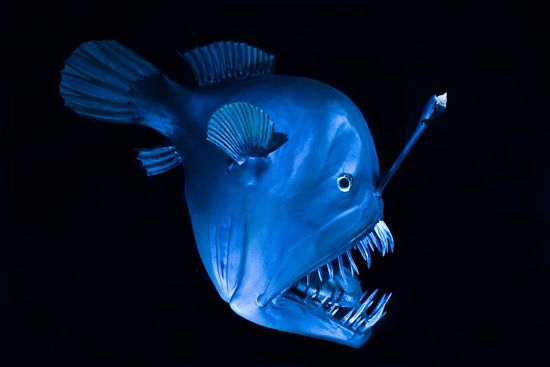
- Feeding Strategies: Because primary food production is limited to the sunlit surface, deep-sea fish are often specialized carnivores or scavengers. Some species, such as anglerfishes, use a modified dorsal fin spine as a luminous lure to attract prey.118127
- Bioluminescence: While many bottom-dwellers lack light organs, others use bioluminescence for species recognition, mating signals, or to attract prey in the darkness.127
What is a burbot and how is it related to the cusk?
The burbot (Lota lota) is an elongated, bottom-dwelling fish found in the cold rivers and lakes of North America, Europe, and Asia. It is characterized by its mottled greenish or brown skin, a single chin barbel, two dorsal fins, and a long anal fin. While it can reach lengths of up to 1.5 meters, its classification is a subject of scientific debate; some taxonomists place it within the subfamily Lotinae of the cod family, Gadidae.13
The relationship between the burbot and the cusk is primarily linguistic and taxonomic. In some contexts, the term “cusk” is used as a common name for the burbot itself, and the burbot is also frequently referred to as a “freshwater cusk” or “freshwater cod”. Taxonomically, both are associated with the cod family, Gadidae, reflecting their shared biological characteristics as members of this group.21413
Sources
- cusk — Encyclopædia Britannica
- cusk — Merriam-Webster
- cod — Encyclopædia Britannica
- gadid — Merriam-Webster
- hake — Encyclopædia Britannica
- gadid — Merriam-Webster
- Bioluminescence - The role of bioluminescence in behavior — Encyclopædia Britannica
- deep-sea fish — Encyclopædia Britannica
- protacanthopterygian - Ecology — Encyclopædia Britannica
- Biosphere - Hydrostatic pressure — Encyclopædia Britannica
- abyssal zone — Encyclopædia Britannica
- atheriniform - Form and function — Encyclopædia Britannica
- burbot — Encyclopædia Britannica
- freshwater cod — Merriam-Webster
Published on · 3 min read