Ehringsdorf Remains
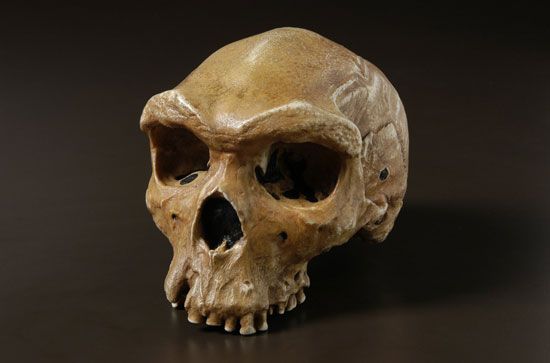
The Ehringsdorf remains are human fossils discovered between 1908 and 1925 near Weimar, Germany. These fossils, which have been dated to approximately…
What is Ehringsdorf remains?
The Ehringsdorf remains are human fossils discovered between 1908 and 1925 near Weimar, Germany1. These fossils, which have been dated to approximately 200,000 years ago, include a fragmented braincase and lower jaw of an adult, as well as the jaw, trunk, and arm bones of a child.1
The remains are typically classified as early Neanderthal due to specific anatomical characteristics, such as a long, low braincase, prominent browridges, and a robust lower jaw that lacks a chin. These fossils were found in association with fossil remains of animals like elephants, rhinoceroses, horses, and bovid species, as well as Acheulean and pre-Mousterian artifacts. While they share many traits with Neanderthals, they also exhibit some more-archaic features.12
What are the primary physical characteristics of Neanderthals?
Neanderthals possessed a unique set of physical characteristics that distinguished them from modern humans, largely reflecting adaptations to cold environments and a robust lifestyle.345
Craniofacial Features
Neanderthal skulls were typically low-vaulted with a large, rounded braincase that was similar in capacity to, or larger than, that of modern humans. Key facial traits included:35
- Brow Ridges: Prominent, arched brow ridges.35
- Midface: A large, projecting midface featuring expansive nasal and orbital openings.35
- Jaw: A robustly built lower jaw that lacked a chin and featured a receding profile.3
- Teeth: Larger front teeth compared to modern humans, often showing significant wear in older individuals.36
Body Proportions and Build
Neanderthals were generally stocky and cold-adapted, with a broad chest and massive, heavily muscled limbs. Their body proportions typically included relatively short lower extremities compared to their upper arms and legs, a build that helped protect against cold stress. Their skeletons also show evidence of high physical stress, including stout limb bones with strongly marked muscle attachments and, in some cases, less lumbar lordosis (back curvature) than modern humans.453
How do scientists determine the age of ancient fossils?
Scientists determine the age of ancient fossils and geological materials using a combination of relative and absolute dating methods.
Relative Dating
Relative dating establishes the chronological order of events without providing a specific numerical age. The primary technique is stratigraphy, which relies on the law of superposition: in undisturbed deposits, older layers are located beneath younger ones. Archaeologists also use cross-dating, where an undated site is assigned an age based on the presence of artifacts from a culture with a known chronology.89
Absolute Dating
Absolute dating provides specific numerical ages, primarily through radiometric dating, which measures the decay of radioactive isotopes into stable daughter elements. Key methods include:1011
- Carbon-14 dating: Used for organic materials (like bone or wood) up to approximately 50,000 years old by measuring the decay of radiocarbon.129
- Potassium-argon dating: Measures the decay of potassium-40 to argon-40 in volcanic rocks, allowing scientists to date materials millions of years old.139
- Uranium-series dating: Useful for dating carbonate deposits like coral or cave formations.14
Other techniques include dendrochronology (tree-ring counting) and the analysis of fluorine content in bones to detect intrusions in archaeological layers.9
What other early human species lived in Europe?
Beyond the well-known Neanderthals, several other early human species inhabited Europe, though the fossil record remains complex and subject to ongoing scientific debate.
- Homo heidelbergensis: Appearing in Europe by approximately 500,000 years ago, this species is often considered a common ancestor to both Neanderthals and modern humans. Notable specimens include the Heidelberg jaw found in Germany and fossils from sites like Petralona in Greece and Arago in France.1516
- Homo erectus: Evidence for H. erectus in Europe is debated, but some researchers classify specimens like the Mauer mandible and the skull from Ceprano, Italy, within this species. Additionally, fossils found at Dmanisi in Georgia, dated to 1.7 million years ago, are among the oldest hominin remains found outside of Africa and are frequently likened to H. erectus.1716
- Homo antecessor: Known from the fossil record starting around 800,000 years ago, this species represents another early hominin presence in Europe.16
These species reflect a long history of hominin dispersal into the continent, preceding the arrival of Homo sapiens approximately 45,000 to 43,000 years ago.616
Sources
- Ehringsdorf remains — Encyclopædia Britannica
- Ehringsdorf man — Merriam-Webster
- Neanderthal - Craniofacial features — Encyclopædia Britannica
- Neanderthal - Body proportions and cold stress — Encyclopædia Britannica
- La Chapelle-aux-Saints — Encyclopædia Britannica
- Homo sapiens - Bodily structure — Encyclopædia Britannica
- Gibraltar remains — Encyclopædia Britannica
- potassium-argon dating — Encyclopædia Britannica
- dating: Top Questions — Encyclopædia Britannica
- stratigraphy — Encyclopædia Britannica
- carbon-14 dating — Encyclopædia Britannica
- Did you know? — Merriam-Webster
- Archaeology - Dating — Encyclopædia Britannica
- dating - Origin of radioactive elements used — Encyclopædia Britannica
- Neanderthal - First discoveries — Encyclopædia Britannica
- Homo erectus - European fossils — Encyclopædia Britannica
- history of Europe - Earliest developments — Encyclopædia Britannica
- Homo heidelbergensis — Encyclopædia Britannica
- Europe - People of Europe — Encyclopædia Britannica
- Stone Age - Mesolithic — Encyclopædia Britannica
- Homo sapiens - The genus Homo — Encyclopædia Britannica
Published on · 3 min read