Harebell
The harebell (Campanula rotundifolia) is a slender-stemmed perennial plant belonging to the Campanulaceae family. It is widely recognized for its delicate…
What is Harebell?
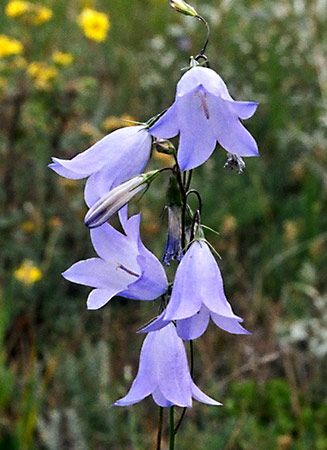
The harebell (Campanula rotundifolia) is a slender-stemmed perennial plant belonging to the Campanulaceae family. It is widely recognized for its delicate, nodding, blue-violet bell-shaped flowers.12
Native to meadows, woods, and cliffsides across North America and Eurasia, the plant typically grows in clumps reaching heights of 30 to 60 centimeters (1 to 2 feet). A notable characteristic of the harebell is that its small, round basal leaves often disappear by the time the flowers bloom, leaving only the long, slender leaves attached to the stem. There are more than 30 named wild varieties of this species.1
What other plants belong to the Campanulaceae family?
The Campanulaceae family, commonly known as the bellflower family, comprises approximately 84 genera and 2,400 species of mostly herbaceous plants. While the genus Campanula is the most well-known, the family includes a diverse range of other plants:3
- Adenophora (Ladybell): Similar to Campanula, these plants feature a cuplike disk at the base of the style.3
- Canarina (Canarian bellflower): Notable for producing berries rather than capsules and having six-lobed flowers.3
- Codonopsis (Bonnet bellflower): A genus of sprawling perennials with pendent, bell-shaped flowers.3
- Cyananthus (Trailing bellflower): Mat-forming perennials characterized by having a superior ovary.3
- Edraianthus (Grassy bellflower): Low-growing perennials with grassy leaves and clustered, upward-facing bells.3
- Michauxia (Dart bellflower): Distinguished by 7 to 10 deep-parted lobes and a dartlike central column.3
- Ostrowskia (Giant bellflower): A fleshy-rooted perennial that can grow up to 2.5 meters tall.3
- Symphyandra (Ring bellflower): Named for its joined ring of anthers.3
- Lobelioideae (Subfamily): Formerly the family Lobeliaceae, this group includes the large genus Lobelia, as well as Siphocampylus, Centropogon, and Burmeistera.3
How do perennial plants survive through the winter?
Perennial plants survive winter by adapting their growth cycles to seasonal changes, often triggered by shortening day lengths or decreasing temperatures. These survival strategies vary by plant type:7
- Woody Plants: Trees and shrubs typically cease growth and form resting buds before winter. These buds contain a short stem axis protected by modified leaves, which help the plant resist frost and prevent drying. Many deciduous trees shed their leaves to reduce water loss and energy expenditure.7
- Herbaceous Perennials: In cold climates, these plants often allow their aboveground parts to die back in autumn. They survive by maintaining protected organs at or below the soil surface, utilizing specialized structures such as bulbs, corms, tubers, or rhizomes8.78
- Evergreens: Unlike deciduous plants, evergreens retain their foliage year-round. Their leaves are often thicker, leathery, or needlelike, which helps them resist water loss during harsh conditions.9
These developmental shifts are regulated by internal hormonal changes, including the role of abscisic acid in inducing dormancy.7
What pollinators are attracted to bell-shaped flowers?
Pollinators attracted to bell-shaped flowers vary depending on the specific plant species and its evolutionary adaptations. Because bell-shaped flowers often hide nectar within their corollas, they frequently rely on pollinators with specialized mouthparts or behaviors to reach their rewards.
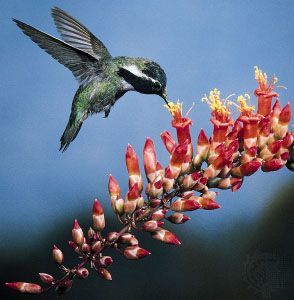
- Birds: Many members of the Campanulaceae family, particularly tropical lobelioids like Centropogon and Siphocampylus, have evolved bright red, yellow, or orange flowers with curved tubes that match the bills of hummingbirds. Similarly, Hawaiian species of Clermontia are adapted to the bills of honeycreepers. Bird-pollinated flowers are generally tubular, produce copious nectar, and lack a strong scent.101112
- Bees: Bees are significant pollinators for a wide variety of bell-shaped flowers. Melittophilous (bee-pollinated) flowers often feature bright colors like yellow or blue, provide a landing platform, and may include nectar guides to direct the insect toward the nectar.13
- Other Insects: While some primitive flowers use traps to capture beetles or flies, more advanced bell-shaped flowers typically offer nectar as a reward to attract insects with sucking mouthparts, such as moths or butterflies, which can reach deep into the floral tube.514
Sources
- Harebell — Encyclopædia Britannica
- harebell — Merriam-Webster
- Bellflower — Encyclopædia Britannica
- Campanulaceae — Merriam-Webster
- Campanulaceae — Encyclopædia Britannica
- Campanulales — Merriam-Webster
- Plant development - Seasonal adaptations — Encyclopædia Britannica
- Perennial — Encyclopædia Britannica
- Evergreen — Encyclopædia Britannica
- Major types of pollinators - Bees — Encyclopædia Britannica
- Asterales - Campanulaceae — Encyclopædia Britannica
- Pollination - Beetles and flies — Encyclopædia Britannica
- Pollination - Evolution of insect pollination — Encyclopædia Britannica
- Major types of pollinators - Birds — Encyclopædia Britannica
Published on · 3 min read