Hyenia
Hyenia is a genus of herbaceous plants that lived during the Middle Devonian Epoch, approximately 398 to 385 million years ago. These fossil plants featured…
What is Hyenia?
Hyenia is a genus of herbaceous plants that lived during the Middle Devonian Epoch, approximately 398 to 385 million years ago. These fossil plants featured horizontal rhizomes that grew parallel to the soil surface, from which upright branches emerged in a spiral pattern. Some of these branches divided to form flattened, leaflike structures, while others bore terminal sporangia that released spores. Due to their creeping rhizomes and leaflike appendages, some researchers suggest Hyenia may represent an early member of the fern lineage an early member of the fern lineage.12
It is important to distinguish this genus from the hyena, which is a family of doglike carnivores (Hyaenidae) found in Africa and Asia. While the names are phonetically similar, they refer to entirely different biological entities—one being an ancient plant and the other a modern mammal.341
What were the environmental conditions like during the Devonian Period?
The Devonian Period (approximately 419.2 to 359 million years ago) was characterized by a generally warm and equitable climate, with Earth likely being warmer than it is today. While the globe was largely covered by water—with oceans spanning about 85 percent of the surface—the landmasses were shifting, with North America, Greenland, and Europe united as the supercontinent Laurussia (or Euramerica) and the southern continents joined as Gondwana.678
Climate and Geography
Evidence for the period’s warmth includes widespread evaporite basins, desert conditions, and carbonate reefs. While some seasonal growth patterns have been identified in tree fossils, there is little evidence of significant polar ice caps. Geologically, the period saw the Caledonian orogeny, a major mountain-building event, and the formation of extensive nonmarine sedimentary deposits known as the Old Red Sandstone.78
Environmental Stress and Extinction
The Devonian environment was also marked by frequent fluctuations in sea level and episodes of marine anoxia (oxygen depletion), often recorded in black shale deposits. These low-oxygen conditions, potentially exacerbated by global warming or nutrient runoff from the colonization of land by plants, are linked to significant extinction events, such as the Taghanic and Kellwasser events, which devastated marine life.89
How do scientists use fossils to classify ancient plants?
Scientists classify ancient plants by analyzing a variety of fossilized remains, ranging from large structural components to microscopic evidence. Because fossilized plant parts—such as leaves, stems, trunks, roots, seeds, and flowers—are often found in isolation, taxonomists frequently assign them to “form groups” or form genera. This allows researchers to provide valid binomial names to these fragments until they can be definitively linked to a single organism, at which point the names are consolidated.11
Classification methods include:
- Morphological Analysis: Scientists examine the external form and internal cellular structure of fossils to identify similarities and differences. This data helps place plants into a hierarchical, branching (dendritic) arrangement that reflects their evolutionary relationships.1211
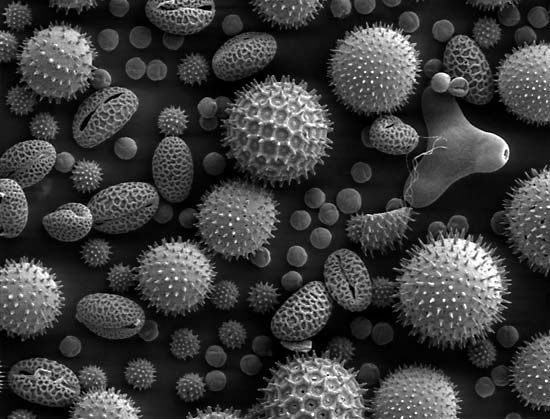
- Palynology: This field focuses on the study of pollen and spores. Because these microfossils are produced in vast numbers, are highly resistant to decay, and are widely dispersed, they provide a statistically significant record of plant distribution and evolutionary sequences, even in sediments lacking larger fossils.1314
- Phylogenetic Reconstruction: Modern classification aims to be phylogenetic, grouping plants based on their descent from a common ancestor. When fossil evidence is sufficient, it is used to trace taxonomic lines back in time. However, when fossil material is scarce or convergence occurs, classification may rely on a compromise between observed structural grades and inferred evolutionary clades.1115
What are the main differences between ferns and other early land plants?
Ferns and other early land plants, such as the primitive Rhyniopsida (e.g., Cooksonia), differ primarily in their structural complexity and reproductive strategies.
Structural Differences
- Body Differentiation: Early land plants were simple, consisting of forking axes without true roots, stems, or leaves, and were anchored by rhizoids. In contrast, ferns are vascular plants that possess true roots, stems, and complex, often pinnate leaves.1017
- Vascular Tissue: While both groups are vascular, ferns exhibit more complex vascular arrangements. Many fern stems feature a siphonostele—a cylinder of vascular tissue surrounding a central pith—whereas primitive plants often had a simpler protostele.18
- Growth: Unlike many seed plants that utilize secondary growth (wood production) to increase diameter, modern ferns generally lack this ability, relying instead on primary growth from the stem apex for their structure.1918
Reproductive Differences
- Spore vs. Seed: Ferns are nonseed plants that reproduce via spores, a method that predates the seed life cycle.17
- Life Cycle: Most ferns are homosporous, producing a single type of spore that develops into a free-living gametophyte. This gametophyte is independent and vulnerable to environmental stress, unlike the reduced, protected gametophytes found in seed plants. Like other lower vascular plants, ferns require water for fertilization because they produce motile, flagellated sperm.101920
Sources
- Hyenia — Encyclopædia Britannica
- Hyenia — Merriam-Webster
- Are hyenas cats or dogs? — Encyclopædia Britannica
- hyena — Encyclopædia Britannica
- hyena — Merriam-Webster
- A Journey Through Time Since the Precambrian - Devonian Period: 419.2 million to about 359 million years ago — Encyclopædia Britannica
- Devonian Period - Paleoclimate — Encyclopædia Britannica
- Devonian Period - Significant geologic events — Encyclopædia Britannica
- Devonian Period - Extinction events — Encyclopædia Britannica
- plant - Evolution of land plants from the Ordovician Period through the middle Devonian — Encyclopædia Britannica
- plant - Evolution and paleobotany — Encyclopædia Britannica
- palynology — Encyclopædia Britannica
- geology - Palynology — Encyclopædia Britannica
- taxonomy - Making a classification — Encyclopædia Britannica
- Morphology - Historical background — Encyclopædia Britannica
- plant - Critical appraisal — Encyclopædia Britannica
- plant - Definition of the category — Encyclopædia Britannica
- plant - Seed plants — Encyclopædia Britannica
- cycadophyte - Seed ferns — Encyclopædia Britannica
- fern - Evolutionary development — Encyclopædia Britannica
- fern - Fossil record — Encyclopædia Britannica
- fern — Encyclopædia Britannica
- lower vascular plant - Vascular system — Encyclopædia Britannica
- pteropsid — Encyclopædia Britannica
Published on · 4 min read