Incense Cedar
The incense cedar (Calocedrus decurrens) is an evergreen conifer belonging to the cypress family (Cupressaceae). Native to the western slopes of the Cascade…
What is Incense cedar?
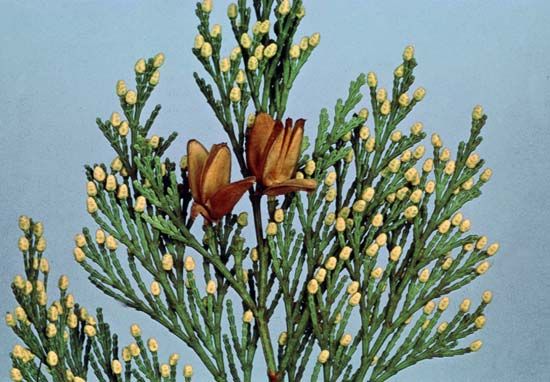
The incense cedar (Calocedrus decurrens) is an evergreen conifer belonging to the cypress family (Cupressaceae). Native to the western slopes of the Cascade and Sierra Nevada mountain ranges in North America, this tree is named for the aromatic odor its leaves release when bruised.12
The tree typically grows between 30 and 45 meters (100 to 150 feet) tall and features a straight trunk with reddish, furrowed bark. Its branches are covered in sprays of dark green, scalelike leaves. Because of its light, soft, and aromatic wood, the incense cedar is highly valued for various practical applications, including carpentry, the manufacturing of pencils, storage chests, interior paneling, and fence posts.12
What are other common types of conifer trees?
Conifers are a diverse group of over 550 species of evergreen trees and shrubs that typically bear needle-like or scale-like leaves. They are categorized into several families, each with distinct characteristics and uses.3
Major Conifer Families and Examples
- Pinaceae: This is the largest and most widespread conifer family in the Northern Hemisphere. It includes:4
- Cupressaceae: This family includes trees with scale-like leaves and often flattened, frond-like branches. Notable members include:74
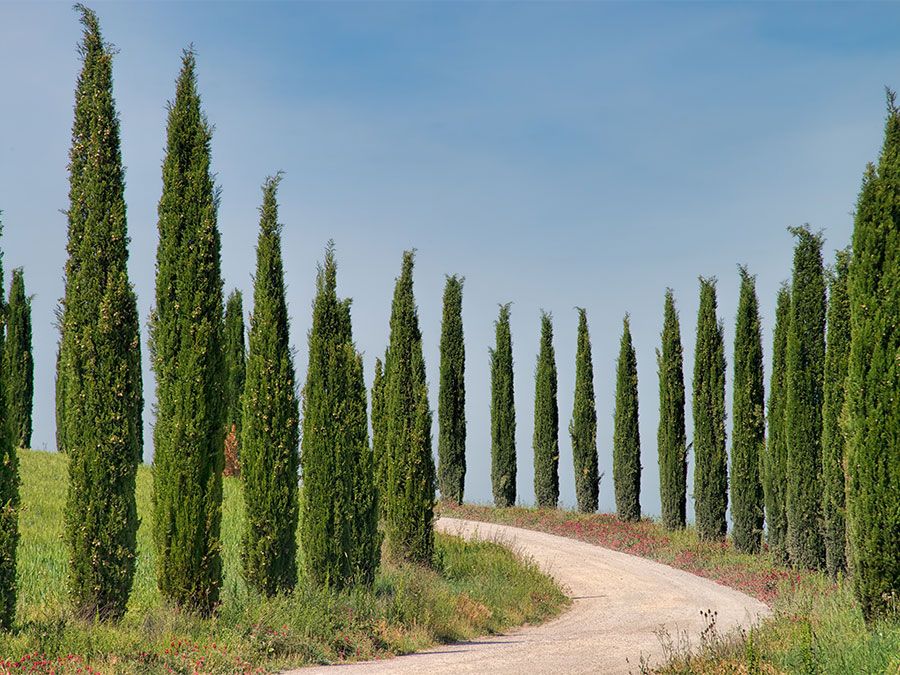
- Cypresses, Junipers, and Arborvitae: Widely used as ornamentals.78
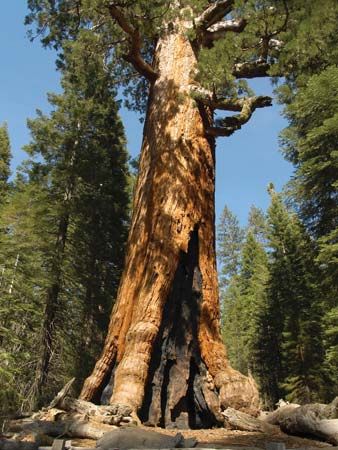
- Redwoods and Giant Sequoias: Some of the largest and tallest living organisms on Earth.6
- Bald cypress: A deciduous member of this family.76
- Other Families:
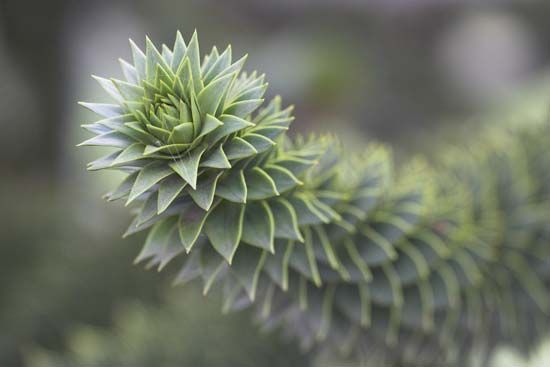
- Araucariaceae: Includes species like Araucaria and dammars, found primarily in the Southern Hemisphere.4
- Taxaceae: Includes the yew, which produces seeds surrounded by a fleshy aril rather than a traditional woody cone.4
How do evergreen trees survive in different climates?
Evergreen trees survive in diverse climates by employing specialized morphological and physiological adaptations that allow them to retain their foliage year-round, enabling photosynthesis whenever environmental conditions are favorable.910
Adaptations to Cold and Temperate Climates
In regions with freezing winters, evergreens—particularly conifers—have evolved leaves that are thicker, leathery, and often needle-like or scale-like. These shapes minimize surface area, which helps reduce water loss. Furthermore, these leaves often feature a thick, waxy, waterproof coating, and their stomates (gas-exchange openings) are deeply sunken to protect them from dry air. These protective mechanisms allow the trees to withstand freezing temperatures and carry out photosynthesis during brief periods of warmth.91110
Adaptations to Dry and Nutrient-Poor Environments
In mild but drier temperate environments, trees often develop thickened leaves to slow transpiration. Because producing these durable leaves requires a high investment of energy and nutrients, the trees retain them for multiple years rather than replacing them annually. This strategy is particularly advantageous in nutrient-poor soils where the cost of producing new foliage every year would be prohibitive.10
Tropical and Specialized Environments
In tropical rainforests, where temperatures are consistently high, evergreens benefit from retaining their leaves to avoid the resource-heavy process of frequent leaf replacement. Additionally, some species have evolved to thrive in extreme conditions, such as fire-dependent forests or flooded swamps, by developing specialized reproductive strategies or insulating bark to survive disturbances.1012
What makes the wood of certain trees ideal for making pencils?
The wood of certain trees, most notably the incense cedar, is ideal for making pencils primarily due to its physical properties. These woods are valued because they are soft, straight-grained, and easy to sharpen without splintering, which allows for a smooth and consistent experience when whittling or using a mechanical sharpener to expose the graphite core.115
Historically, various species of junipers—often referred to as “pencil cedars”—were favored for these same characteristics. The wood must be stable enough to securely encase the graphite and clay mixture, protecting it from breakage while remaining pliable enough to be cut cleanly by the user. The incense cedar, in particular, has become a standard choice for the industry because it combines these mechanical advantages with a reliable, uniform texture that supports the mass production of high-quality writing implements.16151
Sources
- incense cedar — Encyclopædia Britannica
- incense cedar — Merriam-Webster
- Did you know? — Merriam-Webster
- Cupressaceae — Encyclopædia Britannica
- conifer - Annotated classification — Encyclopædia Britannica
- gymnosperm - Pinophyta — Encyclopædia Britannica
- Coniferous forest — Encyclopædia Britannica
- conifer - Economic importance — Encyclopædia Britannica
- Evergreen — Encyclopædia Britannica
- Temperate forest - Environment — Encyclopædia Britannica
- Tropical rainforest - Environment — Encyclopædia Britannica
- Tree - Adaptations — Encyclopædia Britannica
- conifer - Sporophyte phase — Encyclopædia Britannica
- conifer - Leaves — Encyclopædia Britannica
- pencil cedar — Merriam-Webster
- Pencil drawing — Encyclopædia Britannica
- Pencil — Encyclopædia Britannica
Published on · 3 min read