Myrtle
Plants in the genus Myrtus are primarily found in the warmer regions of both the Eastern and Western Hemispheres. While authorities differ on the total…
Where are Myrtus plants typically found in nature?
Plants in the genus Myrtus are primarily found in the warmer regions of both the Eastern and Western Hemispheres. While authorities differ on the total number of species, the majority of Myrtus plants occur in South America.123
Specific distributions include:
- South America: This region hosts the largest concentration of the genus.23
- Mediterranean and Middle East: The common myrtle (M. communis) is a native and significant element of Mediterranean vegetation.21
- Oceania: Some species are also found in Australia and New Zealand.2
It is important to note that the term “myrtle” is often applied to various other unrelated plants, such as the crape myrtle or the mountain laurel, which have different native ranges and botanical classifications.2

What are some common species within the Myrtus genus?
Botanical authorities differ significantly regarding the total number of species within the Myrtus genus, and many plants commonly called “myrtle” are actually unrelated species.
The most prominent and widely recognized species is:
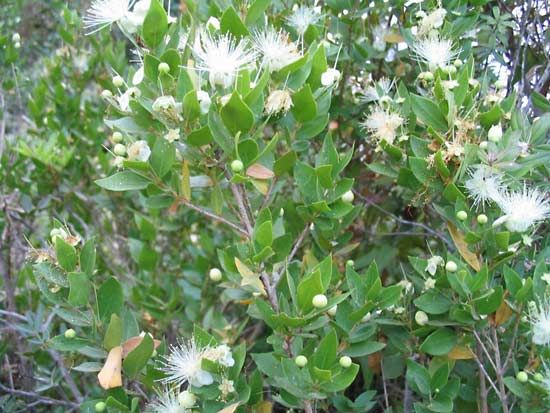
- Common myrtle (M. communis): Native to the Middle East and the Mediterranean region, this aromatic evergreen shrub is known for its lustrous leaves, solitary white flowers, and purplish-black berries. It has a long history of cultural significance, having been considered sacred to Venus in Greco-Roman antiquity.1
While the genus Myrtus includes various shrubs primarily found in South America, Australia, and New Zealand, many other plants often referred to as “myrtles” belong to different families entirely. These include the crape myrtle, the mountain laurel, wax myrtle, bog myrtle, sand myrtle, gum myrtle, downy myrtle, and the periwinkle (often called creeping or running myrtle).13
What pollinators are attracted to Myrtus plants and why?
Plants in the Myrtus genus belong to the family Myrtaceae, which generally relies on insects for pollination. The primary pollinators attracted to these plants are bees, though moths and butterflies also contribute to the process.4
These pollinators are drawn to Myrtus and other members of the Myrtaceae family because the flowers provide essential food rewards, specifically nectar and pollen. The flowers are structurally adapted to facilitate this interaction; as the insects forage for these resources, they inadvertently brush against the reproductive parts of the flower, ensuring that pollen is deposited on the stigma to effect fertilization.4
While some other families within the order Myrtales have evolved to attract birds, bats, or rodents, the pollination of the Myrtaceae family remains predominantly insect-driven.4
What are some common characteristics of plants in the Myrtaceae family?
The Myrtaceae family, commonly known as the myrtle family, consists of approximately 150 genera and 3,300 species of trees and shrubs primarily distributed throughout the tropics.56
Key characteristics of plants in this family include:
- Foliage: Members typically feature leathery, evergreen leaves that are often arranged in an opposite pattern. A defining feature is the presence of large, scattered oil-containing cells within the leaves, which appear as translucent spots when held against the light. These glands yield fragrant, essential oils.5674
- Floral Structure: The flowers are generally bisexual and characterized by an inferior ovary and numerous stamens. They are often arranged in cymose inflorescences, though patterns can vary. Many species possess a floral tube known as a hypanthium that surrounds the ovary.47
- Anatomical Features: Some species, particularly within the genus Eucalyptus, develop lignotubers—woody, rounded outgrowths at the base of the trunk that store food reserves and allow the plant to regenerate vigorously after fire or drought.4
- Economic Importance: The family is highly valued for its essential oils, timber, and edible fruits, such as guava and feijoa. It also provides significant spices, including clove and allspice.58
Sources
- myrtle — Encyclopædia Britannica
- Myrtales - Family distributions and abundance — Encyclopædia Britannica
- Myrtus — Merriam-Webster
- Myrtales - Natural history — Encyclopædia Britannica
- Myrtaceae — Encyclopædia Britannica
- list of plants in the family Myrtaceae — Encyclopædia Britannica
- Myrtales - Characteristic morphological features — Encyclopædia Britannica
- Myrtales - Economic and ecological importance — Encyclopædia Britannica
- Myrtaceae — Merriam-Webster
Published on · 3 min read