Staghorn Fern
The staghorn fern (genus Platycerium) is a unique group of tropical ferns belonging to the family Polypodiaceae. These plants are epiphytic, meaning they…
What is Staghorn fern?
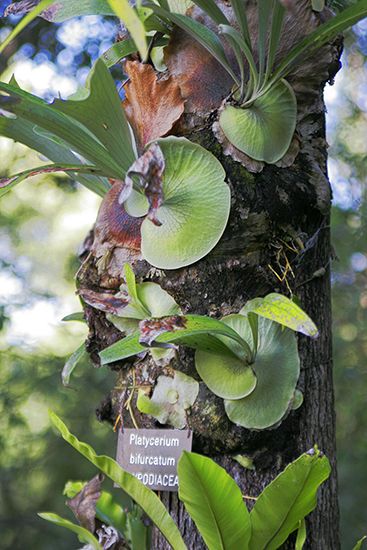
The staghorn fern (genus Platycerium) is a unique group of tropical ferns belonging to the family Polypodiaceae. These plants are epiphytic, meaning they grow naturally upon other plants rather than in soil.123
They are characterized by two distinct types of leaves:
- Fertile fronds: These are elongated, repeatedly forked, and resemble the antlers of a stag or deer, which gives the plant its common name. The spore-producing structures are found on the undersides of these leaves.13
- Mantle leaves: These are flat or bowl-shaped and grow closely against the support structure. In many species, they form a basin that collects organic matter, helping the plant absorb moisture and nutrients.13
Because of their striking appearance, they are popular in conservatories and as houseplants, where they are often mounted on wooden blocks or wire baskets to mimic their natural growth on tree bark.13
What are epiphytes and how do they survive without soil?
An epiphyte is a plant that grows upon another plant or object solely for physical support. Unlike parasitic plants, which derive water or nutrients directly from a host, epiphytes use their hosts only as a structure to reach higher levels of sunlight in dense environments like tropical rainforests.56
Because they do not grow in soil, epiphytes have evolved specialized ways to survive:
- Water Absorption: They obtain moisture from rain and water vapor in the air. While many absorb water through their roots, others utilize specialized leaves to capture moisture.5
- Nutrient Acquisition: Nutrients are typically absorbed from organic debris, such as decaying leaves, that collects on the supporting plant or within the epiphyte’s own structure.5
- Attachment: Many epiphytes use adventitious roots to anchor themselves firmly to tree bark or other non-soil surfaces.7
Common examples include orchids, ferns, mosses, and members of the pineapple family.85
How do mantle leaves help the fern collect nutrients?
Mantle leaves play a crucial role in the survival of the staghorn fern by acting as a specialized collection system. These flat or bowl-shaped leaves grow closely against the surface of the tree or support structure upon which the fern lives.
By forming this bowl-like shape, the mantle leaves create a trap that catches falling organic debris, such as decaying leaves and other forest matter. This accumulated material, known as humus, provides a vital source of nutrients for the plant. Additionally, this structure helps the fern retain moisture, allowing its roots to develop within the collected organic matter and efficiently absorb the water and nutrients necessary for growth.1
What is the difference between sterile and fertile fronds?
The primary difference between sterile and fertile fronds lies in their reproductive function and physical characteristics:
- Fertile Fronds: These are specialized leaves that bear spores, which are essential for the fern’s reproduction. They often feature brown patches on their undersurface known as sori, which contain clusters of sporangia (spore cases). In many species, fertile fronds differ significantly from sterile ones in their size, form, and color.11011
- Sterile Fronds: These leaves are primarily vegetative, meaning they focus on photosynthesis and general plant growth rather than reproduction. They do not bear sporangia and often maintain a different appearance compared to the fertile fronds of the same plant.910
In some ferns, such as the staghorn fern, this division of labor is highly specialized: one type of leaf is elongated and fertile, while the other—the mantle leaf—is flat, sterile, and serves to collect nutrients and moisture.12
Sources
- Staghorn fern — Encyclopædia Britannica
- houseplant - Ferns — Encyclopædia Britannica
- Platycerium — Merriam-Webster
- staghorn fern — Merriam-Webster
- Did you know? — Merriam-Webster
- Epiphyte — Encyclopædia Britannica
- Adventitious root — Encyclopædia Britannica
- Parasitic plant — Encyclopædia Britannica
- Fern - Ecology — Encyclopædia Britannica
- Plant - Subclass Polypodiidae — Encyclopædia Britannica
- fertile frond — Merriam-Webster
- Plant reproductive system - Ferns — Encyclopædia Britannica
- Fern - Life cycle — Encyclopædia Britannica
Published on · 3 min read