Sundarbans
The Sundarbans mangrove forest, a vast deltaic region, is defined by vegetation uniquely adapted to survive in saline, oxygen-poor, and waterlogged…
What are some unique plant adaptations found in the Sundarbans mangrove forest?
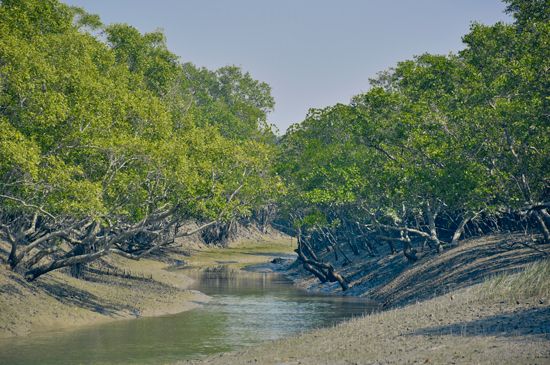
The Sundarbans mangrove forest, a vast deltaic region, is defined by vegetation uniquely adapted to survive in saline, oxygen-poor, and waterlogged environments. Key adaptations include:12
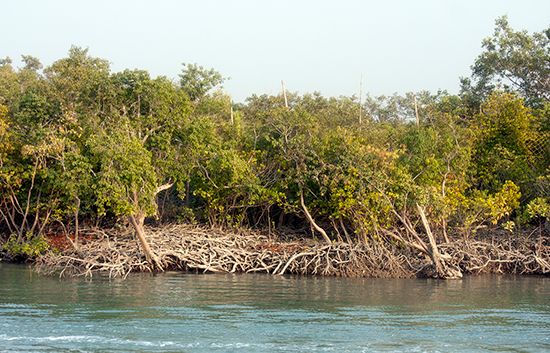
- Specialized Root Systems: To overcome the lack of oxygen in submerged soils, many mangrove species utilize pneumatophores. These are specialized lateral roots that grow upward against gravity, protruding above the mud or water to facilitate gas exchange through small openings called lenticels. Additionally, mangroves often employ prop roots or stilt roots to provide structural stability in soft, shifting tidal mudflats.314
- Halophytic Nature: The flora of the Sundarbans, such as the sundari (Heritiera fomes) and gewa (Excoecaria agallocha), are classified as halophytes, meaning they are biologically adapted to tolerate high levels of salinity.2
- Ecological Resilience: These trees act as a critical buffer, trapping sediments with their complex root networks to reduce erosion and protect the coastline from storm surges and tidal forces.25
What conservation efforts are in place to protect the Sundarbans?
Conservation efforts for the Sundarbans are multifaceted, involving national protections and international recognition to preserve its unique biodiversity.
- National Reserves and Sanctuaries: In India, the Sundarbans Tiger Reserve was established in 1973 to focus on the protection of the Bengal tiger. Within this, the Sundarbans National Park was created in 1984 as a core protected area. In Bangladesh, the government has designated three noncontiguous wildlife sanctuaries to safeguard its portion of the forest.47
- International Recognition: The Indian national park was designated a UNESCO World Heritage site in 1987, and the sanctuaries in Bangladesh received the same status in 1997. Furthermore, UNESCO has demarcated the entire region as a biosphere reserve, promoting a balance between conservation and sustainable development.47
- Human-Wildlife Conflict Mitigation: To protect both human populations and tiger populations, authorities have implemented specific countermeasures, such as the use of nylon fencing, electrified human decoys, and the practice of wearing face masks on the back of the head to deter tiger attacks.7
What is the geographical location and extent of the Sundarbans?
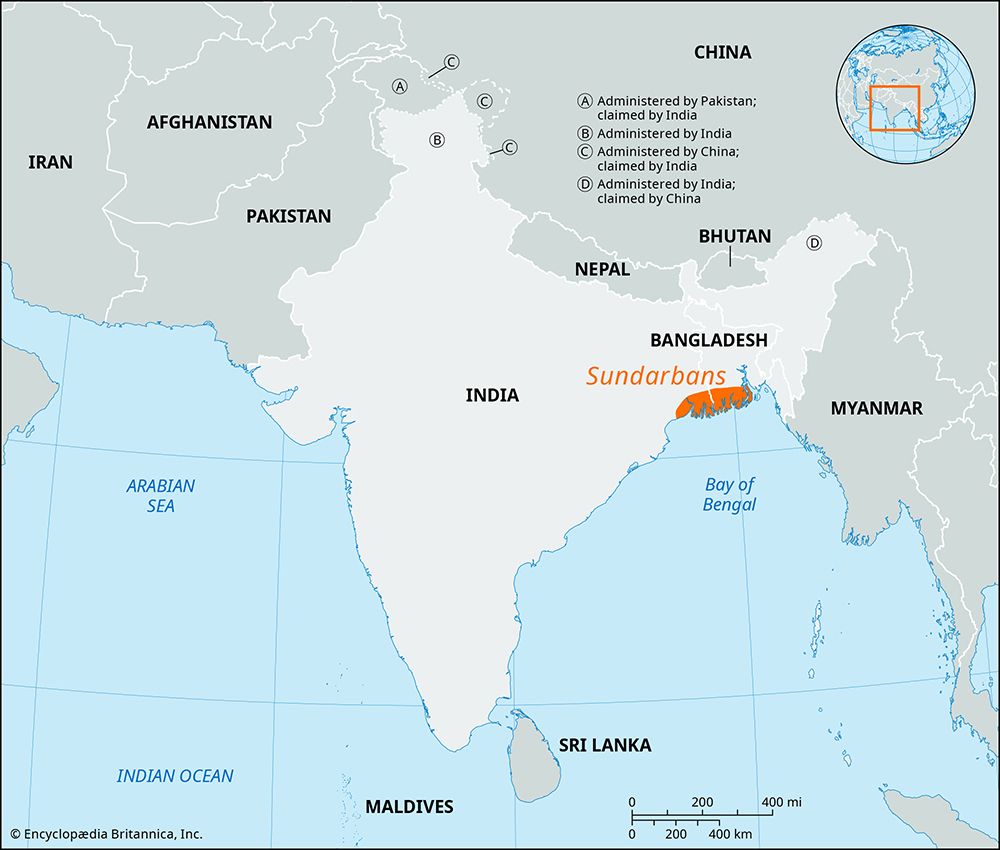
The Sundarbans is a vast expanse of forest and saltwater swamp situated at the lower end of the Padma–Brahmaputra River delta. Geographically, it spans across southeastern West Bengal state in northeastern India and southern Bangladesh.4
The region extends approximately 160 miles (260 km) west-east along the Bay of Bengal, stretching from the Hugli River estuary in India to the western segment of the Meghna River estuary in Bangladesh. At its broadest point, the tract reaches inland for about 50 miles (80 km).4
The total area of the Sundarbans, encompassing both land and water, is approximately 3,860 square miles (10,000 square km), with about three-fifths of this territory located within Bangladesh. The landscape is characterized by a complex network of tidal rivers, creeks, and estuaries that enclose flat, marshy, and densely forested islands.4
What role does the Bengal tiger play in the Sundarbans ecosystem?
The Bengal tiger serves as a vital apex predator within the Sundarbans ecosystem. As the only tiger population in the world to have adapted to a semiaquatic life, these big cats play a critical role in regulating the populations of various terrestrial and aquatic species.10
Their diet is diverse, reflecting the unique nature of the mangrove environment. They are proficient hunters of terrestrial animals, including spotted deer, rhesus monkeys, and wild boars. Furthermore, they have adapted to hunt aquatic fauna, such as crabs, fishes, turtles, and water monitor lizards.10
By maintaining the balance of these prey populations, the Bengal tiger helps sustain the health and stability of the mangrove forest. However, their presence also leads to complex interactions with human populations who enter the forest to harvest resources, necessitating ongoing conservation and conflict-mitigation strategies to protect both the tigers and local communities.410
Sources
- Pneumatophore — Encyclopædia Britannica
- mangrove: Top Questions — Encyclopædia Britannica
- Sundarbans National Park: Top Questions — Encyclopædia Britannica
- Sundarbans — Encyclopædia Britannica
- stilt-root — Merriam-Webster
- Amazing Mangroves — Encyclopædia Britannica
- Sundarbans National Park — Encyclopædia Britannica
- Ganges River - Physiography — Encyclopædia Britannica
- Ganges delta — Encyclopædia Britannica
- Bengal tiger — Encyclopædia Britannica
Published on · 3 min read