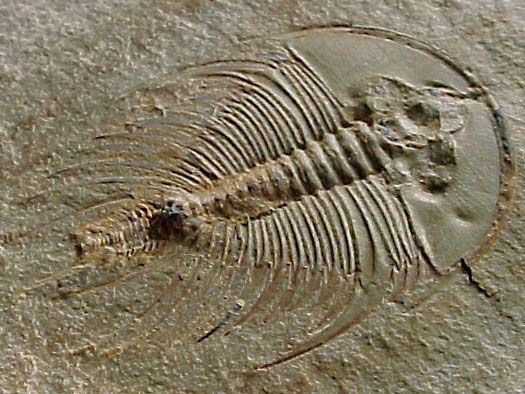
Trilobite
Trilobites were a group of marine arthropods that first appeared approximately 521 million years ago, near the beginning of the Cambrian Period. While they…
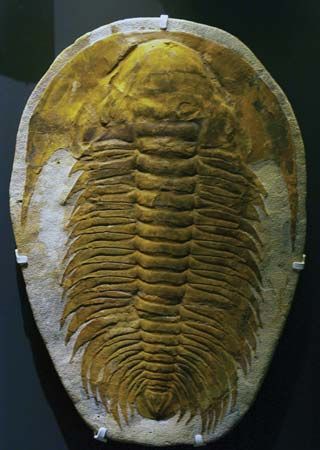
During which geological periods did trilobites exist, and when did they go extinct?
Trilobites were a group of marine arthropods that first appeared approximately 521 million years ago, near the beginning of the Cambrian Period. While they were most abundant during the Cambrian, they persisted through subsequent geological periods, eventually making their final appearance during the Permian Period.12
Trilobites went extinct at the end of the Permian Period, coinciding with the massive Permian-Triassic extinction event that eliminated a vast majority of marine invertebrate species. Although it is possible that ancestral forms originated during the Ediacaran Period of Precambrian times, the fossil record confirms their primary existence spanned from the Cambrian through the Permian.21
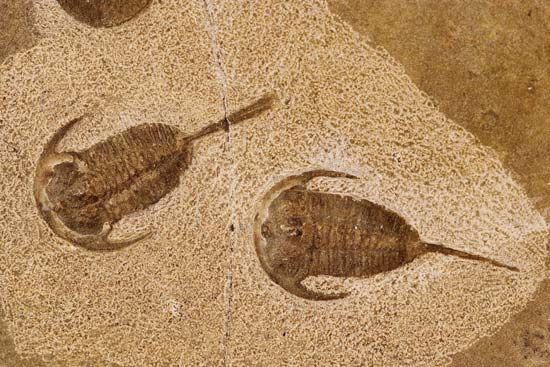
How do scientists determine the age of trilobite fossils?
Scientists determine the age of trilobite fossils using two primary, complementary methods: relative dating and absolute dating.3
Relative Dating
Because trilobites evolved rapidly and were widely distributed, they are highly effective index fossils. By studying the fossil record within sedimentary rocks, geologists can determine the relative age of a fossil based on its position in rock strata. This allows scientists to place trilobite species in a correct chronological sequence relative to other organisms and events.4563
Absolute Dating
To assign a specific age in years, scientists use geochronology, which involves radiometric dating. This technique measures the decay of radioactive isotopes—such as uranium, potassium, or rubidium—trapped within minerals. By calculating the ratio of parent atoms to daughter atoms in a sample, geochronologists can determine the time elapsed since the rock or mineral formed. Because fossils themselves are found in sedimentary rocks that are often difficult to date directly, scientists use absolute ages from associated volcanic or igneous rock layers to calibrate the fossil time scale.7843
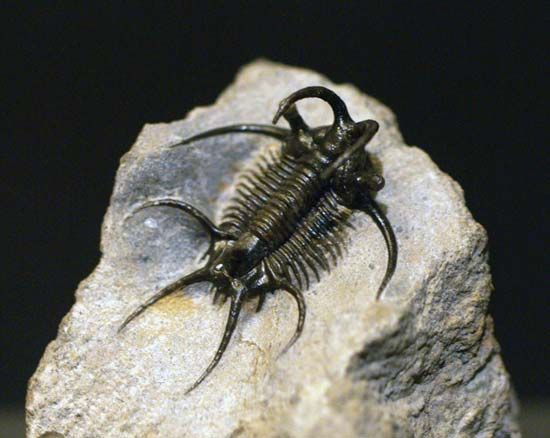
How did trilobites’ exoskeletons contribute to their preservation as fossils?
Trilobites are exceptionally well-represented in the fossil record primarily because of their exoskeleton, a rigid external structure composed of chitinous material.1
This exoskeleton provided the necessary durability for preservation, as hard body parts are significantly more likely to survive the processes of fossilization than soft tissues. In many arthropods, these structures are further strengthened through sclerotization—a process that stabilizes protein chains to create a tough, plastic-like material—and can be reinforced by the incorporation of mineralized substances like calcite.108
Furthermore, the biological necessity for trilobites to grow required them to undergo molting, or ecdysis, throughout their lives. During this process, they shed their old exoskeletons, which were left behind in the marine environment. Because a single individual could produce multiple shed shells over its lifetime, these discarded exoskeletons, or fragments thereof, are relatively common as fossils. This combination of a durable, mineralizable structure and the frequent shedding of that structure ensured that trilobites left behind a prolific and widespread fossil record.110
What are the key characteristics that define trilobites?
Trilobites are extinct fossil arthropods that lived exclusively in marine environments, first appearing approximately 521 million years ago during the Cambrian Period. They are defined by several key characteristics:1
- Three-Lobed Body: Their name refers to their distinctive body structure, which consists of a central longitudinal axial lobe with two additional lobes on either side.1
- Segmented Regions: The body is divided into three distinct regions from head to tail: the cephalon (head), the thorax, and the pygidium (tail).1
- Exoskeleton: Like other arthropods, they possessed a chitinous exoskeleton. Because this structure had to be shed for the animal to grow, discarded exoskeletons are common in the fossil record.1
- Appendages and Senses: Each body segment featured a pair of jointed appendages, with the forwardmost ones modified for sensing and feeding. Many trilobites also possessed compound eyes, which were uniquely constructed with lenses made of calcite.111
Trilobites varied significantly in size and behavior, ranging from small organisms to large predators, and they remain vital tools for stratigraphic correlation in geology.1
Sources
- trilobite — Encyclopædia Britannica
- Triassic Period - Permian-Triassic extinctions — Encyclopædia Britannica
- dating: Top Questions — Encyclopædia Britannica
- dating - Distinctions between relative-age and absolute-age measurements — Encyclopædia Britannica
- dating — Encyclopædia Britannica
- Cambrian Period - Correlation of Cambrian strata — Encyclopædia Britannica
- dating - Principles of isotopic dating — Encyclopædia Britannica
- index fossil — Encyclopædia Britannica
- geology - Invertebrate paleontology — Encyclopædia Britannica
- Integument - Arthropods — Encyclopædia Britannica
- Photoreception - Evolution of eyes — Encyclopædia Britannica
Published on · 3 min read