Tsushima Current
The Tsushima Current is a warm, surface-level oceanic current that serves as a branch of the Kuroshio (Japan Current). It enters the Sea of Japan by flowing…
What is Tsushima Current?
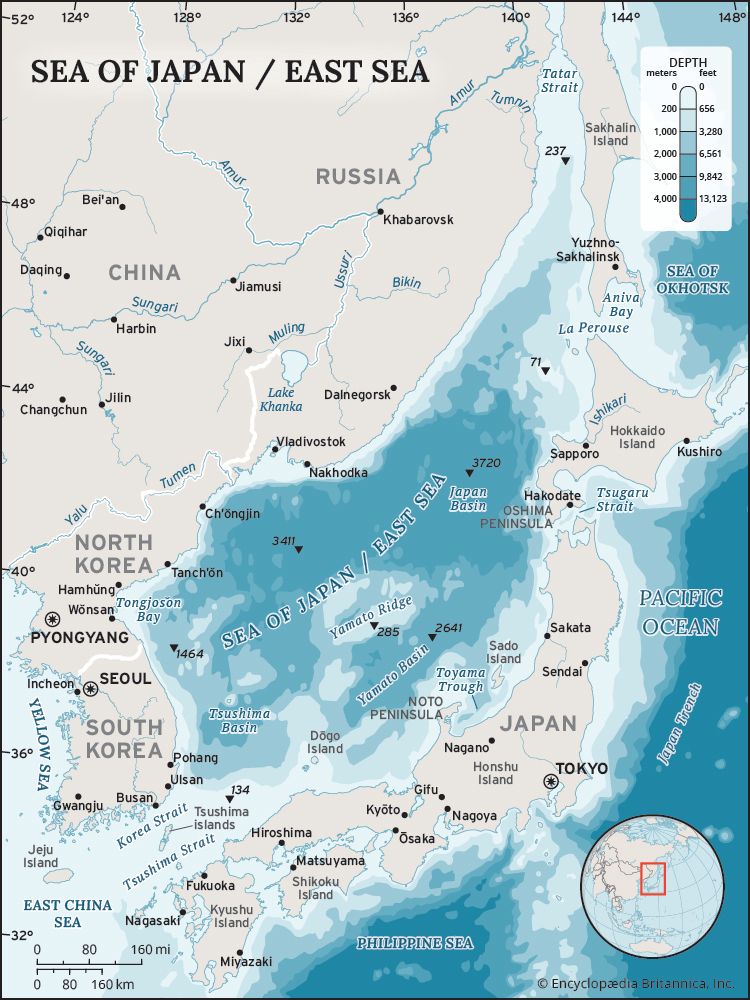
The Tsushima Current is a warm, surface-level oceanic current that serves as a branch of the Kuroshio (Japan Current). It enters the Sea of Japan by flowing northeast through the Korea Strait, subsequently washing the coasts of Honshu and Hokkaido.1234
Key characteristics of the current include:
- Branching: It gives rise to the East Korea Warm Current, which flows northward along the Korean peninsula before eventually dividing into the Tsugaru and Sōya warm currents.156
- Seasonality: The current is most prominent during the spring and summer months and is barely discernable during the winter.1
- Climatic Impact: By transporting warm, saline water into the Sea of Japan, the current plays a significant role in regional climate, notably contributing moisture to the winter monsoon that results in heavy snowfall along Japan’s Sea of Japan coast.46
How does the Kuroshio Current influence global ocean patterns?
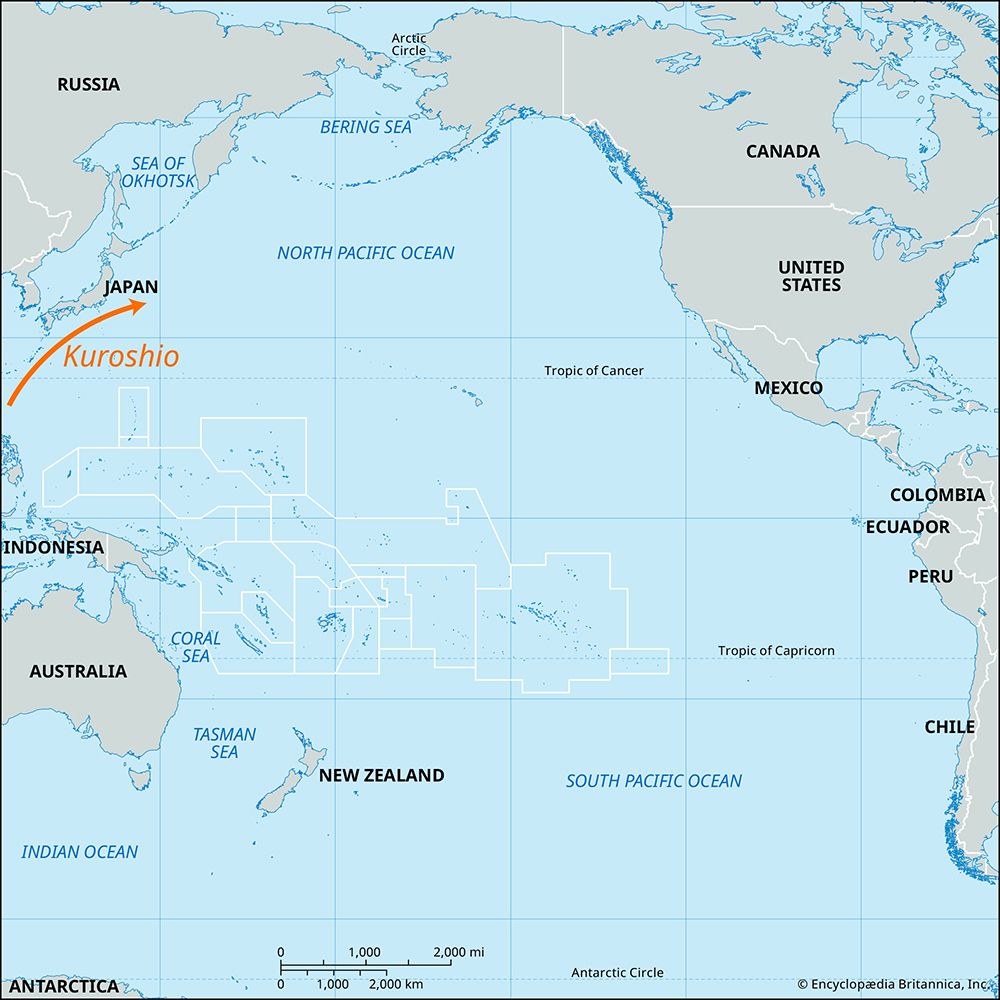
The Kuroshio is a powerful western boundary current in the North Pacific that plays a critical role in global ocean circulation by transporting excess heat from low latitudes toward the poles. As a western boundary current, it is intensified by the Coriolis force, resulting in a swift, jet-like flow that mirrors the dynamics of the Gulf Stream in the Atlantic.57
Its influence on ocean patterns includes:
- Heat Redistribution: By moving warm, saline water northward, it helps regulate the thermal balance of the Pacific Ocean.57
- Current Systems: The Kuroshio feeds into the North Pacific Current, which eventually splits to form the Alaska Current and the California Current, impacting coastal climates across the Pacific basin.5
- Eddy Formation: Similar to the Gulf Stream, the Kuroshio generates warm and cold rings (eddies) that facilitate the exchange of water masses and energy across the thermocline, influencing local marine environments7.8
What is the difference between warm and cold ocean currents?
Ocean currents are large-scale movements of seawater driven primarily by wind friction, gravity, and variations in water density. They are categorized as either warm or cold based on the temperature of the water they transport relative to the surrounding ocean.891011
Warm Ocean Currents
Warm currents typically originate in tropical regions and flow toward higher latitudes, effectively redistributing heat from the equator toward the poles.12109
- Function: By transporting warm, saline water, these currents moderate the climates of the coastal regions they pass, often keeping high-latitude ports ice-free.12119
- Examples: The Gulf Stream in the North Atlantic and the Kuroshio (Japan Current) in the North Pacific are prominent examples that significantly influence regional weather patterns and atmospheric circulation.121011
Cold Ocean Currents
Cold currents generally flow from polar or subpolar regions toward the equator, carrying cooler, often nutrient-rich water.81011
- Function: These currents often contribute to the cooling of adjacent coastal climates and can trigger coastal upwelling, where cold, nutrient-dense water rises from the depths to the surface, supporting intense biological activity.81011
- Examples: The Peru (Humboldt) Current, the Labrador Current, and the Benguela Current are key cold currents that shape the environments of their respective regions.81211
How do ocean currents impact the migration patterns of marine life?
Ocean currents are fundamental to the distribution and migration of marine life, acting as both a transport mechanism and a determinant of species range.115
Horizontal and Vertical Transport
Currents facilitate the movement of organisms across vast distances. Many species, particularly in their larval stages, rely on these flows for dispersal. For instance, the Gulf Stream is essential for transporting European eel larvae from their spawning grounds in the Sargasso Sea to European coastal waters. Similarly, mainstream currents like the East Australian Current can carry tropical larvae to high-latitude regions, effectively introducing new species to those ecosystems.11515
Migration and Life Cycles
Marine organisms often utilize currents to optimize their energy expenditure during migration. By performing vertical migrations, animals can move between water layers with different current directions, effectively “hitching a ride” to reach specific feeding or spawning grounds.15
Furthermore, the annual cycle of oceanographic conditions—driven by currents—dictates the timing and routes of many oceanodromous fish, such as herring and cod, which migrate to feed and reproduce. These movements are often synchronized with the availability of nutrients and favorable temperatures transported by these currents.811
Sources
- Tsushima Current — Encyclopædia Britannica
- Japan - Climate — Encyclopædia Britannica
- Korea Strait — Encyclopædia Britannica
- East Korea Warm Current — Encyclopædia Britannica
- Kuroshio — Encyclopædia Britannica
- Sea of Japan / East Sea - Hydrology — Encyclopædia Britannica
- subtropical gyre — Encyclopædia Britannica
- Climate - The Kuroshio — Encyclopædia Britannica
- ocean current - Distribution of ocean currents — Encyclopædia Britannica
- Climate - Circulation, currents, and ocean-atmosphere interaction — Encyclopædia Britannica
- Marine ecosystem - Ocean currents — Encyclopædia Britannica
- seawater - Temperature distribution — Encyclopædia Britannica
- Atlantic Ocean - Temperature — Encyclopædia Britannica
- How Do Ocean Currents Affect the Biosphere? — Encyclopædia Britannica
- Marine ecosystem - Migrations of marine organisms — Encyclopædia Britannica
- Migration - Oceanodromous fish — Encyclopædia Britannica
Published on · 3 min read