Water Fern
The term "water fern" typically refers to aquatic ferns belonging to families such as Salviniaceae, Marsileaceae, or the genus Ceratopteris. While some…
What is a water fern and how does it differ from other aquatic plants?
The term “water fern” typically refers to aquatic ferns belonging to families such as Salviniaceae, Marsileaceae, or the genus Ceratopteris. While some species root in mud, many are free-floating plants found in shallow, sluggish waters.12
Water ferns differ from most other ferns in several key ways:
- Reproductive Strategy: Unlike most ferns, which produce one type of spore (homospory), aquatic genera such as Marsilea, Salvinia, and Azolla are heterosporous, producing both small microspores and larger megaspores.3
- Life Cycle Speed: Water ferns like Ceratopteris have evolved to complete their life cycles much more rapidly than typical land ferns, often in about four months compared to a year or more.2
- Adaptations: Many water ferns are adapted to environments that may dry out periodically. They often appear only after rains, completing their growth cycles quickly to utilize available water.4
- Ecological Utility: Some, such as the mosquito fern (Azolla), host nitrogen-fixing algae, making them ecologically significant for increasing productivity in environments like rice paddies.5
Are there any economic or environmental concerns associated with water ferns?
Water ferns present a complex mix of significant economic benefits and notable environmental challenges.
Economic Importance
Water ferns, particularly the mosquito fern (Azolla), are highly valued in agriculture. Through a symbiotic relationship with the cyanobacterium Anabaena azollae, these ferns perform nitrogen fixation, converting atmospheric nitrogen into a natural fertilizer. This process significantly boosts the productivity of rice paddies and has been used for centuries in Southeast Asia. Additionally, certain species are cultivated for the ornamental horticulture market, and the genus Ceratopteris serves as a vital model organism for genetics research and education.6275
Environmental Concerns
While beneficial in controlled settings, some water ferns can become problematic when they escape cultivation. Species such as Salvinia molesta are considered aggressive and noxious weeds that can overtake lakes and waterways. Furthermore, the dense growth of mosquito ferns can completely cover the surface of ponds, which, while potentially inhibiting mosquito breeding, can also alter the ecology of the water body.62
How do water ferns reproduce and spread in their habitats?
Water ferns reproduce and spread through both sexual and asexual processes, allowing them to adapt to diverse and sometimes ephemeral aquatic environments.
Sexual Reproduction
Like other ferns, water ferns exhibit an alternation of generations between a spore-producing sporophyte and a sexual gametophyte phase. However, unlike most ferns that produce one type of spore, water ferns in the families Marsileaceae, Salviniaceae, and Azollaceae are heterosporous. They produce two distinct types of spores:3
- Microspores: Small spores that develop into male gametophytes.3
- Megaspores: Larger spores that contain food reserves and develop into female gametophytes.3
This process allows for the creation of new genetic variations, which is particularly important for colonizing new habitats and extending the plant’s geographic range.4
Asexual and Vegetative Spread
Vegetative reproduction is a primary method for the rapid expansion of water fern populations. For example, the genus Ceratopteris produces “daughter plants”—asexual offshoots that develop from buds along the margins of vegetative leaves. These offshoots eventually detach to become independent, free-living clones of the parent plant. Similarly, many other ferns spread through the growth of rhizomes, which allow large stands to form through clone formation rather than sexual reproduction.48
Adaptations for Survival
Water ferns are uniquely adapted to environments that may dry out periodically. Some species, such as those in the family Marsileaceae, produce long-lived spore-bearing structures called sporocarps that can remain viable for over 100 years, germinating only when conditions are favorable. Additionally, water ferns often complete their life cycles much more rapidly than land ferns, allowing them to capitalize on brief periods of water availability.948
What are some common species of water ferns found around the world?
Water ferns are found in tropical and warm temperate regions worldwide, often inhabiting still or shallow waters. Several distinct genera are commonly recognized:
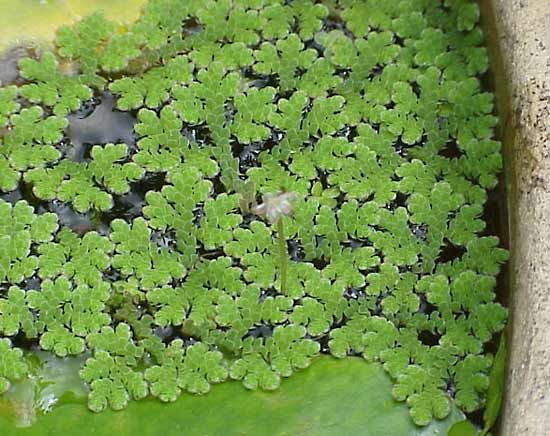
- Azolla: Known as the mosquito fern, this genus contains six or seven species. These tiny, floating plants are economically significant in agriculture for their symbiotic relationship with nitrogen-fixing bacteria, which helps fertilize rice paddies.67
- Salvinia: Commonly called water spangle or floating moss, this genus includes about 10 species. While valued for their beauty in aquariums, some species, such as S. molesta, are aggressive weeds that can clog waterways.69
- Marsilea: Known as water clover, this genus includes about 50 species. These ferns are often confused with flowering clovers due to their four-leaflet leaves and are frequently used in water gardens.1112
- Ceratopteris: This genus, often called water sprite, includes at least four species. They are widely used in research and education—specifically under the trade name C-Fern—due to their rapid life cycle and ease of genetic study.10
- Pilularia: Also known as pillwort, this genus consists of six species characterized by their threadlike leaves.11
Sources
- water fern — Merriam-Webster
- water fern — Encyclopædia Britannica
- Fern - Ecology — Encyclopædia Britannica
- Plant reproductive system - Ferns — Encyclopædia Britannica
- Fern - Importance to humans — Encyclopædia Britannica
- Salviniales — Encyclopædia Britannica
- Mosquito fern — Encyclopædia Britannica
- lower vascular plant - Reproduction — Encyclopædia Britannica
- Marsileaceae — Encyclopædia Britannica
- Fern - Distribution and abundance — Encyclopædia Britannica
- Salviniaceae — Merriam-Webster
- Marsilea — Merriam-Webster
Published on · 4 min read