Dutchman’s-pipe
Dutchman’s-pipe (Aristolochia durior, also known as A. macrophylla) is a climbing vine belonging to the birthwort family (Aristolochiaceae). Native to…
What is Dutchman’s-pipe?
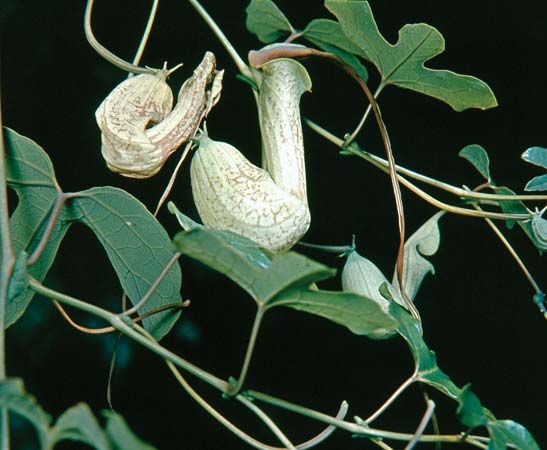
Dutchman’s-pipe (Aristolochia durior, also known as A. macrophylla) is a climbing vine belonging to the birthwort family (Aristolochiaceae). Native to central and eastern North America, this plant is characterized by its large, heart-shaped or kidney-shaped leaves, which can reach widths of 15 to 35 cm (about 6 to 14 inches).123
The plant derives its common name from its distinctive yellowish brown or purplish brown tubular flowers, which are about 8 cm (3 inches) long and resemble the curved bowl of a pipe. Because it is a rapid grower, Dutchman’s-pipe is frequently cultivated as an ornamental plant or used as a screen for porches and arbours.12
Within the broader Aristolochia genus, the plant is related to various other species, some of which have historically been used in herbal medicine, though many members of the birthwort family are known to be poisonous.3
What other plants belong to the birthwort family?
The birthwort family (Aristolochiaceae) comprises seven genera and approximately 590 species of mostly tropical woody vines, shrubs, and temperate-zone herbs. Notable plants within this family include:4
- Aristolochia: A large genus of over 400 species, including the Dutchman’s-pipe, Virginia snakeroot, pelican flower, and the European birthwort.4
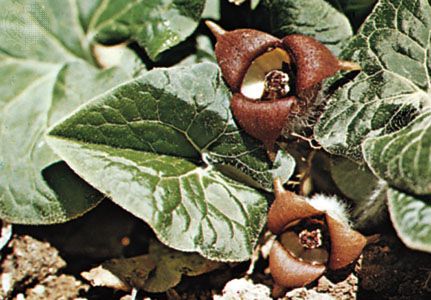
- Asarum: Known as wild ginger, this genus includes about 100 species of herbaceous plants, such as Canadian wild ginger and asarabacca.34
- Thottea: An Asian genus of about 25 species of shrubs and subshrubs often used in traditional and Ayurvedic medicine.4
- Saruma: Contains a single species, the upright wild ginger (S. henryi), which is sometimes grown as an ornamental.4
- Hydnoroideae: A subfamily of terrestrial parasitic plants that lack leaves and chlorophyll, including the genera Hydnora and Prosopanche.4
- Lactoris: Represented by the rare and endangered species L. fernandeziana, found on a single island in the Juan Fernández Archipelago.4
We could dive deeper into the unique characteristics of parasitic plants like Hydnora or explore the medicinal history of the Aristolochia genus.
How do vines climb and attach to structures?
Vines climb and attach to structures using several specialized biological mechanisms that allow them to gain height and support their stems. These strategies include:
- Tendrils: These are slender, threadlike organs that may be modified leaves, leaflets, or stem branches. They are highly sensitive to contact; when they brush against an object, they curve and wrap around it. Once attached, they develop strong mechanical tissue (sclerenchyma) to support the plant’s weight. Some tendrils even secrete an adhesive to cement themselves to a surface.78
- Twining Stems: Many vines, such as honeysuckle and hops, climb by physically twisting their stems around a support in a spiral pattern.8
- Adventitious Roots: Certain climbing plants, most notably English ivy, produce specialized roots that arise from stem tissues. These roots act as holdfasts, gripping rocks, walls, or other plants to provide anchorage.98
These adaptations enable vines to reach sunlight and compete for space in various environments, from temperate forests to tropical rainforests7.8
Why do some flowers have foul-smelling scents?
Some flowers produce foul, carrion-like odors as a specialized evolutionary strategy to attract specific pollinators, such as flies and beetles, that are naturally drawn to rotting flesh or dung. By mimicking the scent of decay, these plants deceive insects into visiting the flower, often under the guise of a site suitable for egg deposition or feeding.1213
To ensure effective pollination, many of these plants employ elaborate mechanisms:
- Deception and Entrapment: Flowers like the cuckoopint (Arum maculatum) and the titan arum use their fetid smells to lure insects into a floral trap. Once inside, the insects are temporarily prevented from escaping by slippery surfaces or inward-pointing hairs, forcing them to come into contact with the plant’s reproductive structures.121413
- Enhanced Volatilization: Some plants, such as the cuckoopint, generate heat through metabolic processes to increase the vaporization of their odor, allowing the scent to travel over a wider area.1214
- Visual Mimicry: To complete the deception, some species, including the massive Rafflesia, feature mottled red and brown petals that resemble rotting flesh, further enticing scavenging insects.13
Sources
- Dutchman’s-pipe — Encyclopædia Britannica
- Dutchman's-pipe — Merriam-Webster
- Aristolochiaceae — Encyclopædia Britannica
- wild ginger — Encyclopædia Britannica
- Aristolochiaceae — Merriam-Webster
- birthwort — Merriam-Webster
- Adventitious root — Encyclopædia Britannica
- vine — Encyclopædia Britannica
- Tendril — Encyclopædia Britannica
- Stem — Encyclopædia Britannica
- reptile - Clinging and climbing — Encyclopædia Britannica
- mimicry - Carrion flowers , stinkhorn mushrooms, and mosses — Encyclopædia Britannica
- Pollination - Beetles and flies — Encyclopædia Britannica
- Botanical Sex: 9 Alluring Adaptations — Encyclopædia Britannica
- Chemoreception - Arthropods — Encyclopædia Britannica
Published on · 3 min read