Ghost Forests Are Becoming the New Haunts of Climate Change
"Ghost Forests Are Becoming the New Haunts of Climate Change" is an article describing how rising sea levels create "ghost forests"—stands of dead, decaying…
What is Ghost Forests Are Becoming the New Haunts of Climate Change?
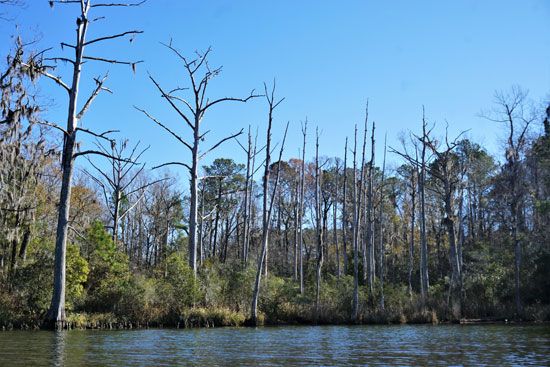
“Ghost Forests Are Becoming the New Haunts of Climate Change” is an article describing how rising sea levels create “ghost forests”—stands of dead, decaying trees in coastal areas.1
These forests form when saltwater inundates coastal land, poisoning trees that cannot tolerate high salinity. This process is often accelerated by climate change, which drives sea-level rise and increases the frequency of extreme weather events like drought and tropical cyclones.1
Beyond being a visual indicator of environmental degradation, ghost forests contribute to global warming. They replace healthy wetlands and mangroves, which act as vital carbon sinks. When these ecosystems die, they release stored carbon into the atmosphere, potentially creating a feedback loop that further exacerbates climate change. Researchers suggest mitigating this through strategies like planting salt-tolerant trees, depositing sediment to raise marsh elevations, and reducing overall carbon footprints sediment to raise marsh elevations, and reducing overall carbon footprints.1
How do mangroves help protect coastlines?
Mangroves serve as a critical buffer between marine and terrestrial environments, providing essential protection for coastlines against environmental hazards. By forming dense, tangled thickets, these salt-tolerant trees act as a physical barrier that absorbs the energy of damaging winds, waves, and storm surges, which significantly reduces the risk of flooding and coastal erosion.23
Beyond their role in storm defense, the complex root systems of mangroves are highly effective at trapping sediments and pollutants. This process not only stabilizes the shoreline but also improves water quality, which is vital for the health of nearby coral reefs and seagrass beds.23
The preservation of these ecosystems is a matter of human safety and economic stability; research indicates that communities with intact mangrove forests experience significantly less damage and fewer casualties during hurricanes compared to areas where these trees have been removed. Because mangroves are foundational to the health of coastal regions, their protection is an ethical imperative for maintaining biodiversity and supporting the habitats that sustain countless marine species and local fisheries.32
What are carbon sinks and why are they important?
A carbon sink is any natural or artificial reservoir that absorbs and stores more carbon from the atmosphere than it releases, effectively helping to regulate Earth’s climate. Common examples include oceans, soils, and forests.56
Why Carbon Sinks Are Important
Carbon sinks are vital because they mitigate global warming by removing carbon dioxide—a potent greenhouse gas—from the atmosphere.6
- Climate Regulation: By sequestering carbon, these reservoirs prevent it from contributing to the retention of infrared radiation, which otherwise raises the planet’s average temperature.6
- Natural Sequestration: Through photosynthesis, plants and phytoplankton naturally pull carbon from the air and water, storing it in biomass or transporting it to the deep ocean floor.67
- Mitigation Potential: Protecting and enhancing these sinks—such as through reforestation or improved land management—is a key strategy for meeting climate goals.6
However, these sinks are fragile. Activities like deforestation, combustion, and decomposition can turn a sink into a carbon source, releasing stored emissions back into the atmosphere and creating a dangerous feedback loop.67
How does saltwater affect tree health?
While excess salinity is generally harmful to most plants, its effect on tree health depends entirely on the species’ specific adaptations.
The Impact of Salinity on Most Trees
For the majority of trees and agricultural crops, high salt concentrations in the soil are detrimental. Under normal conditions, water enters plant roots through osmosis. However, when soil salinity is too high, this process is reversed; water is drawn out of the roots and into the soil, leading to severe dehydration. Furthermore, excess salt inhibits a plant’s ability to take up essential nitrogen, ultimately causing stunted growth, deterioration, and a loss of productivity.8
The Unique Case of Mangroves
Unlike most terrestrial trees, mangroves are uniquely adapted to thrive in saline environments. They are specialized trees that colonize coastal wetlands, such as tidal estuaries and salt marshes, where they are regularly exposed to seawater.24
Their survival is made possible by:
- Specialized Root Systems: Mangroves utilize structures like prop roots and pneumatophores, which allow them to stabilize themselves in muddy, oxygen-poor soils while facilitating necessary gas exchange.2
- High Salt Tolerance: These trees have evolved to manage the high salt content of their environment, allowing them to flourish where other species would perish.4
Sources
- Ghost Forests Are Becoming the New Haunts of Climate Change — Encyclopædia Britannica
- mangrove: Top Questions — Encyclopædia Britannica
- Mangroves Matter - Learn more — Encyclopædia Britannica
- Amazing Mangroves — Encyclopædia Britannica
- carbon sink — Merriam-Webster
- Carbon sequestration — Encyclopædia Britannica
- decarbonization - Natural carbon removal — Encyclopædia Britannica
- salinity — Encyclopædia Britannica
- Swamp — Encyclopædia Britannica
Published on · 3 min read