Milkfish
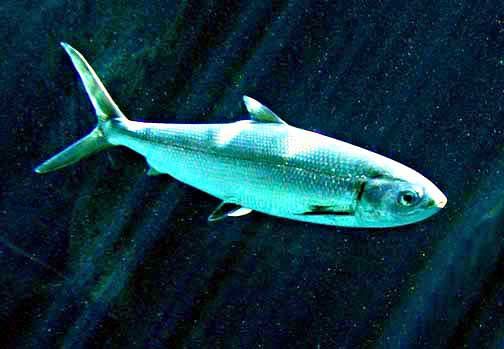
The milkfish (Chanos chanos) is a silvery marine fish and the sole living member of the family Chanidae. These toothless herbivores can grow to lengths of 1…
What is milkfish?
The milkfish (Chanos chanos) is a silvery marine fish and the sole living member of the family Chanidae. These toothless herbivores can grow to lengths of 1 to 1.5 meters (3 to 5 feet) and are characterized by their deeply forked tails.1
Found throughout the warmer regions of the Pacific and Indian oceans, milkfish are highly resilient, capable of thriving in shallow, warm lagoon waters reaching up to 88 °F (31 °C). Their evolutionary history is extensive, with fossils of the Chanidae family dating back to the Cretaceous Period.1
In terms of human use, the milkfish is a significant species in aquaculture. Young milkfish are frequently collected and raised for food in tropical brackish or freshwater ponds. This practice is part of the broader industry of fish farming, which helps supplement natural fish supplies to meet global dietary demands.123
What are the primary benefits of aquaculture for global food supplies?
Aquaculture—the propagation and husbandry of aquatic organisms—serves as a vital supplement to natural ocean and freshwater resources. As the world’s fastest-growing form of food production, it plays a critical role in meeting the increasing global demand for fish and shellfish driven by population growth and dietary shifts.34
The primary benefits of aquaculture for global food supplies include:
- Increased Availability: It provides a reliable supply of protein, ranging from high-priced species like salmon and shrimp to more accessible staples such as catfish, carp, and tilapia.3
- Resource Management: Through ocean ranching, governments can restock lakes and oceans, helping to mitigate the limits of natural wild-caught supplies.3
- Efficiency and Innovation: Advances in technology have enabled more efficient cultivation methods. Systems like aquaponics further enhance sustainability by recycling water and using fish waste as natural fertilizer for crops, reducing the need for external inputs.35
- Diversification: Beyond animal protein, aquaculture supports the growth of seaweeds and algae, which are utilized for food, fertilizer, and animal feed.4
How do brackish water environments differ from freshwater and saltwater habitats?
Brackish water environments are distinct from both freshwater and saltwater habitats primarily due to their salinity levels and the specific physical processes that create them.
Defining the Environments
- Freshwater: These systems typically have very low salt concentrations, generally less than 1,000 parts per million (ppm) or 1 practical salinity unit (psu).6
- Saltwater (Marine): Open ocean water is highly saline, with a relatively constant salt concentration averaging about 35,000 ppm (35 psu).6
- Brackish Water: This is a mixture of saltwater and freshwater, often found where rivers meet the sea. Its salinity falls between that of freshwater and the open ocean, and it is highly variable depending on the degree of mixing between the two water sources.786
Key Differences
The primary differences lie in the physical dynamics and biological impact:
- Formation: Brackish environments, such as estuaries, are created by the meeting of tidal flow and river discharge. In contrast, freshwater and marine habitats are defined by their relatively stable, albeit different, salt compositions.86
- Mixing Dynamics: In brackish zones, fresh water—being less dense—often floats as a distinct layer over the denser salt water. The extent of mixing can vary from “salt-wedge” systems with little interaction to “vertically homogeneous” systems where currents create total mixing.89
- Biological Barriers: Because organisms are adapted to specific osmotic pressures, brackish water acts as a natural barrier that separates many marine and freshwater species. Species that inhabit these zones must be euryhaline, meaning they can tolerate a wide range of salinity levels, unlike stenohaline organisms that have limited tolerance.610
What are some other examples of fish that have been farmed since ancient times?
Beyond the well-documented history of carp and tilapia, ancient civilizations practiced fish keeping and cultivation for food and entertainment using various species.
- Ancient Egypt: In addition to tilapia, which has been raised in warm-water systems since early Egyptian times, the Nile perch and various mullet species have long been associated with the region’s water systems and historical food supplies.161718
- Ancient Rome: The Romans were notable for being the first known marine aquarists. They constructed sophisticated ponds supplied with fresh seawater to keep fish for both food and entertainment, demonstrating an early mastery of managing marine environments for human use.19
- General Historical Context: While many modern aquaculture species—such as salmon, trout, sturgeon, and catfish—are now staples of global production, the practice of capturing immature specimens from the wild to raise them in protected environments has been a foundational method of fish husbandry for centuries.1820
Sources
- milkfish — Encyclopædia Britannica
- aquaculture - Fish farming — Encyclopædia Britannica
- aquaculture — Encyclopædia Britannica
- Did you know? — Merriam-Webster
- Aquaponics — Encyclopædia Britannica
- Did you know? — Merriam-Webster
- brackish — Merriam-Webster
- Inland water ecosystem - Saline lakes — Encyclopædia Britannica
- salinity — Encyclopædia Britannica
- estuary — Encyclopædia Britannica
- Salt marsh — Encyclopædia Britannica
- river - Origin and classification — Encyclopædia Britannica
- Inland water ecosystem - Population and community development and structure — Encyclopædia Britannica
- Biosphere - Salinity — Encyclopædia Britannica
- Inland water ecosystem - Biota of inland waters — Encyclopædia Britannica
- aquaculture - Carp — Encyclopædia Britannica
- aquarium - Historical background — Encyclopædia Britannica
- Egypt - Plant and animal life — Encyclopædia Britannica
- aquaculture - Tilapia — Encyclopædia Britannica
- carp — Encyclopædia Britannica
Published on · 3 min read