Titanosaur
A titanosaur (clade Titanosauria) is a diverse group of sauropod dinosaurs that lived from the Late Jurassic Epoch to the end of the Cretaceous Period. These…
What is titanosaur?
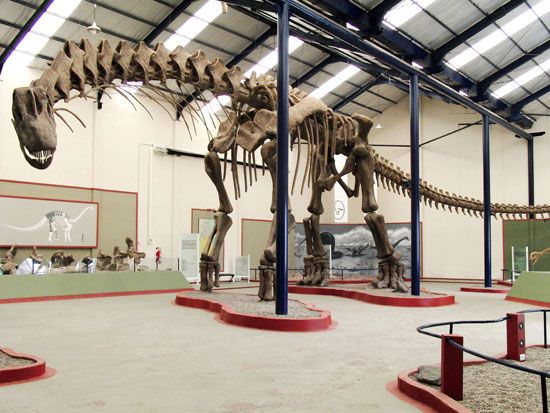
A titanosaur (clade Titanosauria) is a diverse group of sauropod dinosaurs that lived from the Late Jurassic Epoch to the end of the Cretaceous Period. These herbivorous quadrupeds are notable for being the largest terrestrial animals known, with some species approaching the size of modern whales.12
Physically, titanosaurs were characterized by long necks, long tails, and small heads. Compared to other sauropods, they possessed stockier bodies, a wider stance, and vertebrae with a unique honeycomb-like internal structure. Some species, such as Saltasaurus, also featured bony armored plates known as osteoderms.12
Titanosaur fossils have been discovered on every continent except Antarctica. While the group is named after the genus Titanosaurus, that genus is not officially recognized and is considered a “wastebin taxon” for indistinct fossils. Famous members of the group include massive dinosaurs like Argentinosaurus, Patagotitan, and Dreadnoughtus.12
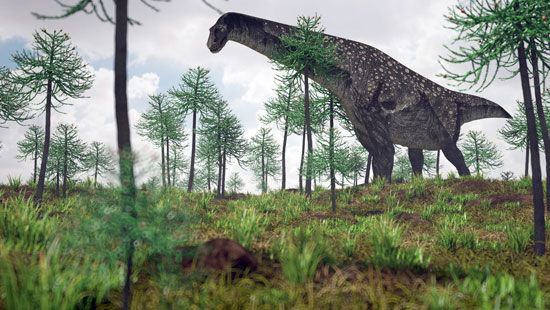
What are sauropods and how do they differ from other dinosaurs?
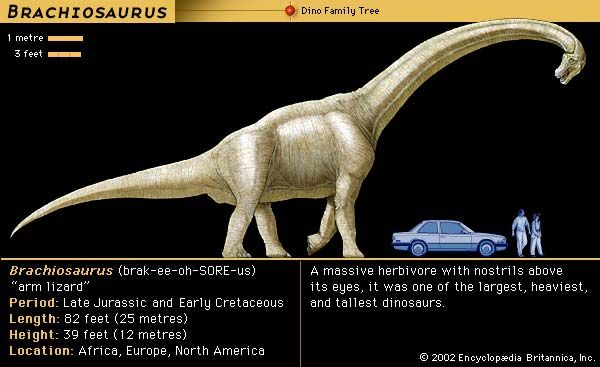
Sauropods are a subgroup of saurischian dinosaurs characterized by their immense size, long necks and tails, small heads, and a quadrupedal, herbivorous lifestyle. As the largest land animals to ever live, they were highly specialized for terrestrial life, utilizing columnar, pillar-like legs to support their massive weight.567
Distinctions from Other Dinosaurs
Sauropods are classified within the Sauropodomorpha lineage, which they share with their ancestors, the prosauropods. They differ from other dinosaur groups in several key ways:87
- Anatomy: Unlike the bipedal theropods—the other major group of saurischians—sauropods were obligate quadrupeds. Their vertebrae were uniquely modified with internal excavations and struts to reduce weight while maintaining structural strength.57
- Feeding Adaptations: Sauropods possessed small heads with spoon-shaped or pencil-shaped teeth, adapted for browsing foliage from tall trees, similar to modern giraffes.57
- Saurischian Traits: They share specific skeletal features with theropods, such as elongated neck vertebrae and a distinct hand structure where the second finger is the longest and the thumb bears a robust claw.9
- Pelvic Structure: As saurischians, they are “lizard-hipped,” meaning their pelvic bones are arranged with the pubis pointing down and forward, distinguishing them from the “bird-hipped” ornithischians.6
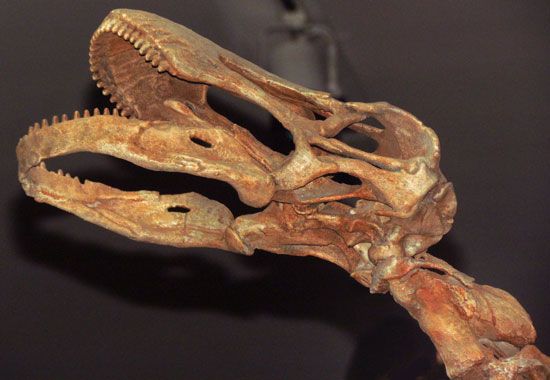
How do paleontologists estimate the size of a dinosaur from only a few bones?
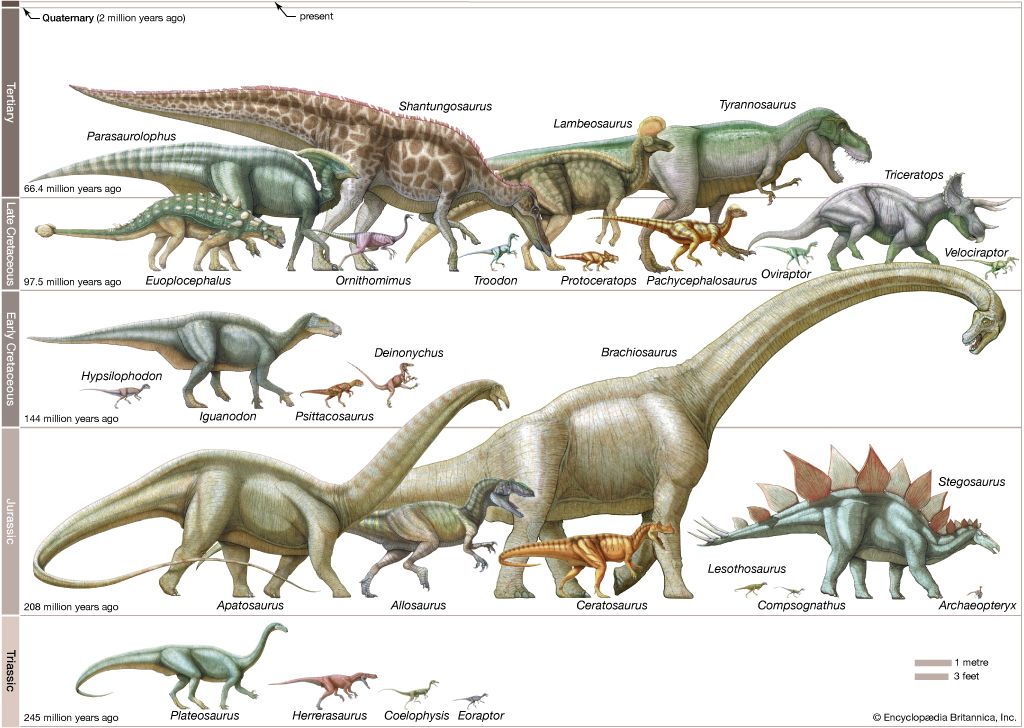
Paleontologists estimate the size of a dinosaur—even when only a few bones are available—by using comparative anatomy and projections based on more complete specimens of related species. When a significant portion of a skeleton is discovered, such as the 70 percent of the Dreadnoughtus skeleton found, researchers can make highly confident estimates of length and weight.10
However, when remains are fragmentary, scientists rely on several methods:
- Scaling from Known Relatives: If a specific bone, such as a femur (thighbone), is found, its dimensions can be compared to the same bone in more complete skeletons of closely related species. By scaling the proportions of the known skeleton to match the size of the new find, paleontologists can project the total length and mass of the animal.101
- Projections and Conjectures: For dinosaurs like Argentinosaurus, where no complete skeleton exists, scientists use mathematical models to estimate size based on the few known elements, such as a single massive vertebra. These estimates are often subject to revision as more evidence is uncovered or as analytical methods improve.101
- Growth Analysis: By examining the internal structure of long bones, researchers can count annual growth rings, similar to tree rings. This helps determine the age of the individual and whether it had reached its full adult size, which is critical for accurate size estimation.8
What were the main differences between the Cretaceous and Jurassic periods?
The Jurassic and Cretaceous periods, both part of the Mesozoic Era, represent distinct chapters in Earth’s history characterized by significant shifts in geography, climate, and life.
Paleogeography and Climate
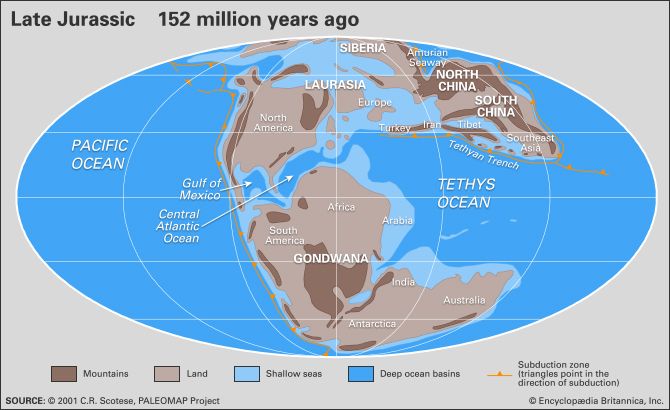
During the Jurassic Period, the supercontinent Pangea began to fragment into Laurasia and Gondwana. By the Cretaceous Period, this rifting had progressed significantly, leading to the formation of the Atlantic Ocean and the separation of most modern continents. Sea levels were notably higher during the Cretaceous than at any other time in Earth’s history, causing widespread inundation of continental interiors. The climate throughout the Cretaceous was generally warm and humid, with no polar ice sheets, allowing forests to grow even in Antarctica.13141516
Biological Differences
- Flora: The Jurassic is often called the “Age of Cycads,” as gymnosperms—including cycads, conifers, and ginkgoes—dominated the landscape. In contrast, the Cretaceous saw the rise and rapid diversification of angiosperms (flowering plants), which became a major component of the ecosystem by the mid-to-late period.171418
- Fauna: Jurassic dinosaur communities were dominated by sauropods, stegosaurs, and various theropods. By the Late Cretaceous, these groups had shifted; stegosaurs were extinct, and new, highly successful groups like ceratopsians (e.g., Triceratops) and hadrosaurs (duck-billed dinosaurs) became dominant. Additionally, the Cretaceous saw the evolution of placental mammals and marsupials.1918
- Extinction: The Cretaceous ended with one of the greatest mass extinctions in history, which eliminated the dinosaurs, as well as many marine and flying reptiles.1415
Sources
- titanosaur — Encyclopædia Britannica
- titanosaur — Merriam-Webster
- Titanosaurs: 8 of the World’s Biggest Dinosaurs — Encyclopædia Britannica
- titanosaur: Top Questions — Encyclopædia Britannica
- sauropod — Encyclopædia Britannica
- saurischian — Encyclopædia Britannica
- dinosaur - Sauropodomorpha — Encyclopædia Britannica
- dinosaur - Sauropoda — Encyclopædia Britannica
- dinosaur - Saurischia — Encyclopædia Britannica
- tyrannosaur - Other skeletal features — Encyclopædia Britannica
- dinosaur - Prosauropoda — Encyclopædia Britannica
- dinosaur - Classification — Encyclopædia Britannica
- A Journey Through Time Since the Precambrian - Cretaceous Period: 145 million to 66 million years ago — Encyclopædia Britannica
- Cretaceous Period - Paleogeography — Encyclopædia Britannica
- dinosaur - Faunal changes — Encyclopædia Britannica
- Mesozoic Era - Mesozoic geology — Encyclopædia Britannica
- Cretaceous Period — Encyclopædia Britannica
- Cretaceous Period - Terrestrial life — Encyclopædia Britannica
- Jurassic Period - Plants — Encyclopædia Britannica
Published on · 4 min read