Casiquiare
The Casiquiare (also known as the Casiquiare Channel or Brazo Casiquiare) is a unique, navigable waterway located in southern Venezuela.
What is Casiquiare?
The Casiquiare (also known as the Casiquiare Channel or Brazo Casiquiare) is a unique, navigable waterway located in southern Venezuela.12
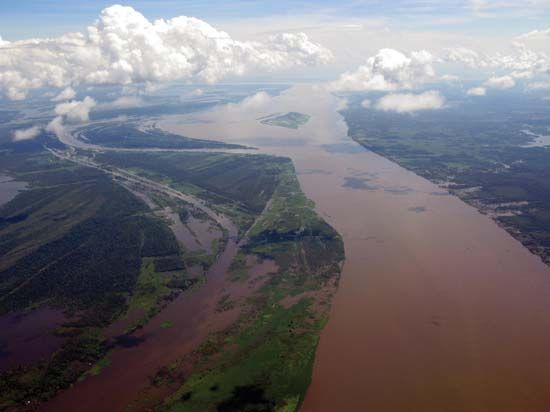
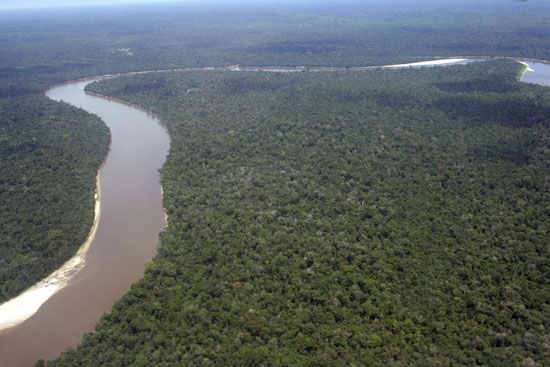
It functions as a natural bifurcation of the Orinoco River, branching off downstream from La Esmeralda. The channel meanders southwestward for approximately 140 miles (225 km) before joining the Guainía River to form the Negro River. By connecting these systems, the Casiquiare serves as a rare natural link between the Orinoco and Amazon river basins.12
What is a natural river bifurcation?
A natural river bifurcation occurs when a single river channel divides into two or more separate paths that flow away from each other. While rivers often feature complex networks like braided channels or deltaic distributaries, a true bifurcation is a distinct geographical feature where a portion of a river’s flow is diverted into a separate, often permanent, channel.324
A notable example is the Casiquiare in Venezuela. In this instance, a portion of the Orinoco River branches off to flow southward, eventually joining the Negro River. This specific bifurcation is unique because it creates a natural link between two major South American river systems: the Orinoco and the Amazon.2
How do the Orinoco and Amazon river basins differ?
The Amazon and Orinoco river basins are two of South America’s most significant drainage systems, differing primarily in scale, geography, and ecological composition.
Scale and Drainage
- Amazon Basin: As the world’s largest drainage system, it covers approximately 2.7 million square miles (7 million square km), accounting for about 34% of South America’s landmass. It carries roughly one-fifth of the world’s flowing freshwater, with a discharge volume at its mouth more than 10 times that of the Mississippi River.678
- Orinoco Basin: Significantly smaller, it covers about 366,000 square miles (948,000 square km). It is the continent’s third-largest system, encompassing large portions of Venezuela and Colombia.82
Geography and Features
- Amazon: The basin stretches from the Andes Mountains to the Atlantic coast of Brazil. It is characterized by vast lowlands, including the terra firme (uplands) and várzeas (floodplains).67
- Orinoco: The river flows in a giant arc from the Guiana Highlands, traversing the Llanos—a vast savanna region—before forming an extensive delta at the Atlantic.29
Connectivity
A defining difference is the Casiquiare channel. This unique natural bifurcation allows water to flow from the Orinoco into the Amazon system (via the Negro River), creating a rare hydrological link between the two basins.89
What are some unique animals found in the Amazon rainforest?
The Amazon rainforest is the world’s most biologically diverse region, housing millions of species, many of which remain unrecorded by science. Because the environment is so vast, many animals have adapted to an arboreal lifestyle, living primarily in the forest canopy.11121314
Notable Wildlife
- Primates: The forest is famous for its New World monkeys, including the loud howler monkeys, agile squirrel monkeys, spider monkeys, and marmosets.1314
- Aquatic Life: The river system contains thousands of fish species, such as the giant pirarucu and the piranha11. Other unique aquatic inhabitants include river dolphins and the manatee, which is currently listed as an endangered species.141315
- Mammals: Large terrestrial mammals are relatively rare, but the basin is home to the jaguar, tapir, and the capybara—the world’s largest rodent.131411
- Birds and Reptiles: The region boasts immense bird diversity, including toucans, macaws, and the powerful harpy eagle. Reptiles include the anaconda, which can reach lengths of 30 feet, and various caiman species.131415
Sources
- Casiquiare — Encyclopædia Britannica
- Orinoco River - Physiography of the Orinoco — Encyclopædia Britannica
- bifurcates — Merriam-Webster
- river - Braided channels — Encyclopædia Britannica
- river - Fall lines — Encyclopædia Britannica
- South America - Rivers of South America — Encyclopædia Britannica
- Orinoco River — Encyclopædia Britannica
- Amazon River — Encyclopædia Britannica
- Amazon River - Physiography of the river course — Encyclopædia Britannica
- Amazon basin — Encyclopædia Britannica
- Amazon River - Animal life — Encyclopædia Britannica
- South America - The Amazonian and Guianan forests — Encyclopædia Britannica
- Vegetarian piranhas — Encyclopædia Britannica
- Amazon River: Top Questions — Encyclopædia Britannica
- Amazon Rainforest: Top Questions — Encyclopædia Britannica
Published on · 3 min read